

Roofing Website Design That Generates Leads: What Actually Works in 2026

Table of Contents
TL;DR — Quick Hits
- Most roofing searches happen on a phone, and Google's research shows 53% of mobile visitors abandon a site that takes longer than 3 seconds to load.
- Speed is a lead lever, not a vanity metric: aim for LCP under 2.5 seconds, INP under 200ms, and CLS under 0.1 on a slow 4G connection.
- Responding to an inbound lead within an hour makes you nearly 7x more likely to qualify it, per Harvard Business Review — so the site must funnel straight to a tap-to-call or instant quote.
- Google Business Profile listings with photos get 42% more direction requests and 35% more clicks to the website, so the site and the GBP listing work as one system.
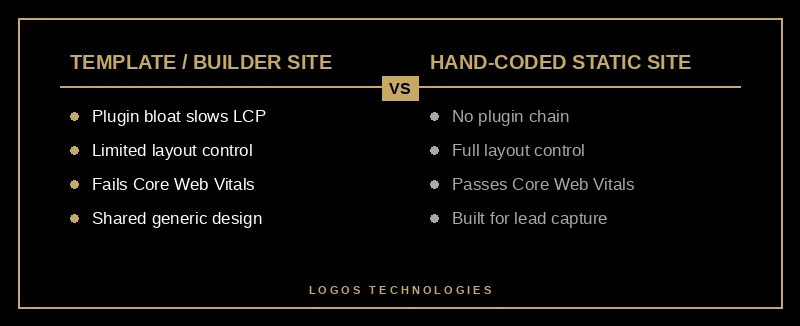
- A hand-coded static roofing site beats a plugin-heavy template build on every Core Web Vitals metric, because there's no database or plugin chain between the homeowner and the HTML.
The average roofing website I audit was built from a generic contractor template, runs on WordPress with a dozen plugins, and posts a Largest Contentful Paint north of 4 seconds on a mid-range Android over 4G. That is not a marketing asset. That is a leak. Per Google's own mobile speed research, 53% of mobile visits are abandoned when a page takes longer than three seconds to load — and roofing is one of the most mobile-heavy categories on the web, because homeowners search the moment they spot a leak or a missing shingle.
Roofers don't get hired the way software gets bought. Nobody reads twelve paragraphs about your company values while water is dripping into a bucket in their hallway. They want a phone number, a service area, proof you're licensed and insured, and a sense of what this will cost. The entire job of roofing website design in 2026 is to surface those four things inside the first viewport, load fast enough that the tap-to-call button paints before they lose patience, and make the next step obvious. This is exactly why generic industry-specific website design templates fail the trades — a layout built for a generic service business was never wired for storm-damage urgency.
Why Most Roofing Websites Don't Generate Leads
Most roofing websites don't generate leads because they were built to look professional rather than to convert a panicked homeowner into a phone call. Those are different design goals. A site that looks professional optimizes for the visitor browsing three pages about your history. A roofing company website that converts optimizes for the homeowner who just found a water stain on the ceiling and has about ninety seconds of patience before they hit back and try the next result in the local pack.
The pattern that kills lead flow is predictable: a hero carousel rotating through stock photos, a contact form with ten fields, no tap-to-call phone number above the fold on mobile, a chat widget that loads 300KB of JavaScript, and a Lighthouse mobile score in the low 30s. I see the identical pattern across roofers, general contractors, and HVAC companies — the trades all share the same search behavior, and an effective roofer website design recognizes that emergency-driven intent demands a different layout than a corporate brochure site.
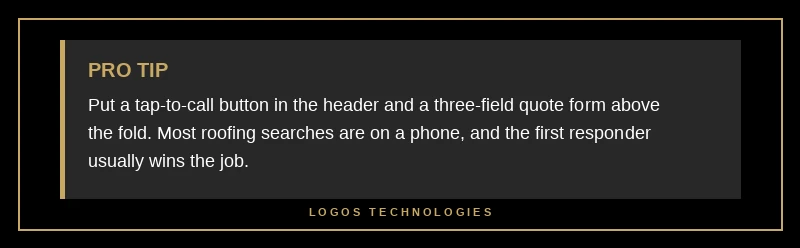
The fix is not subtle. Phone number in the top-right of the header, linked as a tel: tap-to-call. A sticky bottom bar on mobile with "Call Now" and "Get a Free Inspection." License and insurance status next to the logo. Three core services — roof replacement, repair, storm and hail damage — in icon cards on the homepage. A short three-field quote form: name, phone, what's the problem. And the whole homepage shipping under 100KB of JavaScript so it actually paints on a phone.

How Fast Does a Roofing Website Have to Be?
A roofing website needs to hit Google's Core Web Vitals thresholds on a slow mobile connection: a Largest Contentful Paint under 2.5 seconds, an Interaction to Next Paint under 200 milliseconds, and a Cumulative Layout Shift below 0.1. Miss any one of those and you fail the assessment that feeds Google's ranking signals — and, more importantly, you lose half your mobile traffic before the page even finishes loading. Google's Core Web Vitals guidance defines those exact numbers, and they are not negotiable for a category as mobile-driven as roofing.
Here's the uncomfortable reality: most WordPress-based roofing sites fail LCP out of the box. The theme ships with a slider plugin that pulls in hundreds of kilobytes of JavaScript, blocks the main thread for over a second, and posts a 4.5-second LCP on a Pixel over 4G. The fix is rarely "buy a faster host" — it's "stop shipping the slider," or better, stop using a platform that needs constant plugin firefighting to hit performance targets at all. A hand-coded static site built with a generator like Eleventy will out-perform almost any WordPress install on Core Web Vitals, because there's no PHP, no plugin chain, and no database query between the homeowner and the HTML. We break the techniques down in our mobile-first design guide and our walkthrough on image optimization for website speed — roofing sites are image-heavy by nature, and unoptimized project galleries are the number one LCP killer in the category.
Designing the Lead-Capture Path
The single highest-leverage decision in roofing website design is how fast and how obviously the site moves a visitor to contact you. Speed to lead is the whole game in this category. Harvard Business Review's lead-response study found that companies responding to an inbound lead within an hour are nearly seven times more likely to qualify it than companies that respond later — and roofing leads are even more time-sensitive than that, because a homeowner with active water intrusion is calling three roofers in a row and hiring whoever picks up first.
Your website's job is to make that first contact effortless: a tap-to-call number visible without scrolling on every page, a quote form short enough to complete one-handed at a stoplight, and a clear storm-damage path for the homeowner who can't wait. Don't bury the phone number in a footer or gate the estimate behind eleven form fields — every extra field measurably drops your submit rate, more so on mobile. The roofers winning jobs in 2026 treat the homepage as a funnel with one purpose: get the visitor to call or submit before they bounce. For the deeper conversion math behind this, see our breakdown of website conversion rate benchmarks for small business.
Local SEO and Google Business Profile: The Other Half
You can ship the fastest roofing website in your county and still get zero leads if you ignore Google Business Profile. For "roofer near me" searches, the local 3-pack — those three map results sitting above the organic links — captures the bulk of the clicks. If you're not in it, the website almost doesn't matter for local jobs. Search Engine Journal's 2026 local SEO guidance makes the same point: for service businesses, the profile and the website now function as one connected system rather than two separate assets.
The fundamentals are straightforward but neglected. Complete every GBP field, pick the correct primary category (Roofing Contractor), and upload real project photos regularly — Google's data, summarized in WordStream's Google Business Profile optimization guide, shows listings with photos receive 42% more direction requests and 35% more clickthroughs to the website. Post updates a couple of times a month and ask every happy customer for a review. Search Engine Land's 90-day local SEO plan is a sensible framework for sequencing that work if you're starting from scratch. Our own Google Business Profile optimization guide covers the specific fields and posting cadence that move local rankings.
The website still matters for two reasons. First, your GBP listing links to your homepage, and a slow or broken homepage drags down the prominence signal Google uses to rank you locally. Second, the long tail of specific searches — "roof replacement cost," "hail damage insurance claim," "metal roof vs shingles" — drives qualified traffic the 3-pack doesn't capture, and a clean, fast site picks it up. The same playbook works for plumbers and the other trades — building one strong, fast site per trade is the core argument of our pillar on industry-specific website design.
What Roofing Customers Actually Trust
Roofing is a high-ticket, low-trust purchase, so your site has to do the trust-building work that a salesperson would. Reviews carry the most weight, but the way homeowners use them is shifting. BrightLocal's 2025 Local Consumer Review Survey found that only 4% of consumers say they never read online reviews — but the share who trust reviews as much as a personal recommendation has fallen from 79% in 2020 to 42% in 2025. The takeaway for roofers: volume and recency of reviews matter, but so does everything else on the page that corroborates them.
That means real on-site photos of completed roofs — not stock imagery — labeled with the city and roof type, your license and insurance numbers displayed, manufacturer certifications shown as badges, and a clear warranty explanation. A gallery of fifteen real local jobs beats a staged photo shoot for conversion, because it reads as "a real roofer who has worked near me," not "a polished template." We go deeper in our guide to website trust signals that drive conversions.
Frequently Asked Questions
How much should a roofing website cost?
A professional, custom-built roofing website typically ranges from a few thousand dollars for a focused lead-generation site to five figures for a large multi-location build with extensive service-area pages. The number that matters more than the upfront cost is cost per acquired job — a fast, well-converting site that books one extra roof a month pays for itself almost immediately. Avoid the cheapest template option; in a high-ticket category, a slow or generic site costs you far more in lost leads than you saved on the build.
What pages does a roofing website need?
At minimum: a homepage built as a lead funnel, individual service pages for roof replacement, roof repair, and storm or hail damage, a real project gallery, a reviews or testimonials page, an about page with license and insurance details, and a contact page. Separate service pages matter because homeowners search for the exact job they need ("roof replacement cost," not "roofing services"), and a dedicated page lets you rank for that specific intent.
Why is my roofing website not getting leads?
The most common causes are slow mobile load times, no visible tap-to-call number above the fold, an overly long contact form, weak or missing Google Business Profile optimization, and thin trust signals. Run your homepage through a Core Web Vitals check first — if it loads in over three seconds on mobile, fix that before anything else, because you're losing half your traffic before they see your offer.
Do roofing companies need a website if they have a Google Business Profile?
Yes. The Google Business Profile drives local-pack visibility and calls, but it links to your website, and a slow or low-quality site weakens your local ranking and loses the visitors who do click through. The two work as one system: the profile gets you found, and the website converts the homeowner and captures the long-tail searches the 3-pack never shows.
How important is mobile design for a roofing website?
It's the single most important factor. The majority of roofing searches happen on a phone, often outdoors and on a cellular connection, and Google's data shows most mobile visitors abandon a site that takes more than three seconds to load. A mobile-first roofing website with a fast, tap-to-call layout will out-convert a desktop-first design every time.
Build a Roofing Site That Books Jobs
A roofing website should do one thing well: turn a homeowner's "I think I have a problem" moment into a phone call or a quote request, faster than the competitor down the road. That takes a fast, hand-coded foundation, a mobile-first lead-capture layout, real trust signals, and a Google Business Profile working in lockstep with the site. At LOGOS Technologies, based in Papillion, Nebraska, that's exactly what we build — fast, static, SEO-optimized sites engineered to rank and convert, not just to look good in a portfolio. If your roofing site loads slowly, buries the phone number, or isn't pulling its weight in local search, take a look at our web design services and contact us for a straight assessment of what's costing you jobs.