
Google Business Profile Optimization in 2026: What Actually Drives Local Rankings Now

Table of Contents
TL;DR — Quick Hits
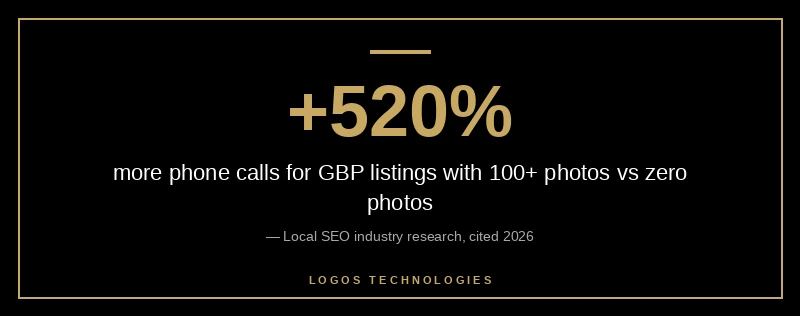
- Listings with 100+ photos get 520% more calls and 2,717% more direction requests than profiles with no photos.
- A profile with 80 recent reviews now outranks one with 200 stale reviews — Google reweighted recency in 2026.
- Going 30 days without a post or photo causes a measurable drop in GBP impressions; activity is now a ranking signal, not a vanity metric.
- April 2026: Google added Recurrence Info to the GBP API, finally enabling true recurring scheduled posts.
- Google Business Profile is now the data layer feeding Gemini, Search, and Maps — your profile is being read by AI before it ever shows a human.
If you're a small business getting customers within driving distance, your Google Business Profile is doing more SEO work than your website. Google confirms primary category and reviews are the two most influential local pack ranking factors, and listings with rich photo libraries see 520% more phone calls and 2,717% more direction requests than profiles without photos. A near-empty GBP costs more revenue per month than most websites generate.
What changed in 2026 is who reads your profile. GBP data is now the data layer feeding Gemini, Search, and Maps simultaneously — meaning your hours, categories, services, posts, and reviews are parsed by AI before they're ever shown to a human. The stuff you skipped during setup is now training data for the answers AI Overviews give about your business.
What Are the Most Important Google Business Profile Ranking Factors in 2026?
The three factors Google has always named — relevance, distance, and prominence — are still the framework, but the weighting has shifted. In 2026 the factors that actually move local pack rankings are, in order: primary category accuracy, review recency and velocity, profile completeness, photo volume and freshness, and engagement signals (clicks, direction requests, calls, dwell time on the profile). The local pack and the organic 10 blue links share most of these signals, which is why everything in our pillar guide on how to rank on Google in 2026 compounds on top of strong GBP optimization rather than competing with it.
Distance still matters for proximity-driven queries — you cannot outrank a competitor who is physically closer to the searcher when the searcher is standing on a sidewalk. But for queries with intent ("best dentist," "emergency plumber near me"), Google now overrides raw distance with prominence and engagement. A profile two miles away with 80 recent reviews and weekly photo uploads will out-rank a profile half a mile away with 200 reviews from 2023 and a six-month-old cover photo.
This is why static, optimized GBPs that worked great in 2022 are quietly losing ground. Google's Improve your local ranking guide still lists the same three factors, but the implementation details under each one have evolved.
What's New in Google Business Profile in 2026
Three changes from the first four months of 2026 matter most for small business owners:
1. Recurring scheduled posts via API (April 2026). Google added Recurrence Info support to the Google Business Profile API, enabling programmatic scheduling of recurring posts and events. For LOGOS clients running automated nightly publishing, this means a post can be scheduled to repeat weekly without third-party tooling — and it solves the 30-day-decay problem (more on that below).
2. AI moderation of review replies. Google's ReviewReplyState moderation system, rolled out in Q1 2026, has already rejected over 12,000 review replies. Replies stuffed with promotional keywords, obviously AI-generated replies, and policy violations are now silently held. If your old playbook was templating every review response with your city + service keyword, that template is now flagged.
3. AI-drafted posts allowed; AI-faked reviews banned. Google updated the GBP content policy in early 2026 to explicitly permit AI-assisted drafting of posts and review replies, but to prohibit AI-generated reviews and Q&A answers posted as if from real customers. This is a permission slip for using AI to scale your own content while a hard ban on faking demand.
The bigger picture is that GBP is no longer a directory listing. It's a structured data feed Google parses every time a user asks Gemini, "Who should I call for X?" — which the generative engine optimization playbook we covered earlier this month treats as the new front door of search.
How Often Should You Post on Your Google Business Profile?
Once a week minimum, twice a week if you have the content. Google's algorithm decays profile visibility for inactivity — businesses that don't post or upload photos for 30+ days see measurable drops in GBP impressions. The cause is mechanical: Google's local algorithm favors profiles that signal "this business is open and operating right now," and silence reads as risk.
Posts don't all need to be marketing pitches. The categories Google rewards are:
- Updates — operational news, hours changes, new services. These are the most common and the easiest to write.
- Offers — discounts or promotions with a defined start/end date. These get the highest click-through rate.
- Events — anything dated. With the April 2026 API recurrence update, weekly events can now schedule once and run indefinitely.
- Photos — the lowest-friction way to keep a profile active. Even one new interior or work-in-progress photo per week counts.
Your post text should answer a question a real customer would ask — not list keywords. Google's AI parses the post body for relevance to incoming queries, and keyword stuffing now hurts you twice: once via the new content moderation pass, and again because the AI extraction layer prefers natural language.
How Do Reviews Affect Google Business Profile Ranking in 2026?
Reviews are the single biggest trust signal Google has, and the math changed in 2026. Five inputs all feed the ranking weight: count, average rating, recency, velocity (how often new ones arrive), and keyword content (what specific services or problems are mentioned).
Recency reweighted hardest. Going into 2026, total review count was the dominant input — a business with 200 reviews and a 4.6 average sat above competitors with 80 reviews and the same rating, full stop. After Google's spring algorithm pass, that's no longer true. A profile with 80 reviews where five came in the last 30 days now consistently out-ranks a profile with 200 reviews where the most recent one was eight months ago. Velocity is a freshness proxy.
This is fixable. The actionable steps are:
- Set up a review request automation in your booking, invoicing, or CRM system that fires after every completed job.
- Reply to every review within 48 hours — both five-stars and complaints. Replies are a public signal of attentiveness Google's AI evaluates.
- Avoid AI-templated replies that mention your service area in every response. Google now flags those.
- Never use review-gating tools that filter out negative feedback before it reaches Google. That practice was banned in the 2026 content policy update.
If review velocity is your weak point, the fix is process — not paid review services, which violate Google's terms and can trigger profile suspension. The correct move is wiring the request into your existing operational workflow.

Does Your Website Affect Your Google Business Profile Rankings?
Yes, and the relationship is stronger than most local SEO articles admit. Google crawls your linked website to corroborate the profile data. If your name, address, phone, services, or category contradict your GBP, you lose ranking weight in the local pack.
Three website elements amplify GBP signal:
- LocalBusiness schema markup mirroring your GBP categories. We covered implementation in schema markup for SEO in 2026 — a JSON-LD
LocalBusinessblock tells Google's AI your site and GBP describe the same entity. - Page speed. Poor Core Web Vitals drag down the GBP linked to that site. Static sites side-step this — hand-built static sites pass Core Web Vitals out of the gate, which is one reason what actually works to rank on Google in 2026 starts with site architecture.
- Service-area pages that match your GBP service areas exactly. If your GBP lists five cities but your website mentions one, Google trusts the GBP less.
What Categories Should You Pick on Google Business Profile?
The primary category is the single most influential ranking input — pick the wrong one and no amount of reviews will save you. The rules:
- Pick the most specific category that accurately describes your core service. "Web Designer" beats "Marketing Agency." "Mexican Restaurant" beats "Restaurant."
- Use up to 9 secondary categories — but only for services you actually offer. Stuffing adjacent categories creates contradictions Google's AI will detect against your reviews and posts.
- Audit your category list quarterly. Google adds and renames categories regularly — the category you picked in 2023 may now have more specific options.
The pillar guide on SEO for small business in 2026 covers category strategy in the broader context of search visibility, but for GBP specifically, the rule is simple: be specific, be honest, and re-check the category list every 90 days.
How Do You Measure Whether Your GBP Optimization Is Working?
GBP gives you a built-in performance dashboard, but the metrics that matter for ranking aren't the ones it surfaces by default. The four KPIs to track:
- Search appearances broken out by branded vs. discovery searches. Discovery growth means you're ranking for new queries.
- Direction requests and calls — the engagement signals Google itself uses for prominence weighting.
- Photo views as a proxy for how compelling your visual content is.
- Interactions per impression — if impressions rise but interactions stay flat, your profile copy isn't competitive.
For deeper measurement, layer GBP data into the broader analytics stack. Our breakdown of the small business analytics metrics that actually matter shows how to tie GBP-driven traffic to revenue, which is the only number that proves the optimization paid for itself.
Frequently Asked Questions
Is Google Business Profile free in 2026?
Yes. Google Business Profile is free to create, claim, and use. There is no paid version that ranks higher. Anyone selling a "premium" GBP listing is selling a service on top of the free product, not a Google upgrade.
How long does it take Google Business Profile optimization to work?
Most measurable ranking changes happen within 30 to 60 days of consistent activity — adding photos, posting weekly, replying to reviews, and keeping categories accurate. Bigger jumps (multi-position moves in the local pack) typically take 90 to 120 days because Google needs time to validate the engagement signals are sustained, not a one-week burst.
Can I run a Google Business Profile without a physical address?
Yes, if you're a service-area business that visits customers (contractors, plumbers, mobile mechanics, web designers). You hide the address and define a service area instead. The catch: service-area-only profiles tend to rank lower than profiles with a verified storefront for proximity-driven queries. If you have any legitimate physical location, list it.
Do Google Business Profile posts directly improve rankings?
Indirectly, yes. Posts themselves aren't a confirmed ranking factor, but the activity they signal is. Google's algorithm reads regular posting as evidence that the business is operating, which raises engagement signals (post views, post clicks) that do feed prominence weighting. Skipping posts for 30+ days creates a measurable visibility drop.
What's the biggest GBP mistake small businesses make in 2026?
Setting it up once and never touching it again. The 2026 algorithm explicitly penalizes static profiles. The second-biggest mistake is templating every review reply with the same city + service keyword — Google's new moderation system flags those replies. Reply like a human, post like a human, and let AI help you draft, not fake.
Ready to Make Your Google Business Profile Actually Rank?
A great Google Business Profile only converts if it links to a website that loads instantly, matches the profile data, and gives visitors a reason to stay. We build hand-coded, fast static websites for small businesses nationwide from our base in Papillion, Nebraska — every site ships with the schema markup, NAP consistency, and Core Web Vitals scores that amplify the GBP it links to. If your profile is working harder than your website, get in touch and we'll audit both for free.