
Schema Markup for SEO in 2026: What Actually Drives Rankings Now

Table of Contents
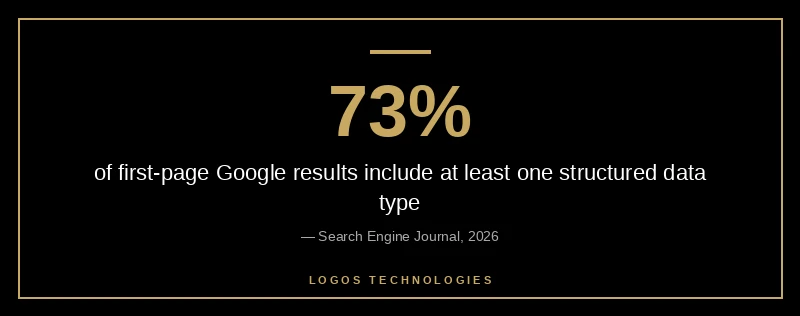
Schema markup used to be the thing SEO consultants sold as an "advanced tactic." In 2026 it is a baseline requirement. Google's March 2026 core update reshuffled which structured data types still earn rich results, and the search engines that actually drive revenue — Google Search, Google's AI Mode, Bing's Copilot answers — all lean on schema to verify what a page is and whether to trust it.
If your site has no structured data, you are competing for page-one real estate with one hand tied behind your back. Worse, you are invisible to the AI answer engines that pull from structured data to decide who gets cited.
This guide walks through what schema markup for SEO actually looks like in 2026, which types still move the needle, and the specific mistakes that now get pages ignored or demoted.
What is schema markup, and why is it suddenly critical?
Schema markup is structured data you add to your HTML that describes the page to search engines in a standardized vocabulary. Instead of making Google guess whether "5 stars" is a product rating, a movie review, or a hotel grade, you explicitly tell it: this is a Product, with an aggregateRating of 5, based on 47 reviewCount. The vocabulary itself is maintained at schema.org, a collaborative project run by Google, Microsoft, Yahoo, and Yandex.
For the past decade, structured data was a nice-to-have. That changed this year for two reasons.
First, Google's AI Mode and the Gemini-powered overviews increasingly cite sources. The selection process for what gets cited leans heavily on entity data — who wrote this, what organization published it, what product is being described, whether the claims can be verified. Schema is how you hand that data to the AI on a silver platter.
Second, Google's Search Central documentation now explicitly treats structured data as part of how Search understands a page. That is a meaningful shift in tone from "eligible for rich results" to "understood by Search." If you want a primer on the broader ranking picture, we break it down in our guide to how to rank on Google in 2026.
What changed with Google's March 2026 update?
The March 2026 core update reduced or eliminated rich result display for several schema types that had been widely abused. The short version:
- FAQ schema is now only displayed for a narrow set of authoritative government and health-related sites. For everyone else, it still helps Google understand the page but no longer produces the expandable FAQ block in search results.
- How-To schema was similarly restricted and is now largely limited to recipe-adjacent and technical how-to content.
- Review schema was tightened. Self-serving reviews (a company marking up its own first-party "reviews" of itself) are ignored. Third-party aggregated review data tied to a verifiable source still works.
- Product, Article, Organization, LocalBusiness, Event, and JobPosting schemas were not only preserved — their weight in the ranking signal increased.
The pattern is clear: Google rewards schema that genuinely describes what a page is, and ignores schema deployed to manipulate the SERP. Sites that implemented structured data for real content intent kept their rich results. Sites that stuffed FAQ blocks onto every page lost them.
Which schema types should a small business actually use?
For most small and mid-sized business websites, there are five structured data types that matter. You do not need to deploy the entire schema.org vocabulary. You need to deploy these five well.
Organization (or LocalBusiness) on your homepage and contact page. This tells Google who you are — legal name, logo, address, phone, founding date, social profiles. It is the single most important type of schema markup for SEO because it is how Google's knowledge graph connects your brand to everything else you publish.
LocalBusiness with specific address, geo coordinates, openingHours, and areaServed if you serve a specific geography. This is what feeds the local pack and the map results. Skip this and you are invisible to "near me" searches even if your Google Business Profile is dialed in.
Article or BlogPosting on every blog post, with author, datePublished, dateModified, publisher, and mainEntityOfPage. This ties content to a real author and organization, which is a proxy for E-E-A-T.
Product with offers, aggregateRating, review, brand, and availability if you sell anything. Product schema is the single biggest rich result driver in e-commerce and still earns star ratings, price snippets, and availability badges in 2026.
BreadcrumbList sitewide. This is low-effort, high-return. It replaces the URL in search results with a clean breadcrumb trail and signals site hierarchy to crawlers.
That is it. Five types, implemented correctly, cover the needs of almost every website we build. If you are running a site with none of these, the conversation about structured data should happen before the conversation about keywords.
How do you implement schema markup correctly?
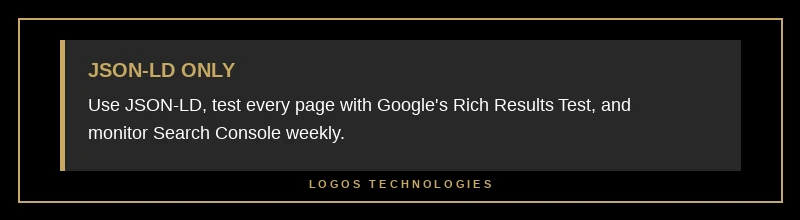
Google recommends JSON-LD as the implementation format, and it is the only format worth using in 2026. JSON-LD is a block of JavaScript-style structured data you drop into the <head> of your HTML. It is completely separate from the visible content, which means it does not risk breaking your layout or creating the visible-to-Google-but-not-to-users cloaking issues that older microdata implementations sometimes caused.
A minimal Organization schema for a website looks like this:
<script type="application/ld+json">
{
  "@context": "https://schema.org",
  "@type": "Organization",
  "name": "LOGOS Technologies",
  "url": "https://logoswebdesigns.com",
  "logo": "https://logoswebdesigns.com/assets/images/logo.png",
  "sameAs": [
    "https://www.facebook.com/logoswebdesigns",
    "https://www.linkedin.com/company/logoswebdesigns"
  ]
}
</script>
That is the entire commitment for site-wide Organization schema. Fewer than 15 lines, pasted into your template once, and applied to every page automatically.
The deployment workflow that actually works in 2026 is straightforward:
- Write the schema by hand or generate it from page data. On a static site, this can be templated from front matter so every new post gets structured data automatically with no extra effort.
- Test it with Google's Rich Results Test. This tool tells you exactly which page elements will earn rich results and which will be ignored.
- Deploy and monitor via the Rich Results report in Search Console. If schema breaks after a deploy, Search Console will flag it — usually within 48 hours.
On the static, Eleventy-built sites we deliver, schema is generated at build time from post data. There are no plugins to break, no database queries to slow the page down, and no version mismatch between the markup and the visible content. If you are stuck on a heavy CMS with bolted-on schema plugins, the resulting markup is often the first thing we rebuild during a migration. The broader performance case for that approach is covered in our breakdown of what the page speed data actually shows.
How does schema markup interact with AI search and answer engines?

This is the piece most SEO guides are still catching up to. Google's AI Mode and the generative answer boxes do not cite at random. They prefer sources where claims can be verified against structured data, where the author and publisher are clearly identified, and where the entity relationships (this article is by this person, who works for this organization, which sells this product) can be walked programmatically.
In practice that means a properly marked-up site with consistent Organization, Article, and Person schema is dramatically more likely to be pulled into an AI answer than an identical site with no structured data. This is why "schema markup for SEO" in 2026 really means "schema markup for Search plus AI visibility" — the same implementation serves both surfaces.
For small businesses, the implication is that the baseline schema set above is no longer just about earning a star rating in the SERP. It is about showing up at all in the answers that are increasingly replacing the classic blue-link results. The technical SEO foundations that make or break rankings are now also the foundations for AI visibility.
If you are trying to stretch a limited SEO budget, structured data is one of the few places where an afternoon of work produces a durable, compounding return. We go deeper on that tradeoff in our guide to SEO for small business.
What are the most common schema mistakes that still tank rankings?
A few failure modes keep showing up on audits:
- Invisible content in schema. Putting reviews, prices, or FAQs into structured data that do not appear anywhere on the visible page. Google treats this as deceptive and will ignore the schema at best — and demote the page at worst.
- Stale data. Prices, availability, and opening hours that are out of date. If your Product schema says a $49 item is in stock and the page actually says $69 sold out, that is a trust hit.
- Missing
dateModified. Article schema withoutdateModifiedsends a stale signal. Update this field whenever the post is meaningfully edited. - Wrong
@type. UsingArticlefor a product page, orLocalBusinessfor a national e-commerce store. The type has to match the page's actual purpose. - Duplicate or conflicting blocks. Multiple
<script type="application/ld+json">tags on one page that describe the same entity differently. Pick one source of truth per entity.
None of these are complicated to fix. All of them are easy to introduce silently when schema is bolted on after the fact instead of built into the template.
Getting schema markup right without turning it into a project
If you are running a small business website, you do not need a dedicated schema specialist. You need a site that generates valid structured data automatically, stays fast, and gets audited when Google changes the rules — which, as the March update proved, they will do at least once a year.
LOGOS Technologies builds static, SEO-first websites for businesses in Papillion, Omaha, and across the country. Every site we ship includes Organization, LocalBusiness, Article, and Breadcrumb schema by default, templated into the build so you never have to think about it. We audit the markup after every major Google update and keep it current.
If your current site has no structured data, or a pile of broken FAQ and How-To blocks left over from an older SEO plugin, that is a conversation worth having. Take a look at our web design services or contact us for a no-pressure audit of what your site is telling Google right now — and what it should be.