
How to Build Topical Authority in 2026 (And Why It Now Beats Domain Authority)

Table of Contents
TL;DR — Quick Hits
- After Google's March 2026 core update, topical authority outweighs raw domain authority — a small site that owns one topic can outrank a generalist giant that drifts off-topic.
- HubSpot reportedly lost roughly 80% of its organic traffic by publishing outside its core topical territory, the textbook cautionary tale for "publish anything that ranks" content.
- Cover roughly 25 tightly-connected articles inside one pillar-cluster system to hit the threshold where Google starts treating you as the authority on that topic.
- Internal links from clusters back to the pillar are how PageRank and topical signals actually travel — without them, your cluster is just a folder of disconnected posts.
- Most ranking lift from a topical authority push shows up in 3 to 6 months, not weeks. Plan accordingly and resist the urge to scrap the strategy at week three.
There is a specific moment in the SEO calendar that changed everything about how small businesses should think about ranking, and it was the Google March 2026 core update. The SEMrush Sensor hit a peak volatility score of 9.5/10. Roughly 80% of URLs in the top three positions changed rank — up from 67% after the December 2025 update — and the winners shared a pattern: narrow, deep topical coverage, not bloated domains stretching to rank for everything.
The losers shared a different pattern. Generalist publishers who had spent years coasting on domain authority to rank for off-topic content got cut down. The widely-reported ~80% organic traffic loss at HubSpot is the headline example. Depth on a topic now beats breadth across topics, even when the breadth comes with a strong backlink profile.
For a small business site, this is the best news in a decade. You no longer need to outrank a 500,000-page competitor on backlinks. You need to know more about your specific topic than they do — and prove it on your site. That is what topical authority is, and that is what this guide is about.
What is topical authority, and why does it now beat domain authority?
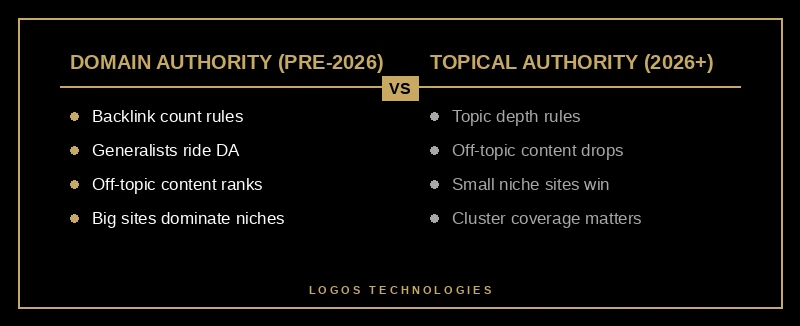
Topical authority is a measure of how comprehensively and credibly your website covers a specific subject, judged by the depth and interconnectedness of your content rather than the strength of your backlink profile. Domain authority measures your domain's cumulative ranking power across any topic; topical authority measures whether you actually know the topic the searcher cares about. After March 2026, Google effectively separated those two signals — a high-DA domain can no longer carry content that sits outside its established topical territory.
That separation is the practical reason a regional plumbing company can now outrank Forbes for "tankless water heater installation cost." Forbes has the backlinks; the plumber has the topical depth. The plumber wins now in a way they would not have in 2022.
If you want the parent context for this — what else changed and how the broader ranking picture looks now — that is the subject of our pillar guide on how to rank on Google in 2026. This article zooms into the single biggest lever inside that guide.
How does Google actually measure topical authority?
Google has never published a "topical authority score" the way Moz publishes Domain Authority. It infers topical authority from a stack of on-page and site-architecture signals that are mostly under your control: topic coverage breadth and depth, semantic relationships between pages, clean topical URL structure, and engagement signals like time on page and return visits.
Schema markup, consistent terminology, and internal linking all feed this — we covered the markup side in our guide to schema markup for SEO in 2026. Topical authority is not magic. It is the cumulative effect of doing the obvious thing consistently for one topic across one site.
The pillar-cluster model: the only architecture that compounds
Every working topical authority strategy in 2026 uses some version of pillar-cluster.
A pillar page is a comprehensive 2,500 to 3,500-word resource that broadly covers your core topic — the page you want ranking for the head term. Cluster pages are 1,200 to 2,000-word deep-dives on specific subtopics. Each cluster links up to the pillar with anchor text containing the pillar's primary keyword, and the pillar links back down to its clusters. Cluster pages also link to relevant siblings.
This shape matters because PageRank and topical signals flow through internal links. The pillar accumulates external backlinks (it is the most linkable asset). Internal links push some of that authority down to the clusters, which rank for narrower terms. Clusters in turn pass topical relevance up to the pillar, telling Google "this site has 14 articles about this exact topic, and they all reference each other coherently." That is the loop that compounds — and it is the same architecture our guide on how to rank on Google in 2026 walks through at the strategic level.
It also forces topic discipline. If you cannot decide which pillar a new post belongs under, the post probably should not exist yet.
How many articles do I actually need to build topical authority?
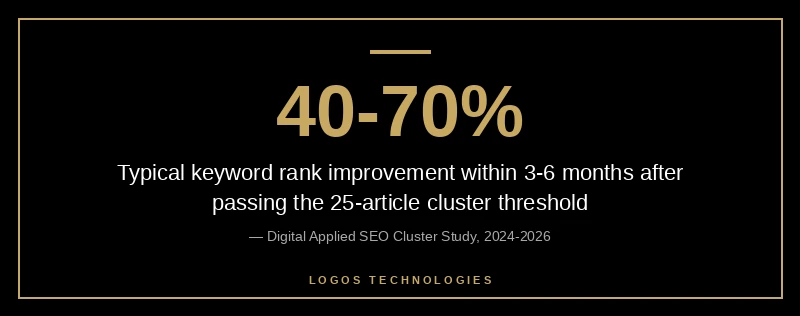
Roughly 25 tightly-connected articles inside one pillar-cluster system is the threshold most SEO teams point to as the point where Google starts treating a site as topical authority for a subject. Below that, the signal is too sparse for the algorithm to lock onto. Above it, sites typically see 40 to 70% rank improvements for target topic keywords within three to six months.
For a small business site, that is more achievable than it sounds. One post a week for six months gets you there. The discipline is not output; it is staying inside one topic instead of zigzagging because something else looked interesting that week.
Internal linking: the part most small sites get wrong
Internal linking is where most small business topical authority efforts quietly fail. The two biggest mistakes:
Linking to the homepage instead of related posts. Every cluster article should link to its pillar at least twice with descriptive anchor text containing the pillar's primary keyword. "Click here" or "read more" wastes the link.
Treating internal links as decoration instead of architecture. A link in the conclusion is fine; a link inside the section that earned the citation is what passes context. Place links where the surrounding sentence is already saying what the linked post is about.
Before publishing, you should be able to point at a content map and show: this cluster links up to that pillar, sideways to those two siblings, and out to two authoritative third-party sources. The SEMrush guide to topical authority calls that a "topic map," and you do not need software to build one — a spreadsheet works fine.
If your CMS makes it tedious to add internal links retroactively (the WordPress and page-builder world is notorious for this), that friction is itself a topical authority tax — covered in our guide to why WordPress is so slow.
Where AI Overviews and topical authority intersect
Google's AI Overviews and generative answer engines do not just summarize the highest-ranking page; they pull from across the cluster of pages that demonstrate authority on the topic. Sites with strong topical authority get cited more often because they show up in more of the candidate pages an AI Overview considers. That makes topical authority a dual-purpose investment: it ranks you in conventional search and gets you cited in AI search.
Thin or off-topic content gets ignored by both systems. We laid out the AI-search side of this in our guide to generative engine optimization for AI Overviews, and Google's own helpful content guidance reinforces the same theme: write for the topic, not the algorithm.

A practical 90-day plan for a small business
The version that actually works for a small business owner without a marketing team:
Days 1 to 7. Pick one topic that aligns with your highest-margin service, not your most enthusiastic interest. Write the pillar page — 2,500 to 3,500 words, broad enough to anchor the cluster but not so deep that you have nothing left for cluster posts.
Days 8 to 60. Publish two to three cluster articles per week, each 1,200 to 2,000 words on one specific subtopic. Each links to the pillar at least twice. Use keyword research for small business techniques to pick subtopics with real search volume, not just questions that occur to you.
Days 61 to 90. Audit. Are clusters linking to each other where topics overlap? Is the pillar linking down to every cluster? Are there subtopic gaps a competitor covers and you do not? Fill them, then start the second topic.
The general SEO foundation under all of this is covered in our SEO for small business guide. Topical authority sits on top of that foundation — it is not a substitute for fast pages, indexable HTML, or basic on-page SEO.
Frequently Asked Questions
How long does it take to build topical authority?
Most sites see meaningful ranking lift three to six months after they hit roughly 25 tightly-connected articles inside one cluster. The first month or two will feel like nothing is happening — that is normal. Google needs to recrawl, reindex, and re-evaluate site-level signals, and that is not instant.
Can a small business beat a big competitor with topical authority?
Yes, and that is the entire point of the post-March 2026 ranking environment. A small site with deep, interconnected coverage of one specific subtopic can outrank a generalist authority site on that subtopic. The big site's domain authority no longer carries off-topic content the way it did three years ago.
Do I need backlinks if I have topical authority?
Backlinks still help, especially to your pillar page, where they push internal authority down to clusters. But backlinks alone no longer compensate for shallow, drifting content. The reverse is increasingly true: topical authority can compensate somewhat for a thin backlink profile. If you have to pick one to focus on first, build topical authority first.
How does topical authority work with local SEO?
For local businesses, the topic and the geography combine. A plumbing site that deeply covers tankless water heaters AND consistently signals its service area through location-specific cluster posts and clean local schema markup wins on both axes. Topical authority does not replace local SEO mechanics — it amplifies them.
Is publishing more often the same as building topical authority?
No, and this is where most small businesses waste years. Publishing 100 disconnected articles produces less topical authority than publishing 25 deeply connected ones. Frequency without focus is noise. Google does not reward output volume; it rewards demonstrated subject expertise, which is a structural property of how your content is connected, not how much of it there is.
Build the system, not just the next post
Topical authority is the rare SEO lever where the playing field actually tilts toward small, focused operators. You do not need a content team of twelve. You need a topic, a plan, the discipline to stay inside it, and a site architecture that lets internal links and topical signals flow cleanly. That last part is where most small business sites built on bloated platforms quietly leak authority.
LOGOS Technologies builds fast, hand-coded static sites for small and medium businesses across the country, including right here in Papillion, Nebraska — sites where adding a cluster post and wiring it into your topical map takes minutes, not a chain of plugins. If you are about to start a topical authority push and want the architecture under it to actually compound, see our web design services or contact us and let's talk through what your topic map should look like.