
Keyword Research for Small Business in 2026: The Process That Actually Finds Customers

Table of Contents
TL;DR — Quick Hits
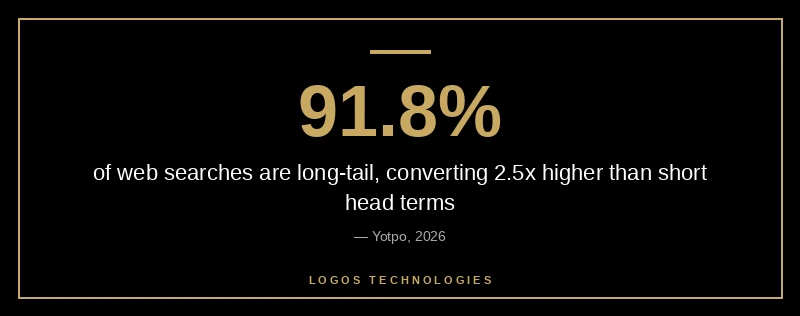
- Long-tail keywords make up 91.8% of all web searches and convert at roughly 2.5x the rate of short head terms.
- Small businesses should start with a focused list of 20-50 primary keywords built from 8-12 service terms, 5-10 location terms, and 10-30 content terms.
- The decisive 2026 signal is search intent, not search volume — a 50-search-per-month term that matches intent beats a 10,000-search term that doesn't.
- Free tools (Google Search Console, Keyword Planner, Google Trends, Search Console's Performance report) cover 80% of what a small business needs.
- AI Overviews now appear on roughly 15% of Google searches, so keyword research must now target both traditional search and how LLMs parse questions into queries.
Most small business SEO struggles trace back to one of two mistakes: picking keywords too broad to rank for, or picking keywords that are easy to rank for but don't match what customers actually buy. Both feel like progress. Neither produces revenue.
The data is unambiguous on which direction to lean. Long-tail queries make up roughly 91.8% of all web searches and convert at about 2.5x the rate of short, head-term keywords, because people typing longer phrases have already narrowed down what they want. On top of that, Google AI Overviews now appear on around 15% of queries and are fundamentally changing how users discover answers — a shift that rewards specific, question-shaped content and penalizes generic filler.
This is the keyword research process that works for a small business site in 2026.
What is keyword research for a small business?
Keyword research for a small business is the process of identifying the specific search phrases real customers use when they are close to hiring or buying, then mapping those phrases to pages that can answer them. It is not about chasing the highest-volume term in your industry. It is about finding the 20-50 phrases where intent matches what you sell, and owning those.
Unlike enterprise keyword research, small business keyword research has to be efficient. Ranking for a broad term like "web design" costs years of content and backlink work. Ranking for "fast static website design for small businesses" is achievable in months because the competition is narrower and the intent is sharper.
Why search intent beats search volume in 2026
Intent — why someone typed a query — is now the dominant ranking signal. Google's helpful content systems have spent three years re-weighting the algorithm toward "does this page actually satisfy what the user was trying to do?" and away from "how many times does the keyword appear on this page?"
Every query falls into one of four intent buckets, and getting this classification right is what separates keyword lists that rank from ones that don't:
- Informational — the searcher wants to learn something ("what is a static website," "how long should a blog post be"). Match with guides, explainers, and FAQ content.
- Commercial investigation — the searcher is evaluating options before a decision ("best small business website design," "Eleventy vs WordPress"). Match with comparison posts, case studies, and buyer guides.
- Transactional — the searcher is ready to act ("hire a web designer," "get a website quote"). Match with service pages, pricing pages, and contact forms.
- Navigational — the searcher wants a specific brand or page ("LOGOS Technologies website design"). These are already yours if the searcher knows you exist.
The single highest-ROI move a small business can make is to identify which of their top-ranking pages are mismatched to intent and restructure accordingly. We covered related intent-matching work in our guide to how to rank on Google in 2026, but the short version is: Google will not reward a page that answers the wrong question, even if it is technically optimized for the keyword.
How to do keyword research in 2026: the step-by-step process
The first two or three sentences here are the answer itself: the process is seed list → intent classification → SERP analysis → long-tail expansion → prioritization. Build a seed list of 15-20 terms based on what you sell, classify each by intent, look at the live SERP for each to see what Google thinks the intent is, expand into long-tail variants with a free tool, then prioritize by intent match and business value. Four afternoons, total. The elaboration:
Step 1: Build a seed list from your actual services
List every service, product, and problem your business solves. For a web design company, that is phrases like "small business website design," "website redesign," "ecommerce website," "fast website." A seed list of 15-20 terms is a good starting point.
Step 2: Add the modifier grid
Multiply each seed term by the modifiers that signal intent:
- Question modifiers: "how," "what," "why," "when," "is," "does"
- Commercial modifiers: "best," "top," "vs," "alternative to," "review"
- Action modifiers: "hire," "get," "buy," "near me," "affordable"
- Freshness modifiers: "2026," "latest"
"Small business website design" becomes "best small business website design 2026," "how much does a small business website cost," "small business website design vs template." This mechanical expansion is the fastest way to find long-tail phrases your competitors aren't targeting.
Step 3: Classify each term by intent using the live SERP
The step most small businesses skip, and the single biggest accuracy unlock. Type each keyword into Google in incognito and look at the top 5-10 results. If they are all blog posts, the intent is informational. All service or product pages, transactional. Mixed with comparison and review pages, commercial investigation.
Do not try to rank a service page for a term where the top 10 are all blog posts. Google has already decided what kind of page wins that query. Match the format or pick a different term.
Step 4: Expand into long-tail with free tools
Three free tools cover most of what a small business needs:
- Google Keyword Planner — requires a free Google Ads account, gives search volume ranges and related ideas directly from Google.
- Google Search Console — shows every query your site already impresses for, including the almost-page-one keywords at positions 11-20 that are a single blog post away from ranking.
- Google autocomplete and "People also ask" — type your seed term, scrape the suggestions and PAA questions. These are the actual phrases real users type.
For a small business without the budget for Ahrefs or SEMRush, these three free sources surface 80% of usable keywords. We dig into Search Console as a planning tool in our post on small business website analytics and the metrics that matter in 2026.
Step 5: Prioritize by the intent-value-difficulty triangle
Every candidate keyword scores on three dimensions: intent match, business value, and ranking difficulty. The sweet spot is the intersection of high intent, high value, and medium-to-low difficulty. Publish the first 10 pages against terms in that intersection before attempting anything harder. Chasing a head term before you have domain authority is how small sites spend two years writing content that never ranks — a pattern we cover in detail in our guide to how to rank on Google in 2026.

Free keyword research tools vs paid tools: what actually matters
Most small businesses don't need a paid tool to start. Google Keyword Planner, Google Trends, Google Search Console, and AlsoAsked together cover the discovery, validation, and opportunity-finding phases for free. The free stack is enough to rank your first ten pages and find your next twenty.
Paid tools earn their subscription when you are tracking 30+ keywords, running competitive gap analysis on multiple competitors, or at a scale where the hour saved per day justifies the $99-299/month cost. For a pre-revenue or early-stage small business, that is usually 6-12 months after launch — not day one.
How keyword research connects to AI Overviews and LLM search
Classic keyword research is still necessary, but it is no longer sufficient. LLMs parse questions differently than Google's classic crawler does. Three concrete implications for small business keyword research in 2026:
- Target the question, not the keyword. An AI Overview is more likely to cite a page that uses
## Is X worth it for small businesses?as a section header than a page that just mentions "X" 15 times. - Structure for extractability. AI summarizers pull from self-contained chunks — a clear TL;DR block, direct-answer paragraphs, tightly bounded FAQs. Our post on generative engine optimization and AI Overviews in 2026 covers the structural patterns in detail.
- Lean into long-tail even harder. LLMs route conversational prompts to search, and conversational prompts are inherently long-tail. The same 91.8% long-tail share now compounds into AI citation share too.
Common keyword research mistakes that kill small business SEO
- Stuffing one page with five primary keywords. One page, one primary keyword. Five means the page ranks for none.
- Ignoring search intent. Writing a sales page when Google wants an informational guide, or vice versa.
- Targeting branded terms owned by competitors. You will not outrank Shopify for "Shopify alternatives." Pick a term where the SERP isn't owned by the brand named in the query.
- Skipping Google Search Console. Your own site has a free dataset of every query it already impresses for. Not using it is the most common small business SEO mistake.
- Over-trusting keyword difficulty scores. They are estimates, not facts. A keyword rated "hard" can be easy for your specific site if the top 10 are thin or outdated.
Frequently Asked Questions
How much does keyword research cost for a small business?
Done yourself with Google Keyword Planner, Search Console, and Google Trends, the cost is zero beyond the time to learn it — typically 8-15 hours for the initial seed list and intent classification. Hire an agency, and expect $500-$2,500 for a one-time deliverable on a site under 50 pages.
What is the best free keyword research tool for small business?
Google Search Console and Google Keyword Planner together cover most of the workflow. Search Console shows what your site already ranks for (including untapped "almost page one" opportunities). Keyword Planner shows search volume and related ideas pulled directly from Google. Google Trends is useful to confirm a keyword's interest is trending up, not decaying.
How many keywords should a small business target?
Start with 20-50 primary keywords: 8-12 service-page keywords, 5-10 location or audience-specific, and 10-30 content keywords spread across blog posts. This scale is small enough to execute in a year and large enough to cover the realistic revenue surface of a small business. Adding more before ranking for the first 20 is almost always a mistake.
Is keyword research still relevant with AI Overviews?
Yes — more relevant, but in a different way. AI Overviews resolve against the same underlying search corpus, and the content they cite is often pulled from pages optimized for traditional long-tail keywords. The shift is that research now needs to include question-shaped, conversational variants, not just the short noun-phrase queries users typed ten years ago.
Should I use location modifiers in my keywords?
Only where there is real local intent. "Web design services Omaha" is legitimate if you serve that market. Do not geo-stuff blog posts — national keywords are where the volume lives, and Google's local pack uses your Google Business Profile data, not repeated city names in copy.
If you are a small business owner in Papillion or the broader Omaha metro area and you want a website built for the keyword strategy above — fast, static, structured for both Google and AI Overviews — that is what LOGOS Technologies does. Take a look at our web design services to see how we build sites that rank, and contact us if you want to talk through your keyword strategy and what a site built around it would look like.