
Search Intent in 2026: How to Match Every Page to What Searchers Actually Want

Table of Contents
TL;DR — Quick Hits
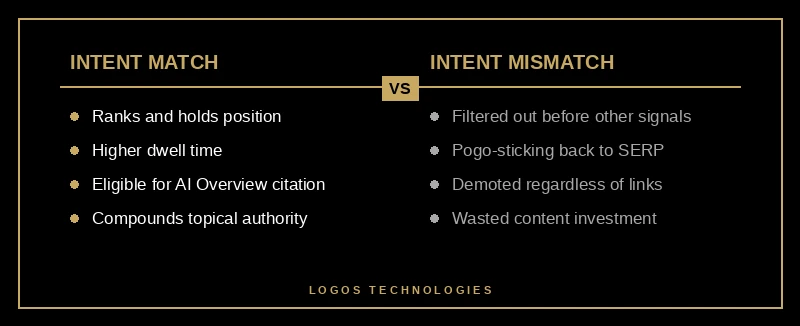
- Search intent is now a pre-filter: Google detects mismatched intent and demotes the page before E-E-A-T, links, or speed even count.
- There are four core intent types — informational, navigational, commercial, transactional — plus an emerging fifth: generative intent (users wanting AI to do a task).
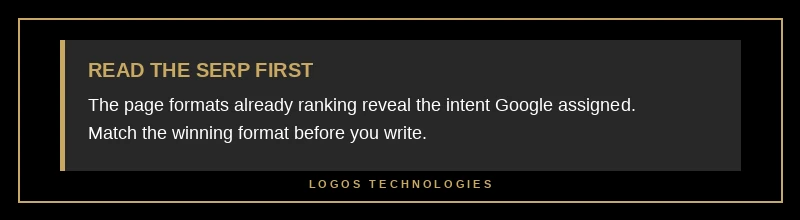
- Read the SERP before you write. The page formats already ranking tell you the intent Google has assigned to a keyword.
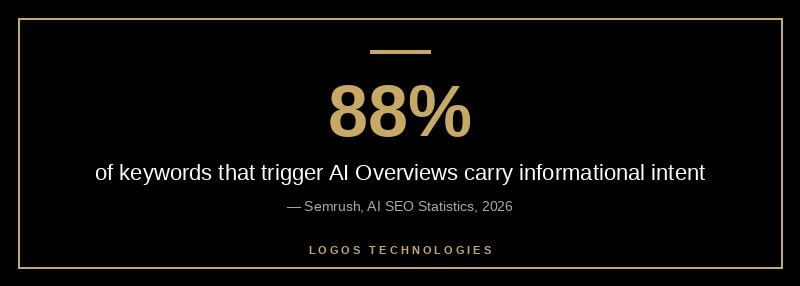
- Nearly 9 in 10 keywords that trigger AI Overviews carry informational intent, so explainer content is now the front door to AI search visibility.
- A page that nails intent but loads slowly still loses — dwell time and pogo-sticking decide who stays at the top.
The single most common reason a well-written page fails to rank in 2026 has nothing to do with word count, backlinks, or keyword density. It is intent mismatch. SEO industry analyses now consistently list search intent alignment alongside E-E-A-T and topical authority at the very top of Google's ranking factors, and Google itself has gotten good enough at reading intent that it filters out misaligned pages before any other quality signal gets a vote. You can do everything else right and still never crack page one if the format of your page does not match what the searcher came to do.
This is the lever most small business sites are leaving on the table. Get intent right and the rest of your SEO work compounds. Get it wrong and none of it matters.
What is search intent, and why does it decide your rankings?
Search intent is the underlying goal behind a query — what the person actually wants to accomplish, not just the words they typed. Google's entire job is to satisfy that goal, so it ranks the pages that best match the intent and quietly suppresses the ones that don't. That is why intent acts as a gate rather than a tiebreaker: a page targeting a commercial-intent keyword with a long informational essay will not rank, regardless of how authoritative or fast it is.
Google describes this in its own helpful, people-first content guidance, where it asks creators whether their content helps a user "achieve their goal" and uses a "Needs Met" scale to judge whether a result actually satisfies the query. Read that the right way and it is a direct instruction: figure out the goal, then build exactly the thing that fulfills it. We unpack the broader framework in our guide to how to rank on Google, but intent is the foundation everything else sits on.
The four types of search intent (and the emerging fifth)
Every query maps to one of four classic intent types, and most ranking failures come from confusing two of them. According to Semrush's breakdown of search intent, the four are:
- Informational — the searcher wants to learn something ("what is search intent," "how to fix layout shift"). They want guides, definitions, and explainers.
- Navigational — the searcher wants a specific site or page ("LOGOS web design contact," "Gmail login"). They want to be sent somewhere, fast.
- Commercial — the searcher is comparing options before buying ("best web design agency," "Shopify vs custom"). They want comparisons, reviews, and pros-and-cons.
- Transactional — the searcher is ready to act ("hire web designer," "buy domain"). They want a product page, a pricing page, or a contact form.
In 2026 a fifth type has emerged: generative intent, where users expect an AI tool to perform a task or produce an output rather than return a list of links. It blurs the line between informational and transactional, and it rewards content that is structured cleanly enough for an AI to lift and act on. That structural requirement — clean, semantic, fast-loading HTML — is exactly where a hand-coded static site has an edge over a bloated page builder.
The practical takeaway: before you write a single word, decide which of these five buckets your target keyword falls into. Picking the wrong bucket is the most expensive mistake in SEO.
How do you read the SERP to identify intent?
You don't guess intent — you read it off the search results page. Google has already done the analysis for you: the pages currently ranking for a keyword reveal the intent Google has assigned to it. Search your target keyword and look at what dominates the top results.
If the first page is full of how-to guides and listicles, the intent is informational. If it's product and category pages, it's transactional. If it's "best of" roundups and comparison tables, it's commercial. If a big brand homepage sits at the top, it's navigational. Match the format that's already winning — this is the same SERP-reading discipline that good keyword research for small business is built on.
Pay attention to SERP features too. An AI Overview, a "People also ask" box, or a featured snippet all signal informational intent and tell you to write answer-first, extractable content. The presence of shopping ads signals transactional intent. These features are not decoration; they are Google telling you what kind of page it wants to surface.
How to optimize a page for search intent
Once you know the intent, optimization is about matching three things: format, depth, and the next step.
Match the format. Informational intent gets a structured guide with a TL;DR and question-based headings. Commercial intent gets an honest comparison. Transactional intent gets a lean page with a clear call to action and minimal friction. Don't bury a "ready to buy" searcher under 2,000 words of background.
Match the depth. Look at how thoroughly the top results cover the topic and meet or beat it on the subquestions that matter — without padding. Depth means answering the real follow-up questions, not inflating word count. This is how you build topical authority across a cluster of related pages instead of one thin post.
Match the next step. Every page should make the searcher's logical next action obvious. An informational page links deeper into the topic; a commercial page links to the relevant service or product; a transactional page puts the form or the phone number front and center.
And remember the part most intent guides skip entirely: delivery. A page can match intent perfectly and still lose if it loads slowly, shifts under the reader's thumb, or makes them wait. When users bounce back to the results and click a competitor — pogo-sticking — Google reads that as a failure to meet the need and lowers your position. Intent alignment buys you the click; performance keeps the ranking. That delivery layer is exactly what we obsess over, and it overlaps heavily with technical SEO.
Why search intent matters even more in the AI Overview era
AI Overviews have changed the stakes. Nearly nine in ten keywords that trigger an AI Overview carry informational intent, according to Semrush's analysis of AI SEO data. That means well-structured informational content is now the primary path to being cited in AI search — and being cited there is increasingly how you earn visibility when fewer searches end in a traditional click.
To win that citation, your content has to be both intent-matched and machine-extractable: clear headings, direct answers in the first two sentences under each heading, and a self-contained summary an AI can lift cleanly. We go deep on that in our guide to getting cited in Google AI Overviews. The throughline is the same one that runs through all of how to rank on Google in 2026: figure out what the searcher actually wants, then be the page — or the answer block — that delivers it best.
Frequently Asked Questions
How do I know if my content matches search intent?
Search your target keyword and compare your page format to the top 5-10 organic results. If they are guides and you wrote a product page (or vice versa), your intent is mismatched. Also check whether your page actually lets the searcher complete their goal — learn, compare, or buy — without leaving to find missing information.
Can one page target multiple search intents?
Usually not well. A single page should serve one dominant intent. Trying to satisfy informational and transactional intent on the same page typically waters both down and confuses Google about which queries to rank it for. The better pattern is a cluster: separate pages for each intent that link to each other.
Does matching search intent help with AI Overviews?
Yes, significantly. Nearly 9 in 10 AI Overview-triggering keywords are informational, so clearly structured, answer-first informational content is the most reliable way to get surfaced and cited in AI search. Matching intent is the entry ticket; clean, extractable structure earns the citation.
What happens if my content has the wrong intent?
Google detects the mismatch and suppresses the page, often before your backlinks, authority, or page speed are even weighed. High bounce-back rates from intent mismatch then reinforce the demotion. The fix is to re-read the SERP, identify the real intent, and either reformat the existing page or split it into intent-specific pages.
LOGOS Technologies builds fast, static, hand-coded websites in Papillion, Nebraska that are structured around search intent from the first wireframe — so your pages match what searchers want and load fast enough to keep them there. If your content is well-written but not ranking, intent mismatch is the first thing worth checking. See our web design services or contact us for a straight answer on where your site stands.