Link Building for Small Business in 2026: What Actually Works After Google's Spam Crackdown

Table of Contents
TL;DR — Quick Hits
- Pages with at least one backlink are 77% more likely to rank in Google's top 10 than pages with none.
- Digital PR is now the #1 link building tactic for 2026 — 34% of SEOs rank it as their best-performing method, ahead of guest posts (18%) and link insertions (14%).
- Google's March 2026 spam update specifically targeted manipulative link schemes, AI-refreshed PBNs, and parasite SEO. Bought links increasingly count against you, not for you.
- Most small businesses need 50–100 quality, relevant backlinks built over 6–12 months to see meaningful ranking gains.
- Expect a new backlink to take 10–12 weeks before it fully influences a page's ranking position.
Around 96.55% of all pages on the internet get zero organic traffic from Google, and the single biggest reason — according to Ahrefs' study of more than a billion pages — is a lack of backlinks. For small business owners trying to rank against bigger competitors with bigger budgets, that's the entire game in one sentence: no links, no traffic.
But the way you actually earn those links in 2026 looks nothing like the playbook from even three years ago. Google's March 2026 spam update — which rolled out alongside the March core update — was specifically aimed at manipulative link schemes, AI-refreshed private blog networks, and parasite SEO arrangements. Cheap backlinks aren't just useless now; they actively suppress rankings. Here's what's working for small businesses instead.
What does link building mean for a small business in 2026?
Link building for small business in 2026 is the practice of earning hyperlinks from other websites back to yours, and it remains one of Google's top-three ranking factors. Each link acts as a third-party endorsement — Google reads them as votes of trust, and pages with more high-quality votes tend to rank higher.
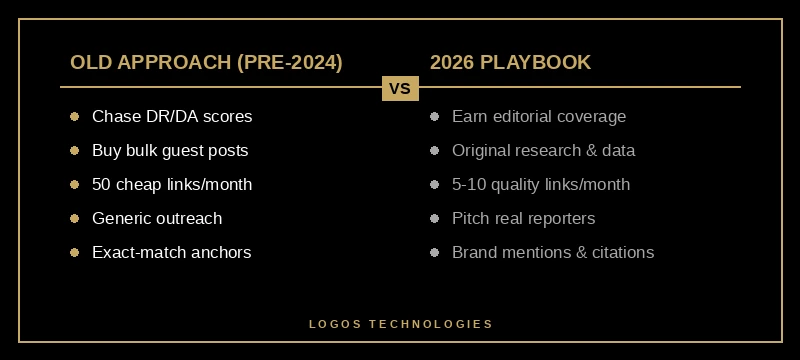
What's changed is what counts as "high-quality." For years, agencies chased domain rating (DR) and domain authority (DA) scores in isolation. That era is over. Search Engine Journal's 2026 guidance is unambiguous: the question is no longer "How many links can you get?" but "Can you earn discoverable authority that gets cited by AI Overviews and real publications?" Topical relevance, editorial intent, and brand mentions now matter more than raw link counts. If you're new to this whole topic, start with our broader guide on how to rank on Google in 2026 — link building is one of four pillars covered there.
How many backlinks does a small business need to rank?
For most local and mid-competition small business niches, 50 to 100 quality, relevant backlinks built over 6 to 12 months is enough to see meaningful ranking gains. That breaks down to roughly 10 to 20 new quality links per month during an active campaign — not the hundreds of cheap links many agencies still pitch.
Two numbers from Backlinko's analysis of ranking factors explain why even a small pile of good links moves the needle so hard:
- Pages ranking #1 on Google have an average of 3.8x more backlinks than pages in positions two through ten.
- Pages with at least one backlink are 77% more likely to appear in the top ten search results than pages with zero.
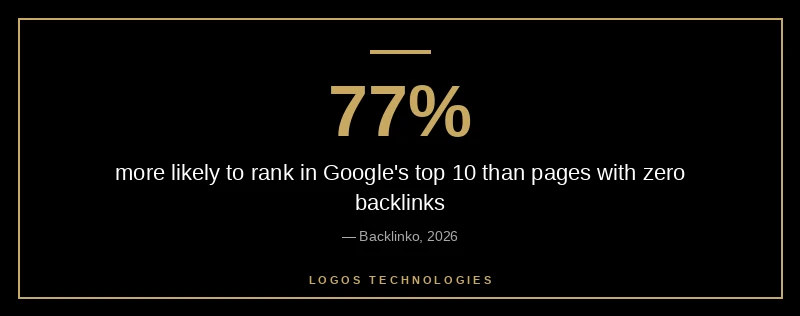
The math behind link building for small business punishes inaction more than it rewards perfection. If your service pages have zero referring domains, the gap between you and a competitor with even ten good links is enormous — and it compounds month over month.
Which link building tactics actually work in 2026?
Five tactics dominate the State of Link Building 2026 survey of 500 SEO professionals. The order has shifted dramatically from 2023.
1. Digital PR (the new #1)
Digital PR — pitching reporters, publishing original research, and earning editorial coverage on news and trade publications — was named the best-performing tactic by 34% of SEOs, ahead of guest posts (18%) and link insertions (14%). Combined with HARO-style journalist sourcing, PR-style approaches accounted for 55% of "best-performing" responses.
For a small business, digital PR — by far the most powerful form of link building for small business in 2026 — doesn't require a six-figure agency retainer. The lightweight version: survey your customers (50 responses is enough), publish a study with one genuinely surprising statistic, pitch it to three trade publications in your industry, and link it from your homepage. One well-placed editorial mention on a DR 70+ news site outperforms 50 directory submissions.
2. Linkable assets and original research
Statistics pages, free calculators, industry benchmark reports, and original studies attract links passively, year over year. Ahrefs' own "stats" pages have ranked #1 for years precisely because every writer covering the topic needs a source to cite. For a small business, "linkable" doesn't have to mean fancy — a single, current, well-sourced statistics page on your niche (e.g., "2026 contractor lead conversion benchmarks") will outperform a dozen generic blog posts. This compounds with topical authority building, which is now what AI Overviews use to decide who to cite.
3. Guest posting (still works, just more carefully)
Guest posting remains the most widely used link building method (64.9% of marketers, per BuzzStream's 2026 report). The catch: guest posts on sites with DR 50+ generate 2.4x more ranking impact than guest posts on lower-authority sites, and the average guest post earns only 1.3 backlinks (one in the body, 0.3 in the author bio). Quality of placement matters more than volume.
4. Unlinked brand mentions
The fastest backlinks you can earn are the ones already there in spirit. Use a tool like Semrush, Ahrefs, or even a Google search for "YourBrand" -site:yourdomain.com to find publications that already mention your business by name but didn't link. A polite, short email asking the writer to add a link converts at a rate most outreach campaigns would kill for — because the trust signal is already in place.
5. Local link building
For brick-and-mortar small businesses, local link building — getting linked from local news sites, chambers of commerce, neighborhood blogs, industry associations, and complementary local businesses — still moves rankings disproportionately. Pair this with Google Business Profile optimization for compounding local SEO gains.
What about Google's March 2026 spam update — what changed?
The March 2026 spam update, which rolled out in roughly 20 hours starting March 24, specifically targeted the link graph. Three patterns took the brunt of it:
- AI-refreshed private blog networks (PBNs) — old PBN sites that had been resuscitated using generative AI to look freshly authored.
- Indirect paid link structures — link insertions, "sponsored guest posts," and reciprocal arrangements designed to obscure that money changed hands.
- Parasite SEO — renting subfolders on high-authority domains to publish unrelated commercial content.
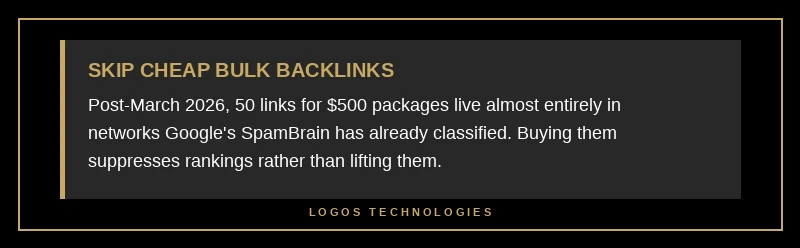
Google's spam policies have always prohibited link schemes — buying or selling links that pass PageRank, excessive link exchanges, and large-scale guest posting where the primary purpose is link acquisition. What changed in 2026 isn't the policy; it's that SpamBrain now flags suspicious link patterns in real time, and algorithmic devaluation happens in minutes rather than months.
The takeaway for a small business owner: if a link-building agency pitches you 50 links for $500, the math doesn't work in your favor. Those links cost roughly $10 each and are almost certainly part of a network Google has already classified. Pay for fewer, better placements — or skip paid links entirely and invest in digital PR and linkable assets.
How much does link building cost a small business?
Realistic 2026 pricing for link building for small business, per Reporter Outreach's industry survey: a single quality, editorially placed backlink on a DA 30–50 site runs $150 to $500, and premium placements on DR 70+ publications run $700 to $1,500+. A reasonable starting monthly budget is $1,000 to $2,000, which secures five to ten quality links per month in the DR 20–40 range.
But cost isn't the only variable. A newly-acquired backlink takes an average of 10 to 12 weeks before it fully influences a page's ranking position, and measurable organic traffic improvements typically show up 3 to 6 months into a consistent campaign. Most small businesses give up around week 8, right before the curve bends. Patience is the second-rarest resource in SEO; the rarest is consistency.
A fully hand-coded, fast, static website — the kind we build at LOGOS Technologies — gives link-building a structural advantage that bolted-on WordPress sites don't have: every link points to a page that actually loads instantly, which means lower bounce rates from referral traffic, better Core Web Vitals signals, and a stronger overall E-E-A-T story for Google to read.
Frequently Asked Questions
Are backlinks still important for SEO in 2026?
Yes. Backlinks remain one of Google's top three ranking factors in 2026, and pages with at least one backlink are 77% more likely to rank in the top ten than pages with none. What changed is that quality, topical relevance, and editorial intent now matter dramatically more than raw link counts — and bought links from low-quality networks can actively hurt rankings post-March 2026.
How long does it take for backlinks to improve rankings?
A newly indexed backlink takes an average of 10 to 12 weeks to fully influence a page's search ranking, and most small businesses see measurable ranking improvements within 3 to 6 months of consistent link building. There is no overnight backlink result — campaigns that promise it are either lying or building links Google will discount.
Is buying backlinks safe in 2026?
Buying links to manipulate rankings violates Google's spam policies, and Google's March 2026 spam update specifically improved detection of indirect paid link structures and AI-refreshed PBNs. The safer rule for small businesses: never pay for a link directly; pay an agency or freelancer for the outreach work that earns editorial links, not for the link itself.
What's the difference between digital PR and traditional link building?
Traditional link building is largely transactional — you ask for a link in exchange for a guest post, a directory listing, or a payment. Digital PR is editorial — you create something newsworthy (a study, a tool, an angle on a trending topic) and pitch reporters who decide to cover it on their own. Digital PR earns higher-authority placements, builds brand recognition, and now drives AI Overview citations the way press releases used to drive Google News rankings.
Do nofollow links help SEO?
In 2026, yes — more than they used to. Google treats nofollow as a hint rather than a directive, and nofollow links from high-authority publications still pass referral traffic, brand authority signals, and citations that AI search engines use to evaluate trust. Don't refuse a nofollow link from a major publication; in many cases it's worth more than a dofollow link from a low-authority site.
Ready to build links that actually rank?
Most link building advice you'll find online was written for SEO agencies trying to sell retainers. The version that works for a small business — focused on a handful of high-quality editorial placements, a single linkable asset, and a fast site that converts the referral traffic when it shows up — is far simpler and far cheaper.
LOGOS Technologies is based in Papillion, Nebraska, and we build fast, hand-coded static websites that rank — including the technical SEO foundation, schema, and page speed that make every backlink you earn count for more. If you want a site that actually capitalizes on the links you build, see what we do or contact us and we'll take a look at where the opportunity is on your domain. Want the broader playbook for everything that drives Google rankings? Start with our pillar guide on how to rank on Google in 2026.