
Title Tag Optimization in 2026: Stop Google Rewriting Yours

Table of Contents
TL;DR — Quick Hits
- Google rewrites roughly 33% of title tags in search results — and is 57% more likely to rewrite ones that are too long.
- The lowest rewrite rate lands in the 50–60 character range; titles under 20 characters get rewritten over half the time.
- When Google ignores your title, it falls back to your H1 about 51% of the time — so your title and H1 should agree.
- Title tags now feed four surfaces: search results, browser tabs, social link previews, and AI citations in ChatGPT and AI Overviews.
- Static, hand-coded sites set a unique title per page by default; page-builder plugins are the #1 source of the boilerplate titles Google overrides.
Most small businesses treat the title tag as an afterthought — a field a plugin fills in automatically. That is a mistake with measurable cost. In an analysis of nearly a million top-ranking pages, Ahrefs found that Google rewrites title tags 33.4% of the time, and it is 57% more likely to do so when a title runs too long. When Google rewrites your title, you lose control of the single most important piece of text deciding whether someone clicks your result instead of a competitor's.
Title tag optimization is the highest-leverage, lowest-effort on-page change you can make in 2026. It is also one of the few SEO levers that is fully within your control — no outreach, no algorithm guessing, just a line of HTML. This guide covers how long a title should be, why Google overrides them, and why a hand-coded site has a structural advantage that page-builder sites rarely capture. For the broader picture, start with our pillar guide on how to rank on Google in 2026.
What is a title tag, and why does it still matter in 2026?
A title tag is the HTML <title> element that defines a page's title. It is the clickable headline that appears in search results, the label on a browser tab, and the headline in social and AI link previews. It matters because it is usually the first thing a searcher reads about your page — and increasingly, the first thing a machine reads too.
In 2026 the title tag works four jobs at once: it appears in Google's search results, in browser tabs, in social link previews, and in the citations that ChatGPT, Perplexity, and Google's AI Overviews surface. A vague or duplicated title doesn't just cost you clicks anymore — it tells AI systems your page isn't worth surfacing. That is why Semrush's 2026 on-page SEO checklist frames title optimization around both traditional and AI search. If you want to go deeper on the AI side, see our guide to generative engine optimization and AI Overviews.

Skipping the title entirely is more common than you'd think: Ahrefs found that 7.4% of top-ranking pages don't have a title tag at all. Those pages still rank — Google generates a title for them — but they hand the wording to an algorithm instead of writing it themselves.
How long should a title tag be in 2026?
Aim for 50 to 60 characters. According to a Zyppy study of Google title rewrites, titles in the 51–60 character range have the lowest rewrite rate, while titles shorter than 20 characters get rewritten more than 50% of the time. Google itself doesn't enforce a hard character limit, but it truncates the visible title link to fit the device width — and longer titles are the ones it most often replaces.
Length is where most title tag optimization goes wrong. The deeper rule is about pixels, not characters: Google measures display width, and a title packed with wide characters can truncate before 60. The safe play is to front-load the part that matters. Put your primary keyword and core value in the first few words so the title still does its job even if the tail gets cut. That early-keyword placement is also a relevance signal — it is one of the same principles behind solid on-page SEO for small businesses.

How to write a title tag Google won't rewrite
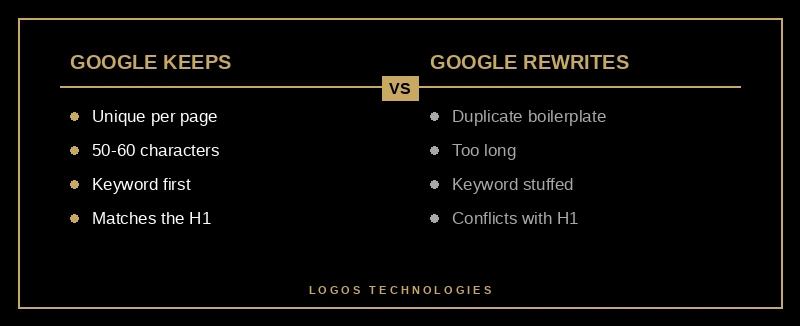
Google rewrites titles when it decides the one you wrote doesn't serve the searcher. Google's own documentation on title links lists the triggers: half-empty titles, obsolete dates, inaccurate descriptions, repeated boilerplate, no clear main heading, and language mismatches. Avoid those and your title survives. Here is the five-step version.
1. Put your primary keyword first
Lead with the term the page targets. Search engines assign more relevance weight to early words, and front-loading your keyword is a proven way to lift clicks. It also helps AI engines understand what the page is actually about.
2. Keep it 50 to 60 characters
This is the range with the lowest rewrite rate and almost no truncation. If you need more, make sure the first 50 characters stand alone — assume everything after that may be cut.
3. Make every title unique
Duplicate and near-duplicate titles are the most common rewrite trigger. Google flags "micro-boilerplate" — pages that share the same title with only one variable changing — and generates its own to tell them apart. Every page needs a title that describes that specific page.
4. Match the title to your main heading
When Google ignores a title tag, it pulls the H1 instead 50.76% of the time. If your title and your visible headline say different things, Google may decide the H1 is the more honest title. Keep them aligned and you keep control.
5. Brand it with one clean separator
End with your site name after a single hyphen, colon, or pipe — for example, Title Tag Optimization in 2026 - LOGOS. Avoid stacking separators or wrapping text in brackets; Zyppy found Google strips bracketed text far more often than text in parentheses.
Why static, hand-coded sites win at title tags
Static, hand-coded sites have a structural advantage: every page gets a unique, intentional title by default, because a developer writes the template instead of a plugin guessing. On a WordPress or page-builder site, titles are often generated from a global pattern — and that pattern is exactly what produces the boilerplate and duplicate titles Google overrides. The result shows up in the data: Ahrefs' site crawls regularly find that a majority of audited sites have page titles that don't match what Google actually displays.
On the static sites we build, the title is driven by front matter, so it is impossible to ship a page without a deliberate title. Here's the actual title template behind this blog, in Eleventy:
<title>true</title>
Each page sets its own title in front matter, and if one is ever missing the site title is the fallback — so no page can ship with an empty or duplicated <title>. There is no plugin injecting a sitewide pattern across hundreds of pages. That discipline — paired with a clean internal link structure — is part of why building topical authority works better on a fast static site than on a bloated CMS, and it feeds directly into how to rank on Google in competitive niches. Title tags are small, but at scale they are the difference between Google trusting your wording and Google replacing it.
Frequently Asked Questions
Does the title tag affect rankings directly?
The title tag is a real but modest ranking signal — its bigger job is winning the click. A clear, keyword-led title improves relevance and click-through, and click-through behavior influences how your result performs over time. Treat it as a conversion lever first and a ranking factor second.
What is the difference between a title tag and an H1?
The title tag is the HTML <title> that shows in search results and browser tabs; the H1 is the visible headline at the top of the page. They serve different audiences but should tell the same story. When they conflict, Google may ignore your title and display your H1 instead.
Why is Google showing a different title than the one I wrote?
Google rewrites a title when it detects an issue — a title that is too long, duplicated across pages, stuffed with keywords, outdated, or mismatched with the page's main heading. Fix the underlying issue and Google usually reverts to your title within a recrawl, which can take days to weeks.
Do title tags matter for AI Overviews and ChatGPT?
Yes. When an AI engine cites a page, the citation often pulls directly from the title, so a clear, accurate title improves both whether you get surfaced and how you're labeled. The same clarity that wins a Google click — keyword first, no fluff, unique to the page — is what makes a title easy for an AI system to quote correctly.
Get title tags that rank — and stay yours
Title tag optimization is the kind of small, compounding fix that separates sites built to rank from sites that just exist. If your titles are auto-generated by a plugin, duplicated across pages, or quietly being rewritten by Google, you are leaving clicks on the table every single day. At LOGOS Technologies, we hand-code fast, static websites in Papillion, Nebraska where every page ships with a deliberate, unique title and clean technical SEO from day one. See our web design services or contact us to find out what your site could be ranking for.