
Optimizing On-Page SEO For Search Engines

Table of Contents
TL;DR — Quick Hits
- On-page SEO in 2026 is a tie-breaker game: Google ranks the page that loads fastest, answers the question most clearly, and is easiest for AI to extract.
- Google AI Overviews now appear on roughly 50-60% of US searches, so on-page structure has to satisfy both human readers and LLM summarizers.
- Core Web Vitals are confirmed ranking signals — and only 42% of mobile sites pass all three thresholds. INP (Interaction to Next Paint) is the most-failed metric, with a 200ms "good" threshold.
- Speed compounds with conversion: every additional 100ms of load time costs roughly 1% in conversions on a typical small-business site.
- The fundamentals — keyword in title, keyword in first 100 words, clean URL, semantic headings, internal links — still matter and are still what most small-business sites get wrong.
Architecting websites that are fast is not only beneficial for the customers visiting your site but also a key metric Google considers when ranking your website in search results. We take pride in the speed we achieve because most websites on the internet are not as dominant in this area as ours. However, speed is just one data point in Google's overall scoring of your domain, as discussed in our post about the value we add to your small business.
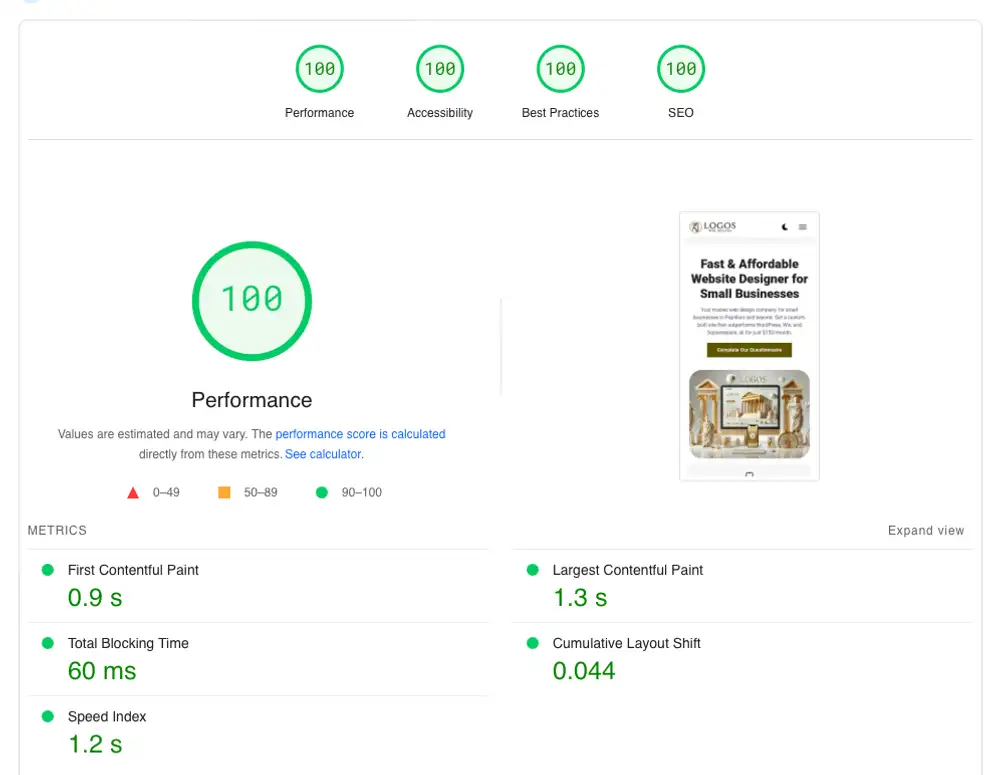
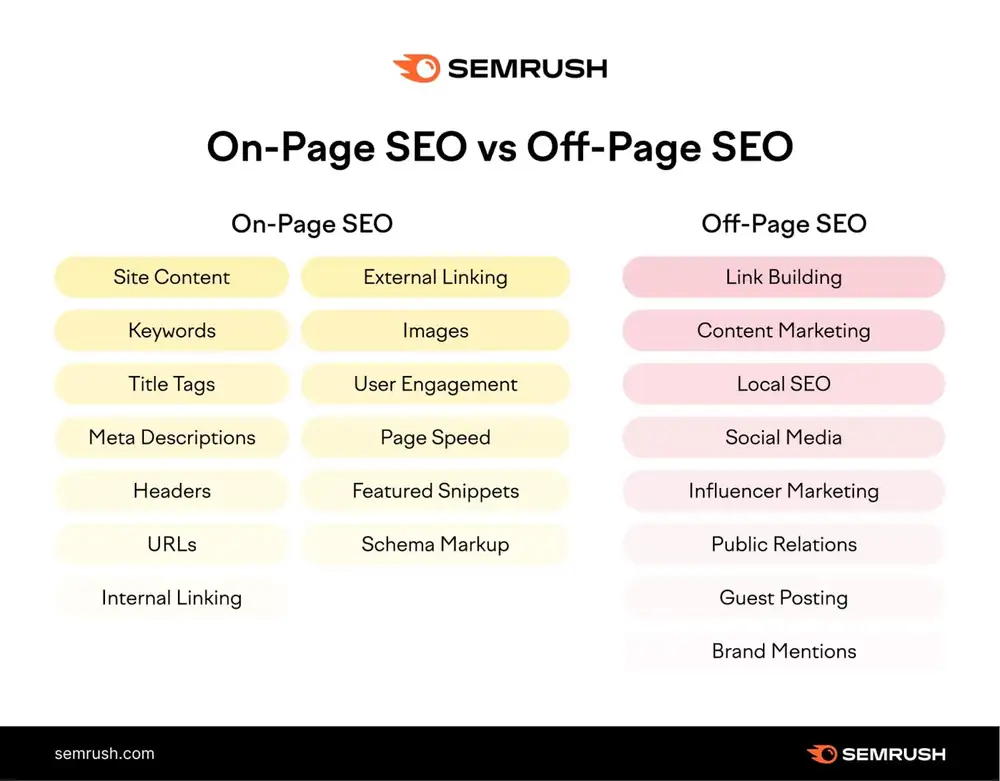
Without delving too deep into the technical details of SEO (Search Engine Optimization), let's discuss why this system exists in the first place. As you know, there are countless websites on the internet today, ranging from expert to amateur in their respective fields. Amazon, for example, is an e-commerce giant that is frequently visited, purchased from, and referred to both online and in everyday life. These interactions grant Amazon authority and visibility in Google's eyes, ultimately securing a top spot in search results. It's no secret how much more successful Amazon is compared to its competition! What we're discussing here includes both "on-page" and "off-page" SEO. At LOGOS Web Designs, our primary focus is on enhancing your website's On-Page SEO.
On the other hand, your small mom-and-pop e-commerce site, selling a niche product in a single category, will have some level of authority and visibility, but the volume is much smaller. These websites are often not built with the speed or structure necessary for high Google search rankings. This is where LOGOS Web Designs can step in, improving these websites to increase their speed, push them higher in the rankings, and ultimately attract new customers.
We take pride in applying the knowledge we've gained from years of working in the e-commerce industry on a larger scale and bringing those lessons to small business websites. Driving more customers to these companies by leveraging best practices and demonstrating compliance with search engine rules is not only something we're passionate about, but also crucial for small businesses to sustain and grow their operations.
What's actually changed about on-page SEO since 2024
Two big shifts have re-shaped what "good on-page SEO" looks like, and most small business sites haven't caught up.
The first is AI Overviews. The block of AI-summarized text Google now puts above the blue links appears on roughly 50-60% of US searches as of early 2026, up from roughly 15% a year earlier. Education, B2B tech, and restaurant queries trigger them more than 75% of the time. The practical consequence: even if your page ranks #1 in the traditional results, the AI Overview can answer the searcher's question first — which is why on-page structure now has to be friendly to LLM extraction, not just to human readers. Short, declarative sentences. Clear question-style H2s. A summary block near the top. We cover the full playbook in our generative engine optimization guide.
The second is Core Web Vitals, particularly the swap from FID to INP (Interaction to Next Paint) in March 2024. INP measures how quickly your page responds when a user taps or clicks something, and the "good" threshold is under 200 milliseconds. Roughly 43% of sites fail that threshold, making it the most commonly failed Core Web Vital in 2026. Google's March 2026 update also moved CWV to a site-level aggregation, so a few slow product pages can now drag down ranking on your fast pages.
Why speed still wins (and the math behind it)
Speed isn't a vanity metric. The conversion impact is documented and consistent across studies: every additional 100ms of load time costs roughly 1% in conversions, and the bounce rate roughly doubles between a 1-second and a 3-second load. For a small business doing $500,000 a year online, the gap between a 1.8-second site and a 3.5-second site is not a rounding error — it's tens of thousands of dollars.
That's why we hand-build every site at LOGOS rather than ship a plugin-laden CMS. Speed has to be designed in; it can't be bolted on after the fact. The full breakdown of what actually ranks on Google in 2026 walks through the order of operations.
The on-page fundamentals — still true, still neglected
The 2026 changes are layered on top of fundamentals that haven't moved in a decade. Backlinko's analysis of Google ranking factors still highlights the same on-page basics that worked in 2018: the primary keyword in the title tag (preferably near the start), the keyword in the first 100 words of body copy, semantic H1/H2/H3 structure, descriptive alt text on every image, internal links to related pages, and a clean, hyphenated URL slug.
Where 2026 adds a wrinkle: structured data. JSON-LD schema markup gives Google and AI Overview generators an unambiguous machine-readable summary of your page — Article, LocalBusiness, FAQPage, Product. Pages that include relevant schema get cited in AI Overviews disproportionately often. Our schema markup guide covers exactly which schemas a small business site should ship with.
For a checklist-style walkthrough of every technical lever — robots.txt, canonical tags, indexability, sitemap hygiene — see our technical SEO checklist.
Frequently Asked Questions
What's the difference between on-page and off-page SEO?
On-page SEO is everything you control on your own website: page speed, title tags, headings, internal links, structured data, image optimization, and the words on the page. Off-page SEO is signals that come from outside your site — backlinks, brand mentions, citations, reviews. On-page is where small businesses get the fastest, most predictable wins because every lever is fully under your control.
Are Core Web Vitals still a Google ranking factor in 2026?
Yes. Core Web Vitals (LCP, INP, CLS) remain confirmed ranking signals, although Google describes them as a tie-breaker rather than a primary ranking driver. The March 2026 update also moved scoring to a site-level aggregate, so weak pages drag down strong pages. The "good" thresholds are LCP under 2.5s, INP under 200ms, and CLS under 0.1.
How do I get my page into a Google AI Overview?
Cite specific data, structure the page around question-shaped H2s, include a summary or "TL;DR" block near the top so the LLM has clean text to lift, and add JSON-LD schema markup so the page is machine-readable. Pages that already rank in the top 10 organic positions are dramatically more likely to be cited.
Sources
- AI Overviews prevalence — BrightEdge / Advanced Web Ranking 2026 data
- Page-speed conversion impact — Page Speed Statistics 2026
- INP threshold and pass rates — Most Important Core Web Vitals Metrics 2026
- Core Web Vitals official thresholds — Google Search Central