
Organic Click-Through Rate in 2026: What's Normal, What Broke, and What You Can Still Fix

Table of Contents
TL;DR — Quick Hits
- For a whole website, 1–2% organic click-through rate is the honest 2026 benchmark — not the 27.6% quoted for position one.
- Sites under Domain Rating 40 typically sit below 1% CTR. That's normal, not failure.
- 68.01% of U.S. Google searches ended without a click in early 2026, up from 60.45% in 2024.
- When an AI Overview appears, clicks to the top organic result fall by roughly 58%.
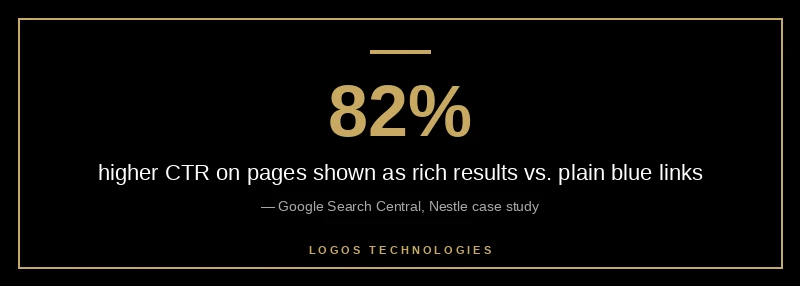
- Structured data is the CTR lever you fully control — Google measured an 82% lift for rich results.
Google Search Console has been telling business owners a confusing story for about two years now: impressions climbing, clicks flat or falling. It isn't a reporting bug and it usually isn't your fault. Ahrefs measured the effect on their own blog and found that daily clicks and impressions carried a +0.425 correlation through late 2024, then flipped to a negative 0.352 in the first half of 2025 — what the industry now calls the Great Decoupling. Impressions and clicks stopped moving together.
That matters because most advice about organic click-through rate is still calibrated to a search results page that no longer exists. If you're benchmarking your site against a position-one ideal, you're going to conclude something is broken when nothing is — and you'll misread what how to rank on Google even requires now. Here's what the current data actually says, and which levers are still worth your time.
What is a good organic click-through rate in 2026?
For an entire website, a good organic click-through rate in 2026 falls between 1% and 2%. Ahrefs pulled anonymized Google Search Console data from 422,421 real websites and published median CTR by industry, authority, and site size — and the typical site lands in that band. This is whole-site CTR: total clicks divided by total impressions, the same number staring back at you from your Search Console overview.
That is a very different figure from the 27.6% average CTR often cited for the number-one organic result. Both numbers are real; they just measure different things. Position-one CTR describes one keyword on one good day. Whole-site CTR averages your best queries together with the hundreds of terms where you rank 30th and nobody was ever going to click. Comparing the two is the single most common way small business owners talk themselves into a redesign they don't need.
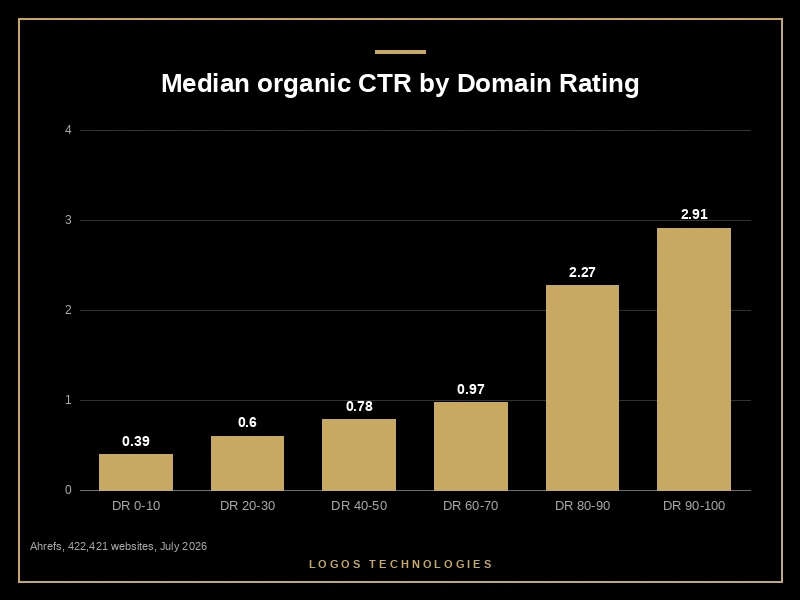
Authority is the clearest pattern in that dataset. Median CTR climbs from 0.39% for sites in the DR 0–10 range to 2.91% at DR 90–100 — roughly a 6x spread, and every tier beats the one below it without exception. Domain Rating doesn't appear in the search results and nobody clicks a link because of its backlink count, so this is a proxy for brand recognition rather than a cause. The practical read for a newer site: sub-1% is the norm below DR 40, and CTR improves as recognition compounds. That's a slow climb, which is also why building topical authority the patient way beats chasing quick wins.
Why are your impressions up and your clicks down?
Because Google increasingly answers the query on its own results page. SparkToro's clickstream study of U.S. Google searches from January through April 2026 found that 68.01% ended without any click at all — up from 60.45% in 2024, a 7.56-point jump in two years. The share of searches producing at least one click fell 9.51 percentage points over that span.

AI Overviews are a large part of it. The same research puts AI Overviews on more than 20% of Google searches, with click-through rates dropping nearly 60% when one appears. Ahrefs' own analysis is even blunter: their updated study across hundreds of thousands of keywords found that an AI Overview correlates with a 58% reduction in clicks to the top organic result, up sharply from the 34.5% they measured a year earlier. The effect is getting worse as the feature matures, not better.
Two things follow from that. First, impressions are a weaker success signal than they used to be — an impression logged inside an AI Overview is not the same asset as an impression on a blue link. Second, you can now separate the two: Google launched Search Generative AI performance reports in Search Console on June 3, 2026, giving you dedicated views of impressions inside AI Overviews and AI Mode. If your crocodile-mouth chart is driven by AIO impressions, that report will show it. Worth pairing with the handful of website metrics that actually matter for a small business rather than tracking clicks in isolation.
How do you improve organic click-through rate?
You improve organic click-through rate by winning more of the clicks that are still available, not by trying to reverse a platform-level trend. Five levers do most of the work, in rough order of leverage.
1. Rewrite title tags to match the query, not the page
Your title link is the biggest CTR variable you control. Sort Search Console by impressions, filter to anything with a CTR below your industry median, and rewrite those title tags to answer the specific query rather than describe the page. Front-load the value and keep it tight enough that Google doesn't truncate it — the mechanics of title tag optimization haven't changed much, but the stakes have gone up now that there are fewer clicks to win.
2. Write meta descriptions that earn the click
Google rewrites meta descriptions most of the time. That's not a reason to skip them — when yours does get used, a specific, benefit-led description with a concrete number outperforms a vague summary. Write it for the searcher, not the crawler.
3. Ship structured data so you're eligible for rich results
This is the lever most small business sites leave on the floor, and it's the one with the hardest numbers behind it. Google's own documentation cites measured results from sites that added markup: Rotten Tomatoes saw a 25% higher click-through rate on 100,000 structured-data pages, and Nestlé measured an 82% higher CTR on pages appearing as rich results versus pages that didn't. Article, FAQPage, HowTo, LocalBusiness, and Product schema all take up more vertical space in the results and pull the eye. Our guide to schema markup for SEO walks through which types are worth implementing.
4. Answer the question in the first two sentences
Extractability is a CTR strategy now. A passage that directly answers what its heading promises can be lifted into a featured snippet or cited in an AI Overview; a paragraph that clears its throat for three sentences cannot. This is the same discipline behind optimizing for AI Overviews and generative search, and it happens to make the page better for humans too.
5. Shift effort toward queries AI Overviews skip
AI Overviews lean hard toward informational, question-shaped searches. Commercial and navigational queries — "web designer near me," "static site pricing," your brand name — trigger them far less often, and those searches convert better anyway. Rebalancing a keyword map toward transactional intent is one of the few structural moves available, and it's a core part of how to rank on Google in 2026 when the informational half of the funnel is being absorbed by the answer engine.
Where a fast, static site has a structural advantage
Three of those five levers are implementation problems, not marketing problems — and that's where how your site is built starts to matter. Schema markup on a plugin-driven CMS is generated by whatever the plugin decides to emit, often duplicated across competing plugins, and frequently invalidated by the next theme update. On a hand-coded static site the JSON-LD is written into the template: one source of truth, versioned in git, validated on every build.
The same goes for the answer-first structure in lever four. It's a content-model decision — how headings, summaries, and FAQ blocks are templated — rather than something you retrofit page by page. And speed still underpins everything: a result that loads instantly keeps the click you just won, which is why we treat speed as something built in rather than bolted on. None of this makes an AI Overview disappear. It does mean that when a click is genuinely available, you're the result that's eligible for the rich snippet, and the page that doesn't lose the visitor to a three-second load.
Frequently Asked Questions
Is a 1% organic click-through rate bad?
No. For a whole website, 1–2% is the typical 2026 benchmark across most industries, and sites below Domain Rating 40 commonly sit under 1%. The useful comparison is your own industry's median and your own trend line over time, not a position-one figure.
Does click-through rate affect Google rankings?
Google has consistently declined to confirm CTR as a direct ranking factor, and there's no reliable public evidence that manipulating it improves rankings. Treat CTR as a measure of how well your result competes for attention at the position you already hold, not as a ranking lever.
Why did my impressions go up while my clicks went down?
Almost always because AI Overviews and other SERP features now answer more queries on the results page. Your pages still log impressions, but fewer searchers need to click through. Search Console's generative AI performance reports let you see how much of your impression volume comes from AI surfaces.
What is the fastest way to lift organic CTR?
Rewriting title tags on high-impression, low-CTR pages usually produces the quickest measurable change, often within a couple of weeks of recrawl. Adding valid structured data to become eligible for rich results is a close second and tends to hold longer.
Should I still invest in SEO if two-thirds of searches are zero-click?
Yes, with adjusted expectations. Branded searches, local business queries, and high-intent transactional searches still send clicks reliably. The change is that visibility and citation now matter alongside traffic, so measure both rather than clicks alone.
If your Search Console chart looks like impressions running away from clicks, the answer usually isn't more content — it's making the pages you already have eligible for the clicks still on the table. That means clean structured data, titles written for the query, and a site fast enough to keep whoever does click. LOGOS Technologies builds hand-coded static websites out of Papillion, Nebraska with that markup and structure baked into the build rather than bolted on afterward. Have a look at our web design services, or contact us and we'll take a look at what your search data is actually telling you.