
Med Spa Website Design That Books Consultations in 2026

Table of Contents
TL;DR — Quick Hits
- The U.S. med spa field is booming and crowded — the global market hit $21.21 billion in 2024 and is growing 15.77% a year — so a pretty site is no longer a differentiator. Speed and booking flow are.
- Mobile bounce probability jumps 32% when load time goes from 1 to 3 seconds. Heavy before/after galleries are the usual culprit on med spa sites.
- Leads contacted within five minutes are 21x more likely to qualify — your booking form has to reach a human fast, not sit in an inbox.
- Aim for LCP under 2.5s, INP under 200ms, CLS under 0.1. Hand-coded static builds hit those numbers; plugin-heavy templates usually don't.
- Most med spa discovery now runs through Google's local results and AI Overviews, which appear on roughly 68% of local searches.
Med spa website design has quietly become one of the hardest jobs in small-business web design — not because the sites need to be beautiful (they all are), but because so many of them are beautiful and slow. The global medical spa market reached $21.21 billion in 2024 and is projected to grow at a 15.77% annual rate through 2033, and the American Med Spa Association counts roughly 10,488 medical spas as of 2023, with 81% operating as a single location. That is a flood of independently owned businesses competing for the same local searches.
When everyone has a gorgeous hero image and a treatment menu, the site that wins is the one that loads instantly on a phone and makes booking a consultation effortless. The aesthetics are table stakes. The conversion machinery underneath is where med spas are quietly losing — or winning — booked appointments.
Why most med spa websites look great but book poorly
Most med spa websites convert poorly because they are built on heavy templates and page builders, then loaded with high-resolution before/after galleries, embedded video, and third-party booking widgets that push mobile load times past the point where visitors give up. The design impresses on a designer's desktop and stalls on a client's phone.
That tradeoff is measurable. Google's research found that mobile bounce probability increases 32% as page load time goes from one to three seconds, and it keeps climbing from there. A med spa homepage carrying a dozen uncompressed treatment photos can easily cross five seconds on a mid-range phone over cellular — which is exactly where a prospective client is when she searches "Botox near me" on her lunch break.
The fix is rarely "use fewer photos." Med spa marketing depends on visual proof. The fix is serving those images correctly: properly sized and compressed into modern formats, lazy-loaded below the fold, and never allowed to block the first paint. We walk through that in detail in our guide to image optimization for website speed, and it is the single highest-leverage change most aesthetic practices can make to their site.

What makes a med spa website actually convert?
A med spa website converts when it loads fast on mobile, makes one primary action — book a consultation — obvious on every screen, proves results and credentials with real trust signals, and routes each inquiry to a human within minutes. Strip away the styling and those four things are what separate a site that books from a site that just looks expensive — good med spa website design is really just those fundamentals executed well.
Speed-to-response is the most overlooked of the four. The classic Harvard Business Review study on lead response found that companies contacting an online lead within five minutes were 21 times more likely to qualify that lead than those who waited 30 minutes, and 100 times more likely to even make contact. For a med spa, that means the booking form on your site is only as good as what happens after someone hits submit. If it lands in an inbox checked once a day, you have already lost most of those consultations to whichever competitor texted back first.
Trust is the second lever, and it is heavier in aesthetics than in almost any other vertical. Provider credentials, real (not stock) photos, clear pricing ranges, and genuine reviews do more to book a consultation than any animation. We cover the specifics in our breakdown of website trust signals that drive conversions, and the same patient-confidence principles we apply to dental website design carry directly into medical aesthetics.

Template build vs. hand-coded static: the speed difference that books consultations
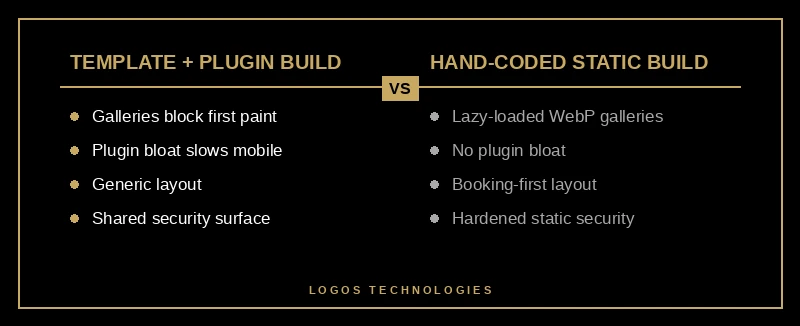
Med spa website design lives or dies on this choice. For an image-heavy med spa site, a hand-coded static build beats a template-and-plugin build on the metrics that actually drive bookings: load speed, mobile responsiveness, and stability. Templates ship with code you'll never use and plugins that each add their own scripts; a static site sends only what the page needs, so galleries load lazily and the page is interactive almost immediately.
That difference is what gets you into Google's "good" range on Core Web Vitals — Largest Contentful Paint under 2.5 seconds, Interaction to Next Paint under 200 milliseconds, and Cumulative Layout Shift under 0.1. Those thresholds are not arbitrary; Google uses Core Web Vitals as part of how it ranks pages, so a fast med spa site earns both more bookings and better visibility at the same time. If you want the full playbook, our website speed optimization guide lays out every fix in priority order.
This is the same argument we make about every vertical in our guide to industry-specific website design: a generic template treats a med spa like a blog, when what a med spa actually needs is a booking-first layout with a gallery system engineered not to wreck performance.
How do you get a med spa found on Google in 2026?
In 2026, most med spa discovery starts in Google's local results and AI Overviews, not the old blue links — so getting found means optimizing your Google Business Profile and your site's structured data, not just your homepage. AI Overviews now appear on roughly 68% of local searches, and when that summary shows, users click a traditional result in only about 8% of visits.
Practically, that puts your Google Business Profile at the center of the strategy. A complete, actively managed profile with current photos, services, and reviews is often the data source Google's AI pulls from when it decides which med spas to surface. Our Google Business Profile optimization guide covers exactly what to fill in and how often to update it, and tools like Semrush's local SEO stack help track how you rank across the map pack.
The website's job in this new landscape is to be the trustworthy, fast, structured source that confirms what your profile claims. Clear service pages with direct-answer headings, schema markup, and consistent business details are what let both Google and AI search engines treat your information as reliable enough to recommend. Done right, med spa website design and local SEO reinforce each other instead of competing.
Frequently Asked Questions
How much does a med spa website cost in 2026?
A professional med spa website typically ranges from a few thousand dollars for a focused single-location site to five figures for a multi-location build with custom booking integration. The bigger cost driver is whether the site is engineered for speed and conversion or just styled to look good — a cheap template that loads slowly costs far more in lost consultations than its price tag suggests.
How fast should a med spa website load?
Aim for a Largest Contentful Paint under 2.5 seconds on mobile, which is Google's "good" Core Web Vitals threshold. For an image-heavy med spa site, that almost always requires compressing before/after photos into modern formats and lazy-loading galleries so they don't block the first screen from appearing.
Do I need online booking on my med spa website?
Yes — online booking or a fast inquiry form is essential, because most prospective clients research and book outside business hours. The critical detail is response speed: inquiries that reach a real person within five minutes convert dramatically better, so connect your form to instant text or call alerts rather than a once-daily inbox check.
How do I get my med spa to show up on Google?
Start with a complete, regularly updated Google Business Profile, then make sure your website is fast, mobile-friendly, and marked up with structured data. Because AI Overviews and the local map pack now intercept most local searches, consistent business information across your profile and site matters as much as traditional keyword rankings.
Book more consultations with a site built to convert
If your med spa website looks the part but the calendar isn't filling, the problem is almost never the design — it's the speed, the booking flow, and the local-search foundation underneath it. A med spa is the clearest possible example of why industry-specific website design beats a one-size-fits-all template: the gallery, the booking path, and the trust signals all need to be engineered for how aesthetic clients actually choose a provider.
LOGOS Technologies builds fast, static, SEO-optimized websites for med spas and other appointment-driven businesses from our home base in Papillion, Nebraska. If you want a site that loads instantly and turns browsers into booked consultations, take a look at our web design services and contact us to talk through what your practice needs.