


Auto Repair Website Design That Fills Your Bays in 2026

Table of Contents
TL;DR — Quick Hits
- 97% of consumers read online reviews before choosing a local business — your website must surface them, not hide them.
- 76% of people who search locally on a smartphone visit a business within 24 hours, so mobile speed decides who gets the call.
- AI tools jumped from 6% to 45% as a way consumers discover local businesses in 2026 — repair shops now need AI search visibility, not just Google rankings.
- Put tap-to-call and online scheduling above the fold; most repair searches happen mid-breakdown on a phone.
- A fast, hand-coded static site beats a template builder for auto shops because local searchers bounce before bloated pages finish loading.
The way drivers find a repair shop has changed more in the last eighteen months than in the previous decade. According to BrightLocal's 2026 Local Consumer Review Survey, 97% of consumers read online reviews before choosing a local business, and 41% now say they always read reviews before deciding — up from 29% a year earlier. Meanwhile, Think with Google's local search data shows 76% of people who run a local search on a smartphone visit a related business within 24 hours.
For an auto repair shop, that funnel is brutally short: a driver with a check-engine light searches on their phone, skims two or three results, and calls the first shop whose site loads fast and looks trustworthy. Auto repair website design in 2026 is about winning that thirty-second decision. This post covers what actually moves the needle — and it builds on our full guide to industry-specific website design, which explains why generic templates quietly lose jobs across every trade.
Why Your Auto Repair Website Decides Who Gets the Call
Your website is the tiebreaker between you and every other shop in the map pack. When a driver sees three shops with similar ratings, the site they tap becomes the deciding factor: it either confirms the review score with a fast, professional experience, or it plants doubt with slow load times and a design that looks abandoned.
That's not a hypothetical. BrightLocal's same 2026 survey found 31% of consumers will only use a business rated 4.5 stars or higher — nearly double the 17% who said so a year ago. Expectations are rising across every touchpoint, and your website is the touchpoint you control completely. A shop with a 4.7-star rating and a site that takes eight seconds to load on mobile data hands its next customer to the 4.5-star shop down the street whose site loads instantly.
The same dynamic we documented in plumber website design applies to auto repair, but with one difference: repair customers are often stressed and stranded. A confusing site doesn't just cost a click — it costs a tow-truck decision made in the moment.

What Should an Auto Repair Website Include?
An auto repair website needs six things: a tap-to-call button above the fold, online appointment scheduling, individual service pages, visible customer reviews, clear location and hours, and photos of your actual shop and team. Everything else is secondary. If a stranded driver can't reach "call now" or "book an appointment" within two seconds of landing on your homepage, the design has failed no matter how good it looks.
Individual service pages matter more than most shop owners realize. A single "Services" page listing brakes, alignments, diagnostics, and oil changes in one wall of text can't rank for any of those searches. A dedicated page for "brake repair" with real pricing guidance, turnaround expectations, and warranty details can rank — and it converts better because it answers the exact question the searcher asked.
Trust elements carry unusual weight in this industry because auto repair consistently polls as a low-trust purchase. Certifications (ASE, AAA-approved), warranty terms, and straightforward pricing language do the reassuring before the phone rings. We broke down the mechanics of this in our guide to website trust signals that drive conversions — auto shops need every one of them.
Speed Is a Trust Signal: Why Slow Shop Sites Lose Jobs
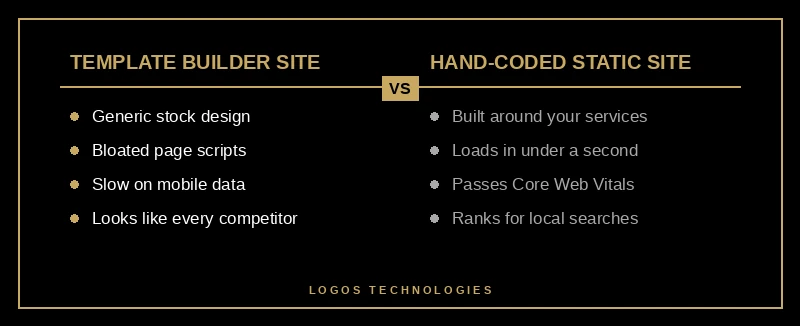
A slow website reads as an unprofessional shop. Google's Core Web Vitals thresholds give you the target: your largest content element should render in under 2.5 seconds, and the page should respond to taps in under 200 milliseconds. Most template-builder shop sites miss both, because they ship megabytes of scripts, sliders, and stock imagery a repair customer never asked for.
This is where the biggest auto repair website design decision matters: architecture. Sites built on drag-and-drop builders or heavyweight themes carry the same payload whether you use the features or not. A hand-coded static site ships only what the page needs — which is why static shop sites routinely load in under a second on mobile connections while builder sites are still painting their hero slider. For a search made from a parking lot on two bars of LTE, that difference is the whole game.
Speed also compounds with local rankings. Google's page experience signals reward fast, stable pages, and fast pages keep visitors on the site long enough to book — the behavioral signal that feeds back into rankings. Slow sites leak at both ends.
AI Search Is Now Sending Customers to Repair Shops
AI assistants have become a mainstream way drivers pick a shop. BrightLocal's 2026 survey found the share of consumers using AI tools to discover local businesses jumped from 6% to 45% in a single year, making AI the third most popular discovery channel — ahead of Yelp. And it's not just chatbots: a Semrush study of 600,000 keywords published in July found AI Overviews on commercial-intent Google searches grew 71% in six months. Searches like "best brake shop near me" increasingly get an AI-written answer before any traditional result.
Getting cited in those answers isn't magic — it's structure. AI systems favor sites with clean, extractable facts: services, prices, hours, location, and credentials marked up in LocalBusiness structured data that machines can parse unambiguously. Static sites have a quiet advantage here, because schema markup baked into pre-rendered HTML is exactly what AI crawlers read most reliably.
Your Google Business Profile feeds the same machine. Categories, services, photos, and review responses all shape what AI tools say about your shop — we covered the mechanics in our Google Business Profile optimization guide. The shops winning AI recommendations in 2026 are the ones whose website and profile tell one consistent, structured story.
Reviews Do the Selling Before You Answer the Phone
Reviews are the most-read content about your shop, and most auto repair website design treats them as an afterthought. With 97% of consumers reading reviews and nearly a third filtering out anything under 4.5 stars, your site should pull recent reviews onto the homepage and service pages — with dates visible, because BrightLocal found consumers increasingly discount reviews older than a few months.
Responding matters as much as collecting. Roughly half of consumers say they'd be put off by copy-paste replies to reviews, so a short, specific response to every review — positive or negative — is now table stakes. A thoughtful reply to a critical review, visible right on your site, often does more to reassure a skeptical customer than ten five-star ratings.
This is also where industry-specific website design earns its keep over generic templates: an auto repair site should surface reviews that mention specific services ("fixed my transmission," "honest about what I didn't need") next to the matching service page. Generic templates can't do that; a purpose-built site can.

Frequently Asked Questions
How much does an auto repair website cost?
Professional auto repair website design typically runs $2,000–$10,000 depending on the number of service pages, integrations like online scheduling, and whether it's custom-coded or template-based. Ongoing costs are lower for static sites because there's no CMS to patch or database hosting to maintain. Beware of $50/month builder plans — the real cost shows up in lost leads from slow load times.
Do auto repair shops really need online scheduling?
Yes. A growing share of repair customers — especially under 45 — prefer booking online over calling, and after-hours visitors can't call at all. Online scheduling captures the customer who finds you at 9 p.m. with a dead battery. At minimum, offer a short appointment-request form that the shop confirms by text the next morning.
What pages should an auto repair website have?
Every shop site needs a homepage, individual pages for each major service, an about page with team photos and certifications, a reviews page, and a contact page with map, hours, and tap-to-call. Shops serving multiple towns should add a page per service area. Individual service pages are what rank for searches like "brake repair near me" — a single combined services page usually can't.
Can my auto repair shop show up in AI search results?
Yes — AI tools recommend shops with structured, consistent information across the web. That means LocalBusiness schema markup on your site, an actively managed Google Business Profile, recent reviews with responses, and clearly stated services and hours. AI discovery of local businesses grew from 6% to 45% of consumers in 2026, so this is no longer optional for shops that want the next generation of customers.
Your Website Should Work as Hard as Your Techs
A repair bay only makes money when it's full, and in 2026 the road to a full bay runs through a thirty-second mobile search. If your site loads slow, hides reviews, or makes booking a chore, you're paying for the marketing that fills your competitor's schedule. LOGOS Technologies, based in Papillion, Nebraska, builds hand-coded static websites for auto repair shops and other local businesses — sites that load in under a second, rank for the searches that matter, and turn stranded drivers into booked appointments. See our web design services or contact us for a straight answer on what your shop's site should be doing better.