


Landscaping Website Design That Books More Jobs in 2026

Table of Contents
TL;DR — Quick Hits
- 76% of people who run a local search on their phone visit a business within 24 hours, so your landscaping site is often the first and only impression.
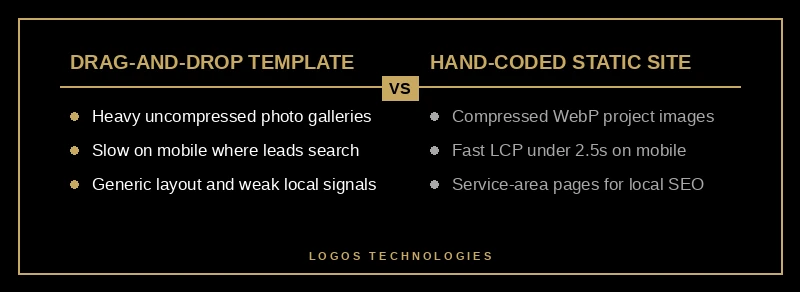
- Heavy, uncompressed photo galleries are the number one reason landscaping sites fail Core Web Vitals — and slow pages lose mobile leads before they load.
- The pages that actually book jobs are service-area pages, individual service pages, and a short quote-request form — not a single sprawling homepage.
- Your Google Business Profile category and recent reviews now outweigh how pretty your template looks for local-pack ranking.
- A fast, hand-coded static site beats a drag-and-drop builder for landscapers because portfolio images are the make-or-break performance bottleneck.
Most articles about landscaping website design show you twenty gorgeous galleries and tell you to use "high-quality imagery." That advice is half-right and quietly dangerous. The customers deciding whether to call you are on their phones, mid-search, with very little patience. According to Think with Google's local search data, 76% of people who run a local search on a smartphone visit a related business within 24 hours, and 28% of those searches end in a purchase. Search Engine Land reports that 82% of smartphone shoppers now run "near me" searches. That is your funnel: a homeowner standing in their backyard, typing "landscaper near me," and clicking the first site that loads fast and looks trustworthy.
The problem is that the prettiest landscaping sites are frequently the slowest. A portfolio stuffed with full-resolution before-and-after photos is exactly the kind of page that crawls on a mobile connection — and a slow page is a lost estimate. This is one more reason generic templates lose to industry-specific website design: a landscaping site has a unique performance profile that a one-size-fits-all builder doesn't account for.
What makes a landscaping website actually generate leads?
A landscaping website generates leads when it loads fast on mobile, makes the service area obvious, and puts a short quote-request form within one tap from any page. Everything else — the hero video, the parallax scroll, the animated logo — is secondary to those three things. A site is a lead generation website first and a brochure second.
The mistake most landscapers make is treating the homepage as the whole website. A homeowner searching "patio installation [their town]" doesn't want your homepage; they want a page about patio installation in their town. When every service and every service area collapses into one long scrolling homepage, you have nothing specific for Google to rank and nothing specific for the visitor to convert on. The fix is structural, and we'll get to it — but it starts with understanding that design choices on a landscaping site are lead-generation choices, not decoration.

Why your gallery is quietly killing your rankings
Your project gallery is probably the single biggest reason your landscaping site is slow, and speed is now a ranking and conversion factor you cannot ignore. Google's Core Web Vitals treat a Largest Contentful Paint (LCP) under 2.5 seconds as "good" — and on an image-heavy landscaping page, that largest element is almost always a hero photo or the first gallery image. If those images are uncompressed, your LCP balloons, your mobile visitors bounce, and Google notices.
The answer is not fewer photos. It's smarter ones. Serve your project images as compressed WebP, size them for the actual display dimensions rather than uploading 6000-pixel camera files, and lazy-load anything below the fold so the browser isn't fetching forty images before the page is usable. We cover the full process in our guide to image optimization for website speed, but the headline for landscapers is simple: the same gallery can either win you the job or cost you the click, depending entirely on how the images are delivered.
This is where a hand-coded static site pulls ahead of drag-and-drop builders. Page builders tend to inject heavy scripts and ship oversized images by default, and for most industries that's a minor tax. For a landscaper, whose entire value proposition is visual, the image pipeline IS the website. Controlling it directly is the difference between a fast site and a slow one.
The pages every landscaping site needs
Every landscaping website should have a dedicated page for each core service and a dedicated page for each primary service area, plus a short quote-request form reachable from all of them. That structure is what lets you rank for "lawn care in [town]" and "retaining walls in [town]" instead of competing with yourself on a single homepage.
Think in a simple grid. Down one axis are your services: lawn maintenance, landscape design, hardscaping and patios, irrigation, seasonal cleanup, snow removal. Across the other are the towns you actually serve. Each meaningful intersection deserves its own page with real, specific content — not a town name swapped into a template paragraph, which Google has been filtering out for years. Then connect them: a service page links to the relevant service-area pages, and each links back to a clear estimate request.
That estimate request is where the money is, and it's where most sites leak leads. A long form asking for square footage, budget, and a project description up front feels thorough but kills conversions. Ask for the minimum — name, contact, and a one-line "what do you need" — and qualify on the follow-up call. Our breakdown of quote-request form design goes deeper, but the rule for landscapers is to remove every field that isn't strictly necessary to call the person back.

How do landscaping websites win local search in 2026?
Landscaping websites win local search in 2026 by pairing a fast, well-structured site with an active Google Business Profile and a steady flow of recent reviews. The website and the profile work together: the profile gets you into the local map pack, and the site closes the visit. According to Search Engine Journal's analysis of 2026 local ranking data, the primary Google Business Profile category remains the single biggest local-pack ranking factor, with proximity and review signals climbing fast right behind it.
Reviews do double duty: they help you rank and they help a homeowner choose you over the landscaper with the same star rating. BrightLocal's Local Consumer Review Survey found that 83% of consumers use Google to read reviews and 89% expect businesses to respond to them — so a profile you set up once and forgot is actively costing you jobs. Keep your business name, address, and phone number identical across your site, your profile, and every directory; Semrush's local SEO guidance flags inconsistent NAP data as one of the most common and most damaging local SEO mistakes. For the full walkthrough, see our guide to Google Business Profile optimization.
The throughline of all of this — fast pages, real service-area content, an active profile — is that a landscaping site has to be built for how landscaping customers actually search and decide. That's the broader argument for industry-specific website design over generic templates: the details that matter for a landscaper are not the details a template optimizes for.
Frequently Asked Questions
How much should a landscaping website cost?
A professional landscaping website typically ranges from a few thousand dollars for a focused lead-generation site to more for larger sites with many service-area pages. The cost driver is structure and performance, not page count — a fast site with well-built service and area pages will out-earn a cheap template many times over because it actually converts the mobile searchers who find it.
Do landscapers need a website if they already have a Google Business Profile?
Yes. The Google Business Profile gets you into the local map pack, but the website is where the visitor decides to call. Search Engine Journal's 2026 ranking data shows the profile and the site reinforce each other, and homeowners overwhelmingly check a business's website before requesting an estimate. Relying on the profile alone caps how many leads you can convert.
What's the most important page on a landscaping website?
The service-area page for your top town and top service, combined with an easy quote-request form. That's the page most likely to match a high-intent "near me" search and turn it into a booked estimate. The homepage matters for branding, but specific service-and-area pages are what rank and convert.
Why is my landscaping website so slow?
Almost always, it's the images. Landscaping sites are photo-heavy, and uncompressed gallery images are the leading cause of failing Core Web Vitals. Converting photos to WebP, sizing them correctly, and lazy-loading below-the-fold images usually fixes the bulk of the problem.
Should landscapers use a website builder or a custom-built site?
For a business whose value is visual, a custom-built static site has a real edge because it lets you control the image pipeline that determines page speed. Builders are convenient but tend to ship heavy scripts and oversized images, which is exactly the wrong trade-off for an image-heavy landscaping site.
Your website is the most overworked salesperson you have — it pitches every homeowner who searches for you, at every hour, before you've said a word. If it loads slowly, hides your service areas, or buries the estimate request, it's losing jobs you'll never know you missed. At LOGOS Technologies, we build fast, hand-coded landscaping websites in Papillion, Nebraska and nationwide that are engineered to turn local searchers into booked estimates. Take a look at our web design services or contact us to talk through what a faster, better-structured site could do for your lead flow this season.