
Industry-Specific Website Design: Why One-Size-Fits-All Templates Fail Small Businesses in 2026

Table of Contents
TL;DR — Quick Hits
- Industry-specific website design beats generic templates because buyer intent, trust signals, and conversion paths change completely between a restaurant, a contractor, a dental office, and a law firm.
- Custom-built industry sites hit PageSpeed 90+ while template-driven industry sites typically land at 70-80 — and Core Web Vitals are a confirmed Google ranking factor in 2026.
- 70% of small business websites still lack a clear call to action, and the specific CTA that works depends on the industry: "book a table" for restaurants, "request a quote" for contractors, "schedule a consultation" for law firms.
- The average U.S. website conversion rate is ~2.35%, but conversion rates by industry vary 3-5x — meaning industry-tuned design has a much bigger revenue lever than global "best practices."
- The right move for most small businesses is not picking an industry template — it is building an industry-specific information architecture on top of a fast, static foundation.
Industry-specific website design is website design where the information architecture, conversion path, trust signals, and technical stack are chosen to match how buyers in a specific industry actually shop and decide. It is the opposite of dropping a generic "small business" template onto a restaurant, a contractor, a dental practice, and a law firm and hoping the pictures make up the difference. They rarely do.
The data is unambiguous. Over 70% of small businesses cite their website as their primary revenue driver, yet roughly 70% of small business websites still ship without a clear primary CTA. A generic template does not know whether the next click should be "order online," "request an estimate," "book a consultation," or "call now." The business owner knows. The site has to reflect that knowledge — and that is what industry-specific website design, done well, actually is.
What does "industry-specific website design" actually mean in 2026?
Industry-specific website design is the practice of matching a website's structure, language, conversion path, credibility signals, and technical performance profile to the buying behavior of a specific vertical — restaurants, contractors, dental practices, law firms, HVAC companies, ecommerce shops, and so on. It is not picking an "industry template." It is a deliberate design discipline where every surface of the site reflects how that industry's customers decide.
The practical test: if you could remove the logo and photography and still tell within 10 seconds what industry the site is in based on the structure alone — menu order, primary CTA, trust block, FAQ topics — the site is probably industry-specific. If it reads as a generic "small business website" with the industry swapped in like a stock photo, it is not.
Industry-specific design sits downstream of professional website design and upstream of our industry cluster guides for contractor, restaurant, HVAC, law firm, and dental sites. Those guides get into the vertical-specific tactics. This pillar covers the pattern that unites them.
Why do generic templates fail for industry-specific businesses?
Generic templates fail because they optimize for the builder, not the buyer. A website template is designed so that thousands of different businesses across dozens of industries can drop in a logo, swap photos, and "look professional." That is a template vendor's goal — not a buyer's goal. The buyer, in every industry, wants to complete a specific task quickly: order food, request a quote, schedule an appointment, read a case study, get a price.
Three failure patterns show up over and over when a template is applied to an industry-specific business.
The information architecture is wrong for the vertical. A restaurant template ships with a "Services" page. Restaurants do not sell services — they sell a menu, a reservation, and a vibe. A law firm template ships with a "Shop" link buried in the footer. Law firms do not shop; they consult. Buyers bounce because they cannot find the one page that matches what they came to do.
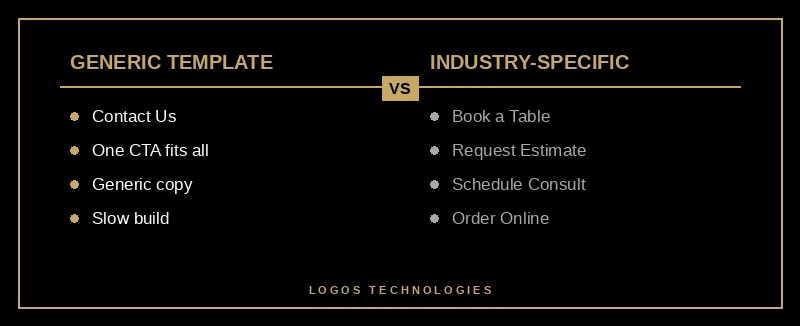
The conversion path is generic. Templates default to "Contact Us" as the primary CTA. That works for nothing specific and everything weakly. A contractor needs "Request a Free Estimate." A dental practice needs "Request an Appointment." A restaurant needs "Book a Table" or "Order Online." The CTA shapes the rest of the page — when you get it wrong, every section above it drifts.
The performance profile drags down rankings. Page-builder and multi-industry templates tend to ship with dozens of unnecessary scripts and design tokens so the builder can "support every industry." That bloat shows up in Core Web Vitals. Independent benchmarks consistently show custom-built sites landing at PageSpeed 90+ while template-driven sites cluster around 70-80. On mobile — where 65% of small business web traffic now lives — that Lighthouse gap compounds with Google's mobile-first index to produce a meaningful ranking delta. We break this down in our custom website design vs templates guide.

What changes by industry — and what stays the same?
The short answer: structure, trust, and CTA change. Performance fundamentals do not.
The long answer is where most "best website design" articles skip the work, so we will not. Here is the pattern that holds across the five verticals we work with most.
Restaurants
Restaurant buyers are high-frequency, low-consideration, and almost entirely mobile. The decision window is measured in minutes, not weeks. What has to be at the top of every page: the menu, hours, location, phone, and either a reservation or online-order CTA. What has to be fast: the menu page itself — a bloated menu page loses the order before the buyer even reads the first appetizer. Our restaurant website design guide walks through the specifics of menu structure, mobile tap targets, and the Google Business Profile feedback loop.
Contractors, HVAC, and Home Services
Home services buyers are emergency-driven or comparison-shopping. Either way, the single most important surface is the quote request form — and it is consistently the surface template sites get most wrong. Long, generic forms tank conversion. Short forms with the right 4-6 fields, a trust-heavy header (license number, years in business, warranty, local reviews), and a clear service-area map outperform by wide margins. The specifics change by trade but the pattern holds in both our contractor website design and HVAC website design guides.
Dental and Healthcare
Dental and healthcare buyers are driven by trust and proximity. They want to see the dentist's face before they book, read real reviews, and know whether their insurance is accepted. They also expect to book online — in 2026, a dental site without online appointment booking is a competitive liability. Privacy, HIPAA handling, and accessibility are not optional decorations. Our dental website design guide covers the full conversion path.
Law Firms
Law firm buyers are research-heavy, emotionally loaded, and deeply skeptical. They are going to read 3-5 attorney bios, look for case results, scan credentials, and usually call — not fill out a form. The design's job is to survive a skeptical, half-page reader and land the call. Credentials, outcomes, and a no-friction phone CTA on mobile are what actually convert. We cover this in detail in the law firm website design guide.
What stays the same across every industry
Three things do not change between verticals, and this is where generic templates paradoxically do fine while still failing — they check the box and then stop.
- Core Web Vitals. Google's Core Web Vitals thresholds are the same whether you sell tacos or trust law. Missing them hurts every industry equally.
- Mobile-first design. Every vertical we build for is 60-80% mobile traffic in 2026. A responsive design that still buries the CTA below three fat hero images on mobile loses the visitor in every industry.
- Structured data and schema markup.
LocalBusiness,Restaurant,Dentist,Attorney,HomeAndConstructionBusiness, andMedicalBusinessare all valid schema types, and using the correct one is a cheap, high-leverage SEO signal every industry-specific site should claim.
How does industry-specific design impact SEO and Google rankings?
Industry-specific design impacts SEO in three concrete ways: it aligns on-page content with vertical search intent, it enables richer structured data, and it — when done on a fast static architecture — gives each industry page the Core Web Vitals headroom to actually rank.
Google is much better at understanding industry intent in 2026 than it was even two years ago. Search "emergency plumber Omaha" and you will get results optimized for the speed-to-call conversion path, not generic plumbing content. Search "personal injury attorney" and the top results lead with case results and credentials. The SERP knows what each industry expects. A website that structurally matches the SERP's intent has an easier ranking job than one that fights it with a generic template.
Industry-specific design also unlocks the correct schema. A dental site using Dentist + MedicalBusiness schema tells Google exactly what it is. A contractor site using HomeAndConstructionBusiness + LocalBusiness + Service with properly-scoped areaServed tells Google where you work and what you do. These are tiny pieces of code; the ranking effect compounds with the rest of your on-page work. For the full picture, see our page-speed-and-revenue breakdown — industry-tuned pages convert more of the traffic they already get, and rank better for the traffic they should get.
And finally: industry-specific design reinforces E-E-A-T (Experience, Expertise, Authoritativeness, Trust) because the content reads like it was written by someone who has actually served that industry. Google's recent core updates have increasingly weighted Information Gain and first-hand expertise signals, which means the thin, paraphrased "What a [industry] website should have" articles are getting demoted in favor of content with actual industry specifics.
What should a small business actually do in 2026?
The right answer for most small businesses is not "pick an industry template." It is: pick a fast, static architecture that gives you performance headroom — then layer industry-specific information architecture, copy, and conversion paths on top. That is exactly what we build at LOGOS Technologies.
That split matters because it preserves the two things a small business cannot afford to lose: speed (which compounds with SEO over years) and flexibility (because your business will change shape and your "2025 industry template" will not bend with it).
Here is the practical sequence we run for every industry-specific site.
- Start from a static foundation. Eleventy, Astro, or similar — anything that ships HTML, not a hydrated JS runtime. This gets you 90+ PageSpeed from day one without fighting a theme.
- Wireframe the conversion path before the design. What is the one action you want every visitor to take? What are the second and third? Structure the homepage and every service page around that answer.
- Build industry-specific trust blocks. Licensing, reviews, years in business, local service area, insurance acceptance, case results — whatever your industry's buyer needs to see. Put them above the fold, not in the footer.
- Write copy a non-competitor would not be able to write. If your "About" page could be copy-pasted to a competitor's site and still read coherently, you have a generic site in disguise.
- Instrument it. Google Search Console, Google Business Profile, and call tracking at minimum. Without instrumentation you are guessing which industry-specific design choices moved the revenue.
- Ship it fast. A 90+ PageSpeed, industry-tuned site published in 4-6 weeks beats a "perfect" template-based rewrite that never ships.

How much does industry-specific website design cost?
Industry-specific custom website design for a small business in 2026 typically runs $3,000-$8,000 for the initial build and $500-$2,000/year for hosting, security, and maintenance, per 2026 market data from Marketing LTB. That is the sweet spot for most single-location small businesses.
The cost drivers, in order of impact, are: number of pages (especially service-area and industry-sub-vertical pages), integrations (online booking, quote systems, payment), copy quality and source material, and the structured-data + local-SEO scope. Multi-location, multi-vertical, or heavy-integration builds move up into the $8,000-$25,000 range.
Here is the cost framing that actually matters, though, and that most "how much does a website cost" articles ignore: an industry-specific site that converts at 4% instead of 2% doubles the revenue from the same traffic. The industry-specific version frequently has a higher initial cost and a meaningfully better ROI within the first 12 months because it was built around the vertical's actual conversion path — not a template's guess at it. See our website ROI guide for the actual math.
Frequently Asked Questions
Is industry-specific website design worth it for a very small business?
Yes, especially for a very small business. Small businesses have thin margins and zero budget for wasted traffic. A generic template that converts at 1.5% wastes 98.5% of traffic. An industry-specific site that converts at 3-4% more than pays for itself within the first year — usually in the first 90 days for home-services businesses with high-value leads.
Can I get industry-specific design with a website builder like Squarespace or Wix?
Partially. Modern builders include industry-labeled templates, but "industry template" is not the same as industry-specific design. You can approximate it by rewriting every section to match your vertical's conversion path. You will run into performance and structured-data ceilings that a custom static build does not have. For a very simple presence site, a builder is fine. For a site that is genuinely trying to rank and convert in a competitive industry, you outgrow the builder quickly.
How do I know if my current website is "industry-specific" enough?
Run a 60-second test. Hide the logo and photography. Read your homepage aloud. If someone from outside your industry would not immediately know what you sell, to whom, and what the one action is they should take, the site is not industry-specific enough. Then check your mobile PageSpeed — if it is under 80, a redesign on a faster foundation will usually pay for itself before any conversion changes land.
How long does it take to build an industry-specific website?
A well-scoped industry-specific site on a static foundation typically ships in 4-6 weeks: 1 week for discovery and wireframes, 2-3 weeks for design and build, 1 week for content and structured data, and a final week for QA, analytics, and launch. Multi-location or heavy-integration builds take 8-12 weeks. The single biggest delay in every project is waiting on the business owner for copy and photos — not the development.
Does industry-specific design help with local SEO?
Yes, meaningfully. Local SEO rewards sites that clearly signal both industry and service area. Industry-specific structured data (Dentist, Restaurant, HomeAndConstructionBusiness), matching on-page copy, and a well-linked Google Business Profile together produce a stronger local-search signal than any of those pieces alone. We cover the full playbook in our how to rank on Google in 2026 guide.
Ready to get serious about industry-specific website design?
LOGOS Technologies is a small, focused web design studio based in Papillion, Nebraska that builds fast, static, industry-specific websites for small and mid-sized businesses across the country. We have shipped sites for contractors, dentists, restaurants, law firms, HVAC companies, and more — and every one of them ranks, converts, and loads in under 2 seconds because it was built for the industry, not cloned from a template.
If you are tired of a template that fights your business instead of supporting it, take a look at our web design services or contact us for a no-pressure conversation about what your industry actually needs from its website. We will tell you honestly whether a rebuild is worth the money for your specific situation — and if it is not, we will tell you that too.