
Custom Website Design vs Templates: Why Custom Still Wins in 2026

Table of Contents
Every small business owner I talk to eventually asks the same question: "Why would I pay for a custom website design when I can get a template for a few hundred bucks?" It's a fair question. The upfront price gap is real. What isn't always obvious is what that gap is actually buying you — and what it's quietly costing the businesses that pick the cheap option.
The 2026 data tells a clearer story than it used to. Template builders have gotten better, but the gap in performance, SEO, and conversion rates has actually widened in the last two years because Google's ranking signals have gotten stricter, mobile traffic has gotten heavier, and users have gotten less patient. If you're trying to decide between a custom website design and a template, the honest answer depends on what you need the site to do — but the honest answer is rarely "just grab a template."
What "custom website design" actually means in 2026
There's a lot of marketing fog in this category, so let's define it. A custom website design is a site where the structure, code, layout, and content strategy are built specifically for one business — not dropped into a pre-built shell. That usually means hand-coded HTML, CSS, and JavaScript (or a static site generator like Eleventy), a tailored content strategy, and an architecture designed around the specific conversions that business cares about.
A template, by contrast, is a pre-built shell — usually on WordPress, Wix, Squarespace, or Shopify — where you pick from a catalog of themes and swap in your logo, copy, and images. The skeleton, the scripts, and the default structure are shared with thousands of other sites.
Both can look fine. The difference shows up in three places: how fast the site loads, how well it ranks, and how many visitors turn into customers.
Why does custom website design outperform templates on speed?
Speed is where the gap is widest, and it's the gap that matters most, because speed feeds into everything else Google measures. Custom-built sites consistently score 90+ on Google PageSpeed Insights, while most template-based sites land in the 70–80 range on a good day and much lower when stuffed with plugins, trackers, and third-party widgets.
The reason is simple: templates load code for features you'll never use. A WordPress theme has to support dozens of configurations, so it ships every script and stylesheet in case you enable them. A custom site only loads what it needs. You're not paying for a carousel you removed, a slider you disabled, or a page builder's render engine — because none of it is there.
That speed difference compounds fast. The probability of a mobile visitor bouncing increases 32% when load time goes from 1 second to 3 seconds, and jumps 123% from 1 second to 10 seconds, according to Google's own research. The average mobile bounce rate is now 56.8%, and it climbs to nearly 53% as soon as load time crosses the three-second mark. If you're running a template site with a PageSpeed score in the 70s, you are losing customers before they ever see your headline.

I've covered the revenue math on this in detail in our post on what the page speed data actually shows, but the short version is that every extra second of load time costs real money. Custom design removes those seconds at the source instead of patching them later with a caching plugin.
How much does it affect SEO and organic traffic?
The SEO gap is the second surprise for most business owners. Google's ranking signals care deeply about performance, and Core Web Vitals — LCP, INP, and CLS — are now embedded in how pages get scored for search. Only about 48% of mobile sites currently hit a passing Core Web Vitals score, according to the HTTP Archive Web Almanac, which means more than half the web is sitting below Google's quality threshold. Most of the sites failing are template-based.
Custom websites, in general, are built with those metrics as a design constraint from day one, not a cleanup task after launch. That's why custom sites deliver roughly two to three times more organic traffic value over a two-year window than comparable template sites in the same niche. Part of that is the speed advantage feeding into rankings. Part of it is that a custom site can be structured around a specific keyword strategy — internal links, headings, schema markup — instead of fighting against a theme's default structure.
I walked through the full ranking signal picture in our schema markup guide for 2026 and our Core Web Vitals update post. The pattern is consistent: sites with control over their own HTML outrank sites that are renting someone else's.
Does custom design actually convert better?
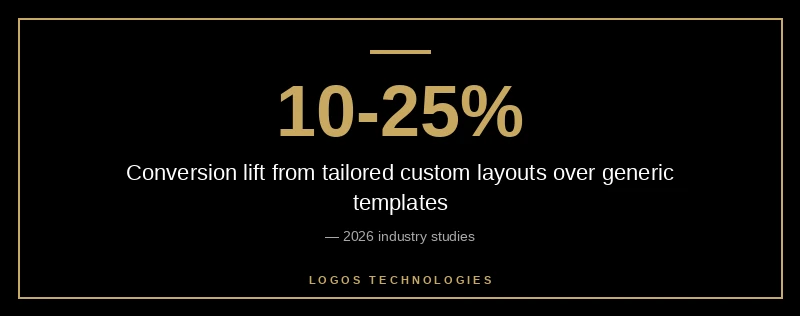
Yes, and the numbers are bigger than most people expect. Personalization and tailored layouts increase conversions by 10–25% for service and e-commerce businesses compared to generic template layouts, according to recent 2026 industry studies. The mechanism is straightforward: a custom site can put the conversion path where the business's specific customers actually look, instead of where the template designer guessed visitors would look.
Think about what a template enforces. Hero image at the top. Three feature columns. Testimonial strip. Contact form at the bottom. That layout exists because it works for a broad average — not because it's the best structure for a law firm, a plumber, or a SaaS startup. Custom design lets you do things like put the phone number in the header where contractors need it, or front-load a pricing table where transparency drives clicks, or kill the hero image entirely if your audience lands with a specific intent and just wants to get to the point.
We go deeper on what makes layouts actually convert in our guide to what separates sites that convert from sites that don't.
When does a template make sense?
I'll be honest: templates aren't always the wrong answer. If you're launching a hobby project, a short-term campaign site, or a placeholder while you figure out your brand, a $30 template will get you online for now. Templates also work fine if you truly have no SEO ambition and no conversion goal — the site is just a digital business card and nobody is expected to find it through search.
What templates do not handle well is growth. The most common pattern I see is a business that launches on a template, starts getting traction, and then hits a wall: the site is too slow to rank for competitive keywords, the theme can't be extended without breaking updates, and every new feature requires another plugin that adds weight. At that point they end up paying for a custom rebuild anyway — plus the cost of the lost months spent on the template. That's the path our WordPress alternative post digs into in detail.
The real cost comparison isn't "template today vs. custom today." It's "template today plus a custom rebuild in 18 months vs. custom today." When you run that math honestly, custom usually looks cheaper on a two-year horizon, not more expensive.
What to look for when hiring for a custom website design
A few things separate a real custom build from a theme with a fresh coat of paint:
The developer should be able to show you the actual code, not just a dashboard. If every conversation is about which page builder plugin to use, that's not really custom. Ask for PageSpeed scores on their previous work — legitimate custom builds should be hitting 90+ on mobile, not just desktop. Ask how they handle content updates; a static site generator with a clean CMS layer beats a dashboard full of plugin settings every time. And ask what happens when you want to add a feature in six months — does it require rewriting the theme, or just adding a new component?
If you're evaluating whether a custom website design makes sense for your business, that's exactly the conversation we have at LOGOS Technologies. We're based in Papillion, Nebraska, and we build fast, hand-coded static sites designed around performance and search — take a look at our web design services or reach out directly if you want a straight answer about whether custom is the right call for where you are right now. Sometimes it isn't. More often, it is, and the longer a business waits to make the switch, the more organic traffic and conversions it's leaving on the table.