
Static Website vs WordPress in 2026: Which Is Faster, Safer, and Better for SEO?

Table of Contents
TL;DR — Quick Hits
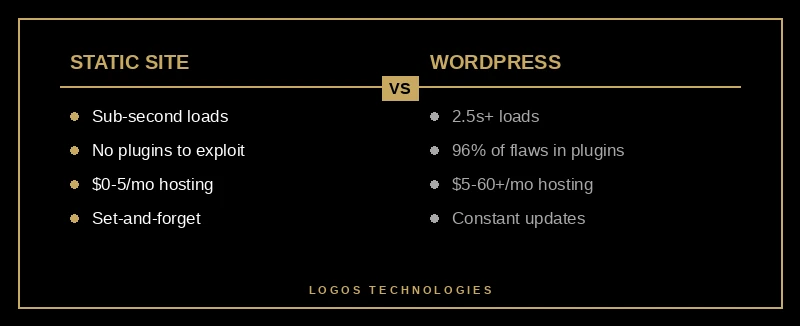
- WordPress runs about 42% of the web, but static sites routinely render in under a second versus WordPress averaging 2.5s on desktop and far slower on mobile.
- 96% of WordPress vulnerabilities live in plugins and themes — a static site has no plugins and no database to exploit.
- Static HTML passes Core Web Vitals by default; WordPress needs caching plugins, a CDN, and ongoing tuning to get close.
- Static hosting on a CDN costs roughly $0–$5/month; WordPress hosting that runs PHP and MySQL runs $5–$60+/month.
- WordPress still wins for large stores, membership sites, and content teams that need a built-in admin dashboard.
WordPress powers roughly 42% of every website on the internet, so when a small business asks "should I build on WordPress or a static site?", the honest answer has to start by acknowledging how dominant WordPress is. Popularity is not the same as performance, though. The same architecture that makes WordPress flexible — a PHP application assembling each page from a database on every request — is also what makes it slower, heavier to secure, and more expensive to host than a static website that ships pre-built HTML straight from a CDN.
This is a comparison we make with business owners constantly, because the gap between the two approaches has widened in 2026. Google's page-experience signals reward speed and stability, the WordPress plugin attack surface keeps growing, and static hosting has gotten cheaper. Here is the head-to-head, with the tradeoffs called out honestly so you can decide what actually fits your business.
What's the real difference between a static website and WordPress?
A static website is a set of pre-built HTML, CSS, and JavaScript files served exactly as they are, while WordPress is a dynamic application that builds each page on demand by running PHP and querying a MySQL database. That single architectural difference drives almost every practical difference in speed, security, and cost that follows.
With a static site, the work of "building the page" happens once, at deploy time. A visitor's browser requests a file and a CDN hands it over — no server-side processing, no database lookup. With WordPress, that work happens on every single request: the server boots PHP, queries the database, runs whatever plugins are active, assembles the HTML, and then sends it. WordPress masks this with caching, but caching is a patch over the architecture, not a change to it. Static sites are what you get when speed is built in rather than bolted on, which is the same reason a hand-coded custom build outperforms a templated one.
Is a static website faster than WordPress?
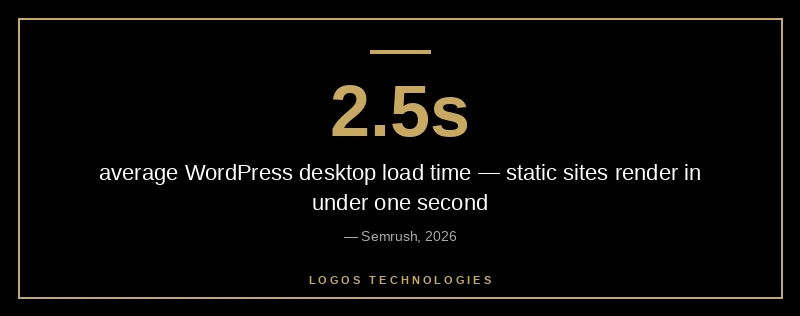
Yes — meaningfully. Well-built static sites routinely load in under one second and can hit a time-to-first-byte under 200 milliseconds, while WordPress sites average around 2.5 seconds on desktop and considerably more on mobile once plugins and third-party scripts pile up. The reason is structural: serving a flat file from a CDN edge is the fastest thing a web server can do.
Speed is not vanity. Google found that as page load time goes from 1 second to 3 seconds, the probability of a bounce rises 32%, and 53% of mobile visitors abandon a site that takes longer than three seconds. WordPress can be made fast, but it takes a caching plugin, image optimization, a CDN, and continual maintenance to approach what a static site does on day one. We dug into the underlying cause in our breakdown of why WordPress sites are so slow.
Static website vs WordPress for SEO: which ranks better?
For most small and local business sites, a fast static website has a structural SEO advantage because it passes Core Web Vitals — Google's confirmed page-experience ranking signals — by default. Largest Contentful Paint, Interaction to Next Paint, and Cumulative Layout Shift all reward a site that loads fast and stays visually stable, which is exactly what serving cached static HTML produces. You can read more on this in our coverage of the Core Web Vitals 2026 update.
WordPress is not bad at SEO — plugins like Yoast and Rank Math make on-page optimization approachable, and that ecosystem is a genuine strength. But those plugins govern metadata and content structure, not the raw page-experience metrics that Semrush and other tools now track as ranking correlates. A static site gives you the speed foundation automatically and still lets you control titles, meta descriptions, schema, and internal linking through the build. The result is that you compete on content quality rather than fighting your own platform for milliseconds. If you are weighing the broader move, our guide to the best WordPress alternative for a small business website walks through what changes and what doesn't.
Is a static site more secure than WordPress?
A static site is dramatically more secure because it has almost nothing to attack — no database, no admin login, no server-side code executing on each request. WordPress, by contrast, exposes a large and constantly shifting attack surface. According to Patchstack's State of WordPress Security report, 96% of WordPress vulnerabilities are found in plugins and themes rather than core, and the ecosystem logged 7,966 new vulnerabilities in a single year — a 34% jump over the prior year.
It gets worse when you look at patching: 33% of reported WordPress vulnerabilities were still unpatched at the moment they were publicly disclosed, and 43% required no authentication at all to exploit, which is exactly what automated bot attacks feast on. A static site sidesteps the entire category. There is no plugin to leave unpatched and no login form to brute-force. We covered the full picture in our deep dive on static site security versus WordPress.
What about cost and maintenance?
Static sites are cheaper to host and far cheaper to maintain. Because a CDN just serves files, static hosting typically costs $0–$5/month, while WordPress hosting that runs PHP and a MySQL database lands in the $5–$60+/month range and climbs with traffic. But the bigger cost difference is your time and ongoing risk, not the monthly bill.
WordPress is never truly finished. Core, themes, and every plugin need regular updates, and skipping them is how sites get hacked — yet applying them sometimes breaks layouts or features, which is its own maintenance tax. A static site is genuinely set-and-forget: there is nothing to auto-update and nothing to silently break overnight. For a small team without a dedicated webmaster, that difference compounds month after month. If you already run WordPress and want out, we wrote a step-by-step on migrating from WordPress to a static site.

When does WordPress still make sense?
To be fair, WordPress is the right tool for some jobs. If you need a large e-commerce catalog with inventory and accounts, a membership or course platform, a publication where non-technical authors log in and publish daily, or deep third-party integrations that already exist as WordPress plugins, that dynamic admin layer earns its keep. WordPress's ubiquity means there is a plugin for almost everything and a large pool of people who know it.
The point is not that WordPress is bad — it is that for the most common small-business need, a fast, secure marketing-and-lead-generation website that ranks, the dynamic CMS architecture is overkill that you pay for in speed, security exposure, and maintenance. Match the tool to the job. For a brochure site, a local service business, a portfolio, or a lead-gen site, static wins on the metrics that move the needle. If that describes your business, our complete guide to the WordPress alternative built for small business sites lays out exactly what the switch looks like.
Frequently Asked Questions
Can a static website have a contact form or blog?
Yes. Static sites handle contact forms through services that capture submissions without a server-side database, and blogs are first-class — this very post is a Markdown file built into static HTML. You get the content management benefits without running a live application on every page view.
Is WordPress more SEO-friendly than a static site?
WordPress has a richer plugin ecosystem for managing on-page SEO, but a static site has the structural advantage in page-experience signals like Core Web Vitals, which a fast static build passes automatically. You can replicate WordPress's metadata and schema control on a static site, so the speed edge is the deciding factor for most local and small-business sites.
How much does it cost to host a static website?
Static hosting typically runs $0–$5/month because a CDN simply serves pre-built files with no server-side processing. WordPress hosting that runs PHP and MySQL generally costs $5–$60+/month and increases with traffic and the resources your plugins demand.
Will switching from WordPress to a static site hurt my rankings?
Done correctly, a migration preserves URLs, redirects, metadata, and content, so rankings typically hold or improve thanks to the speed gains. The risk comes from sloppy migrations that break URLs or drop redirects, which is why a careful, mapped migration matters more than the platform switch itself.
Static versus WordPress is not really a debate about which platform is "better" in the abstract — it is about matching architecture to what your business actually needs. For the majority of small businesses that want a fast, secure, low-maintenance website that ranks on Google, a static site delivers more of what matters and less of what doesn't. At LOGOS Technologies in Papillion, Nebraska, we build exactly that: hand-coded, static, performance-first websites engineered to load fast and stay out of your way. If you're weighing your options, take a look at our web design services or contact us and we'll give you a straight answer about which approach fits your goals.