
Static Site Security in 2026: Why Sites With No Database and No Plugins Are Almost Impossible to Hack

Table of Contents
TL;DR — Quick Hits
- The WordPress ecosystem disclosed 11,334 new vulnerabilities in 2025, a 42% jump over 2024, and 91% of them lived in plugins — not in WordPress core.
- The median time from a public vulnerability disclosure to mass exploitation is 5 hours. Patch windows that small aren't a maintenance problem — they're a structural problem.
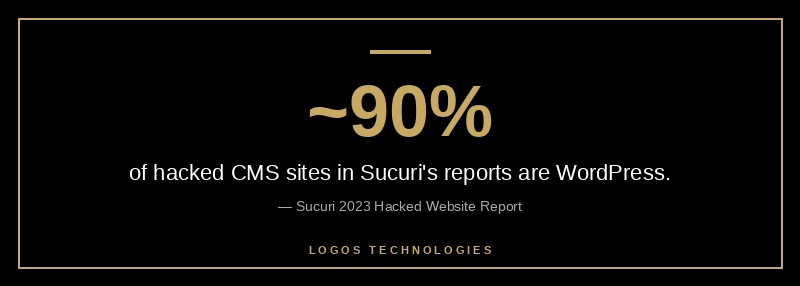
- WordPress accounts for roughly 90% of all hacked CMS sites in Sucuri's annual reports, even though it powers ~43.5% of the web.
- A static site has no database, no PHP, no admin login, and no plugin dependency tree — the four surfaces that account for almost every WordPress compromise.
- Static-site security is not "security through obscurity." It's the elimination of entire vulnerability classes (SQL injection, plugin RCE, credential stuffing on
/wp-login.php) because the code paths simply do not exist on the server.
Small-business owners almost never search for "static site security" before they get hacked. They search for it afterward — usually right after pulling up a Google Search result page that flags their website with a "this site may harm your computer" warning, or after a hosting provider emails to say the site has been pulled offline for serving malware. The numbers behind that experience are not subtle. WordPress runs roughly 43.5% of the entire web, and according to multiple security vendors, WordPress accounts for ~90% of compromised CMS sites worldwide. That dominance is mostly explained by market share, but only mostly — the architecture itself is doing real work to keep that number that high.
Static sites flip the model. There is no PHP runtime, no MySQL database, no admin URL to brute-force, and no plugin marketplace to introduce supply-chain risk. Pre-built HTML, CSS, and JS files sit on a CDN. The result, when you compare apples to apples, is a different threat model entirely — and for a small business that doesn't need a dynamic backend, it's the only honest answer to "how do I keep my website from getting hacked again."
What does "static site security" actually mean?
Static site security means hardening a website whose server only has to do one thing: deliver pre-built files. There is no application server interpreting code for each visitor, no database returning rows, no authentication system protecting an admin URL. The "attack surface" is whatever the CDN exposes (TLS, HTTP headers, DNS) plus whatever third-party scripts you've voluntarily added.
Compare that with WordPress. Per Patchstack's State of WordPress Security in 2026 whitepaper, 91% of the 11,334 new vulnerabilities disclosed in the WordPress ecosystem in 2025 were in plugins, 9% were in themes, and only 6 were in WordPress core. A static site doesn't have plugins or themes in that sense — it has a build script and a Git repo. The 91%-of-vulnerabilities surface is gone before the build even runs.
This is the same architectural argument we make in our pillar on the best WordPress alternative for small business websites: you can spend your life patching a dynamic stack you don't actually need, or you can remove the stack. Most small-business sites — a brochure, a service-area map, a blog, a contact form — fit neatly into "remove the stack."
Why WordPress dominates the hacked-website statistics
WordPress isn't unusually bad code — it's an unusually big target running an unusually permissive plugin model. Three things compound to produce the dominance you see in Sucuri's reports:
Plugin sprawl is the real attack surface. The 2023 Sucuri Hacked Website Report and the recurring Wordfence weekly vulnerability reports tell the same story month after month: the WordPress core team patches quickly, but plugin developers do not. Patchstack found that more than half of plugin developers did not patch the vulnerability they were notified about before public disclosure, and 46% of disclosed vulnerabilities had no patch available at the moment they went public.
Five hours is the new window. The same Patchstack 2026 report measured the weighted median time from public disclosure to first mass exploitation at 5 hours. A small business that updates WordPress on a "I check it Monday morning" cadence is, mathematically, hosting an exploitable site for most of every week. That cadence is not unusual — it's typical.
Supply chain attacks are now routine. In April 2026, attackers pushed malicious updates to a cluster of WordPress plugins — including the "essentialplugin" family — that were already installed on hundreds of thousands of sites, after the underlying accounts had been quietly acquired in 2025. Coverage in the Search Engine Journal WordPress category and across the WordPress press treated the incident as the expected consequence of a model that lets thousands of third parties push auto-updates into your site at any time. A static site built from a versioned Git repo cannot be silently updated by anyone other than the people with commit access — there is no auto-update channel for someone to compromise.
The point isn't that WordPress is insecure. The point is that the threat model of a CMS with a global plugin marketplace is fundamentally different from the threat model of pre-built HTML on a CDN.
The four attack vectors a static site simply doesn't have
This is the heart of the static-site security argument. Four of the most common attack categories against small-business websites don't apply to a static site because the underlying code path doesn't exist on the server.
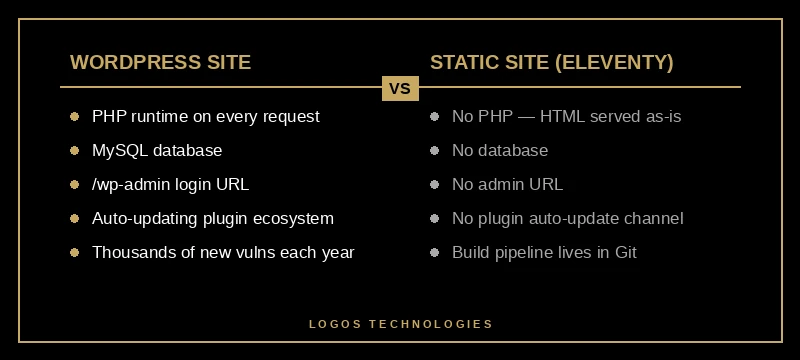
1. SQL injection. There is no database. Every SQL injection vulnerability in the OWASP Top 10 targets parameterized queries that don't exist on a static site. The classic ?id=1' OR '1'='1 attack pattern has nothing to attack.
2. Plugin remote code execution. No PHP interpreter is running on the server. Even if an attacker uploaded a malicious .php file via some misconfigured CDN endpoint, there is nothing to execute it. Plugin RCE was the dominant category of WordPress compromise in 2025 per Patchstack; on a static site, it's a non-event.
3. Admin login brute force. The single most-attacked URL on the public internet is /wp-login.php. A static site doesn't have an admin URL because content is edited in a Git repo (or a headless CMS like Decap or Sanity) and deployed via a build pipeline. There is no login page on the production site to brute-force.
4. Stale-software exploitation. The "exploit a 6-month-old plugin version" attack — which made up the majority of compromises in Sucuri's data — assumes there is software on the server with a version number. A static HTML file does not have a version number, a plugin registry, or a CVE feed. It is, in this very narrow sense, "done."
What you're left with is a much smaller surface: TLS configuration, HTTP security headers, DNS hijacking, and the integrity of your build pipeline and third-party scripts. Those are real concerns — and the next section covers them — but each is mechanical, version-pinned, and audit-friendly in a way the WordPress plugin model isn't.
Are static sites immune to attacks? No — here's what they can still be exploited for
If a sales page tells you a static site "cannot be hacked," close the tab. Static sites collapse most of the WordPress attack surface, but they do not eliminate it. Three categories of risk remain, and they all matter for a small business:
Client-side script injection (XSS via third-party scripts). If you embed a third-party widget — analytics, chat, a booking iframe — that vendor is now in your security model. If that vendor is compromised, your visitors can be compromised even though your origin server is fine. The mitigation is a strict Content Security Policy, which is structurally easier to write on a static site than on WordPress because you control every script tag at build time. A useful starting CSP for an Eleventy site is restrictive default-src 'self' plus explicit allow-lists for each third-party domain you actually need.
Build-pipeline compromise. If an attacker pushes a malicious commit to your Git repo, the next build will publish that commit. This is the static-site equivalent of a WordPress supply chain attack — except that it requires either a stolen developer credential or a malicious dependency, and the entire change is preserved in Git history for forensics. Use signed commits, branch protection on main, and a lock file for build dependencies. We covered this when explaining the architecture of the WordPress alternative.
DNS and domain-level attacks. If an attacker gains control of your registrar account, no amount of CDN-level security helps — they can repoint your domain to a phishing page in minutes. Use registrar 2FA, lock the domain, and turn on DNSSEC if your registrar supports it.
The honest summary is that static sites move the security problem up the stack: from server software (which you can't realistically keep current as a small business) to identity and supply chain (which a small business can keep current, because there are five or ten things to harden instead of a moving target of plugins).
How does Eleventy plus Netlify implement security for free?
A site built on Eleventy and deployed to Netlify inherits a security baseline that would cost a WordPress site real money in plugins and managed-hosting subscriptions:
- TLS is automatic. Netlify issues and renews Let's Encrypt certificates for every site without any configuration. The TLS version is current (TLS 1.3 by default), and HTTPS is enforced by HSTS.
- DDoS protection is included. Netlify mitigates both network-layer (L3/L4) and application-layer (L7) DDoS without a plug-in or paid add-on, which on a WordPress site would normally require Cloudflare in front and a security plug-in like Wordfence or Patchstack behind it.
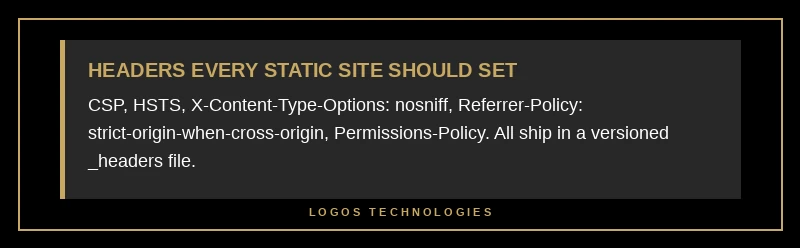
- Security headers are config-as-code. A
_headersfile in the Eleventy project adds Content Security Policy,X-Content-Type-Options: nosniff,Referrer-Policy: strict-origin-when-cross-origin, andPermissions-Policyon every response. These headers are versioned in the repo and reviewed in pull requests, not configured in a WP plugin admin UI. - No admin URL exists. Content edits happen in Git or a build-time CMS. There is no production
/wp-adminor/loginto defend.
That's the architecture we ship on every site we build at LOGOS. It is also the same architecture used by sites like the React documentation and large Jamstack deployments — the difference is that we ship it for small-business brochure sites where the WordPress security tax has always been disproportionately painful.
Frequently Asked Questions
Can a static website be hacked?
A static website can be defaced or have its DNS hijacked, but it cannot be hacked through the traditional CMS attack vectors — SQL injection, plugin RCE, admin login brute force — because those code paths don't exist on the server. The realistic threats are third-party script compromise, build-pipeline takeover via stolen credentials, and registrar/DNS account compromise. Each has a known, mechanical mitigation that does not require a security plug-in.
Is WordPress more insecure than other CMS platforms?
WordPress is not more insecure on a per-line-of-code basis — its core ships fewer vulnerabilities than its plugins do. The reason WordPress appears in ~90% of compromised CMS reports is the combination of dominant market share (43.5% of all sites) and an open plugin marketplace where Patchstack found 91% of new vulnerabilities in 2025. Other CMSes look "safer" mostly because they are smaller targets with smaller plugin ecosystems, not because their code is more careful.
Do I need a WAF or security plugin for a static site?
For a typical small-business static site on a managed host like Netlify, no. The L7 DDoS protection, automatic TLS, and absence of dynamic code paths mean the security work that a WordPress site outsources to a WAF (mod_security rules, login throttling, malware scanning) has no equivalent thing to protect on a static site. The exception is if you add a serverless function or third-party form handler that processes user input — in that case, you secure that specific function, not the whole site.
What about a managed WordPress host like WP Engine or Kinsta?
Managed WordPress hosts reduce some risk — they patch core promptly, ban known-bad plugins, and offer malware cleanup. They do not change the underlying architecture, so the 91% plugin-vulnerability share still applies inside your site, and you still pay an ongoing security tax in subscriptions, monitoring, and clean-up retainers. If your content workflow truly needs WordPress (a large editorial team, a specific WP-only plugin), managed hosting is the right answer. For most small-business brochure sites, the static path is cheaper, faster, and structurally more secure.
Next reads if you are ready to move
If everything above lines up with your situation, the next read is the step-by-step migration guide from WordPress to a static site, and the explanation of why static sites are structurally faster and what a modern static site generator looks like for a small business in 2026.
LOGOS Technologies builds fast, static, hand-coded websites for small businesses — based in Papillion, Nebraska, working with clients nationwide. If you've been quietly worried that your WordPress site is one stale-plugin update away from a clean-up bill, the right next step is a real conversation, not another plugin. See our web design services or contact us to talk through whether a static rebuild makes sense for your business.