


Electrician Website Design That Converts: What Actually Drives Calls in 2026

Table of Contents
TL;DR — Quick Hits
- Roughly 75% of electrical service searches happen on a phone, and 53% of mobile visitors abandon a site that takes longer than 3 seconds to load.
- "Electrician near me" gets around 230,000 searches per month in the US, and the businesses winning those clicks rank in Google's local 3-pack, not just on the blue links.
- Google Business Profile signals account for roughly 32% of local pack rankings — your website is only half the lead-generation equation.
- The top three local-pack electricians in most markets average 200+ Google reviews, and 48% of consumers say they won't consider a business under 4 stars.
- Specialized electrician landing pages can convert up to 232% better than sending paid traffic to a homepage.
The average electrician website I audit was built by a generalist template shop, runs on WordPress with 14 active plugins, and posts a Largest Contentful Paint of 4.8 seconds on a mid-range Android over 4G. That is not a website. That is a leak. Every second past the 3-second mark is roughly half your mobile traffic walking away — and per Google's own field data referenced in the Web Almanac's performance chapter, fewer than half of mobile pages pass all three Core Web Vitals thresholds. The trades are well below that average.
Electricians don't get hired the way SaaS gets bought. Nobody is reading a 12-paragraph landing page about your company values before they call. They're standing in a dark kitchen with a tripped breaker, or staring at a smoking outlet, or trying to figure out whether the EV charger install needs a permit. They want a phone number, a license number, a price ballpark, and proof you're not going to ghost them. The job of an electrician website in 2026 is to surface those four things inside the first viewport and load fast enough that Chrome's main thread doesn't time out before the tap-to-call button paints. Everything else is decoration.
Why Most Electrician Websites Don't Get Phone Calls
The honest answer is that most electrician website design projects were never built to generate calls. They were designed to look professional. Those are different jobs. A site that looks professional optimizes for the homeowner who clicks through three pages reading about the company's history. A site that converts optimizes for the homeowner whose breaker just popped at 9pm and has 90 seconds of patience before they hit back and try the next result.
The pattern that kills conversion rates: hero carousel rotating through "About Us / Services / Contact" headlines on a 5-second loop, a contact form with 11 fields, no visible phone number above the fold on mobile, and a Lighthouse mobile score around 32. I see the exact same pattern across electricians, plumbers, and HVAC contractors — which is exactly why generic industry-specific website design templates fail for the trades. A real estate template repurposed into an electrician site never had emergency-call psychology built into the layout.
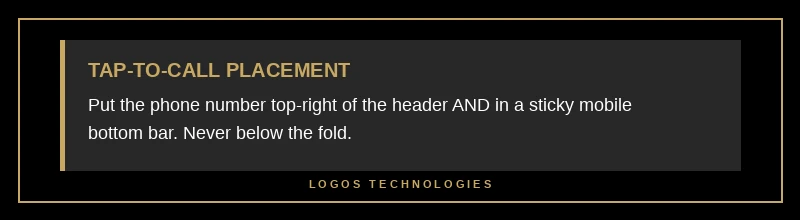
The fix is not subtle. Phone number top-right of the header, tap-to-call linked. Sticky bottom bar on mobile with "Call Now" and "Request Quote." License number and city next to the logo. Three primary services in icon cards on the homepage. A single short contact form below that — name, phone, what's the problem — three fields, not eleven. And the entire homepage in under 100KB of JavaScript so it actually paints.

What Does a High-Converting Electrician Website Actually Look Like?
A high-converting electrician website does five things in the first viewport on a phone: it says what kind of electrician you are (residential / commercial / industrial), it says where you work, it shows a license number, it shows a phone number you can tap, and it shows whether you handle emergency calls. Nothing else above the fold. Trust signals — reviews, certifications, project gallery — come immediately below, but they are not what gets the call. The phone number gets the call.
Below the fold, the structure that converts is service-page-per-job, not one giant Services page. "Panel upgrade," "EV charger installation," "ceiling fan install," "generator install," "rewire" — each gets its own page with its own H1, its own schema, its own price-range FAQ, and its own internal link from the homepage. This is also how you rank for the specific search a homeowner is typing. Nobody types "electrician services." They type "EV charger installation near me." If you have a page for that exact intent, you can rank for it.
The other piece most templates miss is the gallery. Not stock photos. Actual on-site photos of completed panels, labeled service panels, finished EV chargers, generator pads. Phone-quality is fine — homeowners are pattern-matching to "this looks like a real electrician who has done this work," not "this looks like a Squarespace landing page." A gallery of 15 real project photos beats a $4,000 photo shoot for conversion because it reads as trustworthy, not staged.
The Speed Threshold: How Fast Your Site Has to Be
Page speed is not a vanity metric in electrician website design. It is the single highest-impact lever on conversion you have, because emergency-search traffic has the lowest patience of any segment on the web. Google's own Core Web Vitals guidance puts the LCP threshold at 2.5 seconds — meaning your largest above-the-fold element (usually the hero image or H1) needs to paint inside 2.5 seconds on a slow 4G connection. INP needs to land under 200ms. CLS needs to stay below 0.1. Miss any of those and you fail the Core Web Vitals assessment that feeds into Google's ranking signals — which we cover in detail in our website speed optimization guide.
The depressing reality is that most WordPress-based electrician sites are LCP-failing out of the box. The theme ships with a slider plugin, the slider plugin pulls in 600KB of JavaScript, the JavaScript blocks the main thread for 1.2 seconds, the LCP element waits, and your site posts a 4.5-second LCP on a Pixel 6a over 4G. The fix is rarely "buy a faster host." It's "stop shipping 600KB of slider JavaScript." Or — and this is the path we recommend — stop using a CMS that requires fighting plugin sprawl to hit performance targets in the first place. A hand-coded static site built with Eleventy will out-perform almost any WordPress install on Core Web Vitals because there's no PHP, no plugin chain, and no database query path between the homeowner and the HTML. See our practical walkthrough on how to improve LCP for the specific techniques we use.
Local SEO and Google Business Profile: The Other Half of the Equation
You can ship the fastest electrician site in the country and still get zero leads if you ignore Google Business Profile. According to Whitespark's annual local ranking factors survey, Google Business Profile signals account for roughly 32% of local pack rankings — the largest single category, ahead of on-page signals, link signals, and review signals individually. The local 3-pack (those three map results above the organic links) gets the bulk of click volume for "electrician near me" searches. If you're not in it, the website itself almost doesn't matter for local jobs.
The GBP fundamentals are straightforward but neglected: complete every field, pick the correct primary category (Electrician, not Electrical Contractor — the categories are different), upload real photos weekly, post updates twice a month, and aggressively ask happy customers for reviews. The top three local-pack businesses in most markets average over 200 Google reviews, and 87% of consumers read reviews before booking — with 48% saying they won't consider a business under 4 stars. That's not a marketing platitude. That's the conversion math for your category. Our full breakdown on Google Business Profile optimization covers the specific fields and posting cadence that move the needle.

The website still matters, though — for two reasons. First, your GBP listing links to your homepage, and a slow or broken homepage tanks the prominence signal Google uses to rank you locally. Second, the long tail of specific searches — "panel upgrade cost," "EV charger install permit," "generator wiring diagram" — drives qualified, high-intent traffic that the 3-pack doesn't capture. A real, technical-SEO-clean site picks up that long tail, and the patterns are the same ones that work for plumber websites, HVAC sites, and general contractor sites — the trades all live in the same search ecosystem, and an effective industry-specific website design recognizes that.
What to Stop Doing on Your Electrician Website
A short list of electrician website design patterns I see every week that are costing calls: rotating hero carousels (kills LCP, splits attention), contact forms with more than 4 fields (every additional field drops submit rate ~7%), no tap-to-call link (the phone number is text, not a tel: link — you cannot tap it), stock photos of "electricians" that are clearly models in costumes (kills trust instantly), service descriptions written in third person ("ABC Electric provides quality service to our valued customers"), and a Services page that lists 47 services in a flat bulleted list with no individual pages or schema. Every one of those is fixable without redesigning the whole site.
The one I want to flag specifically: the live-chat widget. I know they're popular and the salesperson promised they'd 3x your leads. In practice, on an electrician site, they cost more than they earn. The third-party chat widget loads 200-400KB of JavaScript, blocks the main thread, tanks INP, kills LCP, and the homeowner trying to call you at 9pm doesn't want to type to a chatbot — they want to dial. Pull the chat widget. Make the phone number the obvious primary CTA. Conversion rate goes up.
Frequently Asked Questions
How much does a custom electrician website cost?
Custom electrician websites typically run $3,500-$12,000 for the initial build, depending on page count and whether the developer is also doing photography, copy, and local SEO setup. Template-based sites on Wix or Squarespace can run $500-$2,000 plus ongoing platform fees. The cheaper option is almost always more expensive in 18 months — slow load times and rigid templates mean lost calls, and lost calls compound. A single missed emergency call on a Friday night is more revenue lost than the difference between a $1,500 template build and a $5,000 custom build.
Do electricians need a website if they have a Google Business Profile?
Yes. Google Business Profile drives local-pack visibility, but the homepage your GBP links to is itself a ranking signal — if it's slow, broken, or thin, your GBP ranks worse. More importantly, GBP doesn't capture the long-tail searches ("EV charger installation cost," "200 amp panel upgrade") where the higher-margin work lives. A clean, fast website is what turns those specific searches into qualified leads, and is the surface where you actually convert traffic into booked jobs.
What is the best platform for an electrician website?
The honest answer is that the platform matters less than the build quality, but the practical answer is: static-site generators (Eleventy, Astro, Hugo) give you the best Core Web Vitals out of the box with the least maintenance overhead, and that translates directly to higher conversion rates and better local-SEO performance. WordPress can work but requires aggressive plugin discipline and a fast host. Wix and Squarespace work for the smallest one-person shops but hit a ceiling on speed and SEO that limits growth.
How long does it take to rank an electrician website on Google?
For "electrician near me" and similar local-pack searches, a properly-optimized Google Business Profile with active reviews can rank within 4-8 weeks. For organic blue-link rankings on competitive terms like "electrician [city name]," realistic timelines are 4-9 months — assuming consistent content, schema markup, citation building, and review velocity. The trade-off is that organic rankings, once earned, are more durable than paid-ads spend and compound over time.
Ready to Build a Site That Actually Books Jobs?
LOGOS Technologies offers custom, hand-coded electrician website design out of Papillion, Nebraska — fast static sites engineered to pass Core Web Vitals on day one, paired with the local-SEO and GBP groundwork that gets you into the 3-pack. No template, no plugin sprawl, no live chat that tanks your INP. Just a site built for the homeowner standing in front of a tripped breaker at 9pm. See our web design services or contact us to talk through what your build would look like.