


Plumber Website Design That Actually Drives Calls in 2026

Table of Contents
TL;DR — Quick Hits
- Roughly 800,000 U.S. searches a month for "plumber near me" — almost all on mobile, almost all in emergency mode.
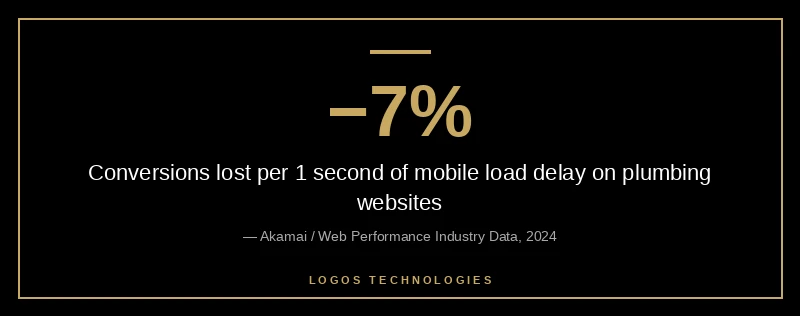
- A 1-second load delay cuts plumbing site conversions by about 7%. Three seconds and 53% of mobile visitors bail.
- Click-to-call buttons in the header, sticky on mobile, are non-negotiable. Three CTA types in view raises conversion by ~30%.
- Google's March 2026 update lowered the "good" LCP threshold to 2.0s. Most WordPress plumber templates can't hit that.
- Service-specific pages (water heater, drain cleaning, sump pump) outrank generic "plumber" pages because that's what homeowners actually type.
Plumbing website design is one of the few service industries where speed isn't a nice-to-have. It's the entire conversion funnel. A homeowner with water spreading across the kitchen floor isn't going to read your "About Our Family-Owned Business" copy. They're going to grab their phone, type "emergency plumber near me," tap the first result that loads, and call whoever answers first. If your site is on the second or third tab they open, you don't exist.
The data backs this up bluntly. Search volumes for plumbing services in the U.S. run close to 2.9 million queries per month, with around 800,000 of those being "plumber near me." Roughly 46% of all Google searches now have local intent, and 53% of mobile users abandon any site that takes longer than three seconds to load. For an emergency service, "abandon" means "called your competitor." Pretty much every conversion lever for a plumber website starts there.
What plumber website design actually has to do
A plumber website has one primary job: convert a panicked homeowner into a phone call within five seconds. Everything else is secondary. The design has to make a phone number visible above the fold on mobile, load fast enough that the visitor never sees a spinner, and answer "are you the right plumber for this specific problem in my specific area" without forcing them to read.
That sounds obvious, but most plumbing sites get it wrong because they were built for the wrong audience. Generic small-business templates were designed to look impressive to other business owners shopping for templates. They prioritize hero photos, parallax scrolling, and service grids that look great in a portfolio. They do not prioritize a click-to-call button that thumb-reaches on a 4.7-inch screen at 11 p.m. This is the same gap we covered in our pillar on why one-size-fits-all templates fail in industry-specific website design — the buyer journey for a plumber is fundamentally different from the buyer journey for a coffee shop, and the website has to reflect that.
The good plumbing sites I see in 2026 share a small list of traits: a phone number in the header that's a real tel: link, an emergency-service banner, a service area block that names actual cities and neighborhoods, social proof above the fold (Google rating + review count, not a stock-photo "Trusted by 1000s"), and individual pages for each service so Google can rank them for specific queries.
How fast does a plumber website have to be?
Faster than you think. A plumber website needs a Largest Contentful Paint under 2.0 seconds on a mid-tier Android over 4G — that's the new "good" threshold Google rolled out in its March 2026 Core Web Vitals update. Hitting that on a WordPress template stuffed with sliders, popups, and tracking scripts is essentially impossible without a serious cleanup. Most plumbing companies' WordPress sites I audit clock in at 4–7 seconds on mobile, which means they're losing at least half their potential customers before the page even paints.
The conversion math is brutal. A 1-second delay reduces conversions by about 7%. For a plumbing company doing $30,000/month in jobs, that's roughly $25,000 a year leaving on the table for every second of slowness. Stretch that to the 3-4 seconds that's typical for a templated plumbing site and you're talking about a site that's costing more in lost calls than it ever could have cost to build.
This is why the static-site architecture we use at LOGOS exists. A static plumber website serves prebuilt HTML directly from a CDN — no PHP, no database queries, no plugin chain — which means the homepage paints in well under a second on cellular. We covered the speed mechanics in detail in our guide on why fast website design has to be built in, not bolted on, but the short version: speed is an architecture decision, not an optimization plugin you install later.
Click-to-call placement is the entire conversion funnel
If a plumber website has one element that matters more than any other, it's the click-to-call button. In emergency mode, homeowners do not fill out forms. They do not read. They tap the first phone number they see. Three placement rules cover most of what works in 2026:
The phone number lives in the header on every page, large enough to thumb-tap without zooming, formatted as a tel: link so a tap auto-dials. On mobile, a sticky bottom bar duplicates that button so it's always visible no matter how far down the visitor has scrolled. And on the homepage hero, a third visible CTA — usually a contact form for non-emergencies or scheduling — gives the small subset of visitors who aren't in panic mode somewhere to land.
Implementing three distinct CTA types raises overall conversion by about 30% (per industry conversion-optimization analyses) because it covers the three modes of plumbing inquiry: emergency (call now), non-urgent service (book online), and price-shopping (request a quote). Each mode has a different urgency level, and one button cannot serve all three.
The mistake I see most often: a phone number that displays as plain text instead of a clickable link. On desktop that doesn't matter much. On mobile, where 70%+ of plumbing traffic now sits, it kills conversion outright. The visitor has to memorize the number, switch apps to the phone dialer, and key it in manually. About a third of them give up at that step.
Why service-specific pages outrank generic "plumber" pages
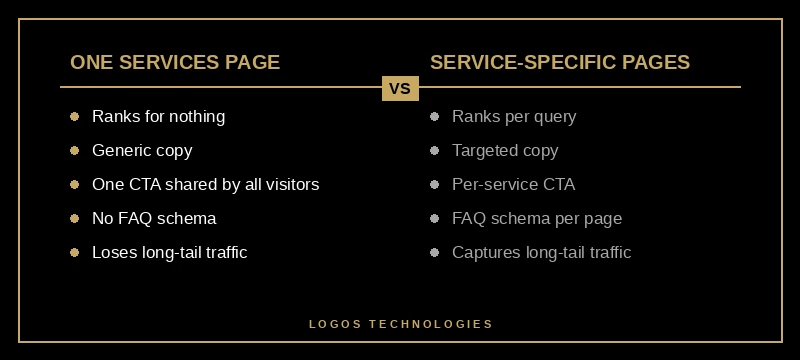
Plumbers usually publish one page called "Services" with a bulleted list of everything they do. That page ranks for nothing. The reason: homeowners don't search for "plumber." They search for "burst pipe repair near me," "tankless water heater installation," "sewer line camera inspection cost," "garbage disposal won't drain." Those are different keywords with different search intent, and Google ranks one page per query.
A plumbing site with seven dedicated service pages — each one targeting a specific problem with its own H1, FAQ section, and structured data — will outrank a site with one Services page every single time. Each page becomes a separate ranking opportunity. Each one captures a different cluster of long-tail queries. Each one has its own click-to-call CTA, its own service-area list, its own trust signals.
The structure that works in 2026 is the cluster pattern — a service hub page that links to deeper individual service pages, all of which link back to the hub. We dig into the mechanics in our Google Business Profile optimization guide for 2026, but for plumbers specifically: GBP categories should match your top three service pages exactly, and your GBP service descriptions should mirror your on-site service-page content. When Google's AI Overview is asked "who fixes burst pipes in [city]," it pulls from the GBP listing whose categories and on-site content most consistently say "burst pipe repair."
Trust signals that actually move plumbing conversion
86% of consumers verify online reviews before hiring a plumber. That number alone tells you what to put above the fold: a real Google rating with the actual review count, not a generic "5 stars" badge. Below that, license number and bonded/insured status need to be visible without scrolling, because in plumbing that's a regulatory requirement in most states and a credibility marker in all of them.
The trust elements that move the needle for plumbing specifically are not the ones generic templates emphasize. Stock photos of smiling families don't help. Real photos of your actual trucks, your actual technicians in branded uniforms, your actual completed jobs do. So does naming the local cities and neighborhoods you serve — not in a SEO-stuffed footer, but in service-area copy that reads naturally. So does a written service guarantee with a specific timeframe (e.g., "100% satisfaction or we re-do the work within 30 days") rather than vague "we stand behind our work" language.
I also recommend embedding the Google review widget rather than copying reviews as text. Google's own crawlers verify the reviews are real, which compounds with the GBP signal and feeds the AI Overview. Static copies of reviews — even real ones — don't carry the same weight in 2026 because search engines can't independently verify them.
Frequently Asked Questions
How much should a plumber spend on website design in 2026?
For most independent plumbers and small plumbing companies, expect to spend somewhere between $1,500 and $6,000 for a custom-built site, plus ongoing hosting and maintenance. Templated builders run cheaper upfront but cost more long-term in lost conversions from slow load times and weak local SEO. We break down the numbers in how much a small business website actually costs in 2026.
Do plumbers really need a website if they have Google Business Profile?
Yes. GBP drives the "near me" map results, but Google's AI Overview and organic results still favor businesses that have a fast, well-structured website backing up the GBP claims. Without a website, you're capped at whatever traffic GBP alone delivers — and competitors with strong sites will outrank you on every non-map query.
What's the most important page on a plumber website?
The homepage is the most-visited page, but the highest-converting pages are typically individual service pages targeting urgent problems (burst pipe, water heater leak, no hot water). Those visitors arrived on a specific keyword in emergency mode, which means they have the highest call intent on the site. This page-specificity rule is universal across trades — it's the same pattern we cover in our overview of industry-specific website design and why generic templates underperform.
Why is mobile speed so much more important for plumbers than for other businesses?
Because plumbing inquiries are overwhelmingly emergency-mode. Most service businesses get a mix of casual browsers and urgent buyers. Plumbing skews toward the urgent end — a homeowner with water on the floor isn't going to wait three seconds for your hero image to fade in. They'll abandon and call the next plumber on the list. Mobile speed isn't a nice-to-have here; it's the funnel.
How do AI Overviews affect plumber SEO in 2026?
AI Overviews now answer many plumbing-related queries directly on the search results page, but for transactional "near me" queries they redirect users to local business listings. The plumbers who win cited mentions in AI Overviews are the ones with consistent NAP (name, address, phone) data across their website, GBP, and major directories — and with FAQ-style structured content on individual service pages that LLMs can quote directly.
Get a plumber website that actually books jobs
If your current plumbing site loads in four seconds on mobile, doesn't have a click-to-call button in the header, or sends every service to a single "Services" page, it's costing you money every day it stays up. At LOGOS Technologies, based in Papillion, Nebraska, we hand-build static plumber websites that load in under a second, rank in local map packs, and turn emergency searches into booked jobs. See our web design services for what's included, or contact us and we'll audit your current site for free.