
How Much Does a Small Business Website Cost in 2026? The Honest TCO Breakdown

Table of Contents
TL;DR — Quick Hits
- A small business website in 2026 typically costs $500 to $5,000 for DIY/freelance and $6,000 to $15,000 with an agency, plus $1,100 to $5,000 per year in recurring costs.
- The "sticker price" is roughly half the real spend over 5 years once hosting, security, plugin renewals, and a mid-cycle redesign are added.
- A 1-second delay in load time cuts conversions by ~7% — the cheapest tier of website often costs more in lost revenue than it saves in build cost.
- Websites that load in 1 second convert 3x more than ones that load in 5 seconds, which is why "what your money buys" matters more than the headline number.
- Most small businesses overpay for visual polish and underpay for performance, accessibility, and SEO infrastructure — the things that actually drive ROI.
If you ask ten web design firms "how much does a small business website cost," you'll get ten different answers — and most of them are technically correct. The honest answer in 2026 is that a professional small business build runs anywhere from a few hundred dollars a year on a DIY builder to $35,000+ at a full-service agency, with most owners landing between $3,000 and $15,000 for the initial build. What almost none of those quotes include is the 5-year total cost of ownership, which is where the real number lives.
This guide breaks down what you'll actually pay, what each tier really buys you, and the hidden costs that turn a "$2,000 website" into a $10,000 website by year three. If you'd rather start with the broader picture of return on investment, our pillar guide on how to measure website ROI for small businesses walks through the metrics that determine whether any of these numbers are worth it.
How much does a small business website cost in 2026?
A small business website in 2026 costs roughly $500 to $5,000 for a DIY or freelance build and $6,000 to $15,000 with a professional agency, with high-end custom builds reaching $35,000 or more. On top of that initial build, expect $1,100 to $5,000 per year in recurring costs for hosting, domain, security, backups, plugin licenses, and maintenance.
That's the headline range, but the spread inside it is enormous. The same $5,000 can buy you a polished template-based WordPress site or a hand-coded static site that loads in under a second, ranks for competitive keywords, and converts at twice the rate. Price alone tells you almost nothing about quality.
What you actually get at each price tier
The four tiers below represent how the market is segmented in 2026. Pay attention to what's included beyond pixels — performance, accessibility, schema markup, and a content strategy are the things that move revenue.
DIY website builders ($16–$50/month, $200–$600/year)
Wix, Squarespace, and Shopify's built-in builders give you a working website fast. You pay between $16 and $50 a month, and you'll have something live in a weekend. The trade-off is what's under the hood: most builders ship 1–3 MB of unused JavaScript per page, which tanks Core Web Vitals and pushes you down in mobile rankings. Lock-in is the other catch — your design and content are stuck inside the platform, and migrating off later costs more than building elsewhere from the start.
Freelance web designer ($1,500–$4,000)
A freelancer typically delivers a 5–10 page WordPress or Webflow site for $1,500 to $4,000. You usually get more visual polish than DIY, but quality varies wildly. The freelance tier is where most "I have a website but it doesn't bring in business" stories come from — the designer hands off a pretty template, and nobody owns ongoing performance, SEO, or content strategy after launch.
Boutique agency / professional shop ($6,000–$15,000)
This is where most growing small businesses land. A boutique shop builds a custom or semi-custom site, handles SEO foundations, sets up analytics, and offers a maintenance plan. Quality still varies, but you're paying for someone who reads Google's Core Web Vitals documentation and bakes performance in from day one rather than bolting it on.
Full-service agency ($15,000–$35,000+)
At this tier you're getting strategy, brand, custom design, content, technical SEO, and ongoing optimization. It's worth it for businesses with a real growth plan and the marketing budget to support it. For most small businesses, it's overspending on polish.
What hidden costs do most pricing guides skip?
The biggest gap in most "how much does a website cost" articles is what happens after launch. Recurring costs add $1,100 to $5,000 per year for hosting, domain renewal, SSL, security tools, backup services, premium plugin licenses, and basic maintenance. Skip the maintenance and your contact form silently breaks, your shopping cart stops accepting payments, or — worst case — your site gets compromised and Google flags it.
There are four cost buckets nobody talks about up front:
Plugin and theme renewals — On WordPress, premium plugins (forms, sliders, security, SEO) auto-renew at $50–$200 each per year. A typical site has 15–25 plugins. That's $300–$1,500/year just to keep features working.
Performance debt — A slow website costs money every day. According to Cloudflare's analysis of website performance and conversion rates, a 1-second delay in page load time can reduce conversions by 7%. Portent's research on site speed found that pages loading in 1 second convert about 3x better than pages loading in 5 seconds. We covered this in detail in page speed and revenue: what the data actually shows, but the short version is that the "cheap" website that loads in 6 seconds is often the most expensive option you can choose.
Mid-cycle redesign — Most small business sites need a meaningful refresh every 3–4 years to keep up with design trends, mobile patterns, and Core Web Vitals thresholds. A second build at year 3 doubles your effective spend if you didn't pick a stack designed to age well. Our guide on when you actually need a website redesign goes deeper on the signals that mean it's time.
Compliance and accessibility — ADA-related lawsuits over inaccessible websites have continued climbing, and small businesses are increasingly named in them. Retrofitting accessibility onto a site that wasn't built for it costs more than building it in. So does retrofitting schema markup, structured data, and the technical SEO foundation that determines whether you show up on Google at all.

What's the 5-year total cost of ownership?
This is the calculation almost no pricing guide does. Here's what the same business might spend over five years on three different paths, holding all other variables steady:
DIY builder path: $40/month x 60 months = $2,400, plus a likely platform migration at year 3–4 ($3,000–$5,000) when you outgrow the builder. 5-year TCO: ~$5,400–$7,400.
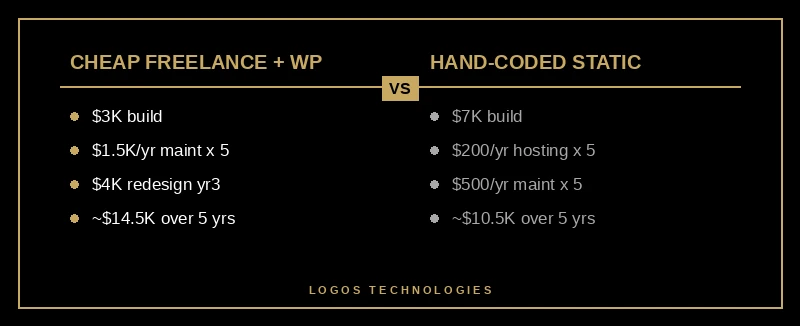
Cheap freelance + WordPress path: $3,000 build + $1,500/year maintenance x 5 + a $4,000 redesign at year 3. 5-year TCO: ~$14,500.
Hand-coded static site path: $7,000 build + $200/year hosting x 5 + light maintenance ($500/year x 5). 5-year TCO: ~$10,500, with no forced redesign because the stack ages well and Core Web Vitals stay green.
The middle path — the one most small businesses pick — is usually the most expensive. It looks cheap on day one and bleeds money for the next 1,800 days. A more durable architecture (we wrote about why in our piece on hand-coded custom web design) tends to be the cheapest option once you do the math past year one.
How do I budget for a website that actually pays for itself?
Start with the revenue your website needs to generate, then back into the budget. If your average customer is worth $500 and your site needs to drive 5 new customers a month to be worth its cost, your math changes completely depending on whether you're spending $200/month or $20,000 up front. The cheapest site that fails to convert is more expensive than a more expensive site that does.
Three rules of thumb for budgeting in 2026:
- Allocate 60% of your spend to performance, SEO infrastructure, and content strategy — the things that drive traffic and conversions. Visual polish is the last 20%, not the first 80%.
- Plan for 5 years, not for launch. Hosting and maintenance are not "extras." They're 30–40% of the real cost.
- Pick a stack designed to age well. Static-site architecture (Eleventy, Astro, Next.js as static export) doesn't accumulate plugin debt the way WordPress does, which is the single biggest cost driver in the freelance/agency tier.
If you want a deeper read on what drives website ROI past the price tag, we covered the conversion side in website conversion optimization: how to turn more visitors into customers and the underlying philosophy in what is an SEO-optimized, high-quality website worth.
Frequently Asked Questions
Can a small business get a good website for under $1,000?
You can get a functional website for under $1,000 using a DIY builder, but it almost certainly won't be optimized for Core Web Vitals, accessibility, or organic search. For a business that depends on its website to bring in leads, the under-$1,000 tier usually loses you more in conversions than it saves in build cost. It's fine as a placeholder while you raise the budget for a real site.
Why is one $5,000 website worth way more than another $5,000 website?
Because price doesn't reveal what the money bought. Two sites at the same price can have wildly different load times, mobile experiences, schema markup completeness, and ongoing maintenance plans. Ask any vendor for their target Lighthouse scores, their approach to LCP and INP, and whether they hand-code or stack a builder. Those answers determine whether your $5,000 buys an asset or a liability.
Is WordPress still the right choice for a small business website in 2026?
WordPress still powers a huge share of the web, but for a small business prioritizing speed, security, and low maintenance overhead, a static-site architecture is usually a better fit in 2026. We compared the trade-offs in our guide on custom website design vs. templates. WordPress is still defensible for content-heavy publications and stores with complex plugin needs.
How much should I spend on ongoing maintenance?
Plan on $1,100 to $5,000 per year for a small business website, depending on the stack. WordPress sites with many plugins land near the top of that range; static sites with simple hosting land near the bottom. The cheapest stack to maintain is the one that needs the least maintenance — which is usually the stack that costs more to build well up front.
Does a more expensive website rank better on Google?
Not directly, but indirectly yes. Google ranks sites based on Core Web Vitals, content quality, schema markup, internal linking, mobile experience, and authority signals. A more expensive build is more likely to ship those things correctly, but plenty of expensive sites get them wrong and plenty of cheaper builds (especially hand-coded static ones) nail them. The price tag isn't the signal — what's under the hood is.
The bottom line — and a Papillion-Nebraska note
A small business website in 2026 costs what you make of it. The sticker price is the start of the conversation, not the end. Spend on performance, content, and SEO infrastructure first; spend on visual polish last. And do the 5-year math before you sign anything.
At LOGOS Technologies in Papillion, Nebraska, we build hand-coded static websites designed to load fast, rank well, and stay maintainable for the long haul — without the recurring plugin debt that turns "cheap" sites into expensive ones. If you'd like a straightforward conversation about what a site that pays for itself actually looks like for your business, take a look at our web design services or contact us directly. We'll give you a real number, and we'll show you what's behind it.