Does My Business Need a Website in 2026? What the Data Says

Table of Contents
About one in four U.S. small businesses still operates without a website. The usual reasoning goes something like this: "I have a Google Business Profile, I'm on Facebook, I get most of my work through referrals, and I can't justify the expense." It is a reasonable argument. It is also, in 2026, a costly one.
If you have been asking yourself "does my business need a website?" — the short answer is yes for almost every small business, but the more useful answer is the one that explains why, and where the returns actually come from. The data is clearer than it has ever been, and the economics of building a site have shifted enough that a lot of the old objections no longer hold up.
Does my business need a website if I already have Google Business Profile and social media?
This is the most common version of the question, and it deserves a direct answer. A Google Business Profile plus a Facebook page is better than nothing. It is not a substitute for a website, and treating it like one leaves measurable money on the table.
Here's what those platforms cannot do:
Google Business Profile only appears on Google Search and Google Maps. It does not show up on Bing, DuckDuckGo, Yahoo, or any AI-generated answer experience that draws from the broader indexable web. It also gives you almost no control over layout, messaging, or lead capture — you're working inside Google's template, with Google's limits. Facebook requires visitors to have or create an account to see most of your content in any depth. And neither platform belongs to you. If Google changes its policies or Facebook's algorithm quietly stops showing small business posts, your visibility goes with it.
A website is the one piece of your online presence that you actually own. Everything else is rented infrastructure.
The trust problem: what happens when someone hears about you
The strongest case for a website has nothing to do with SEO. It's about what happens in the moment right after somebody hears your business name.
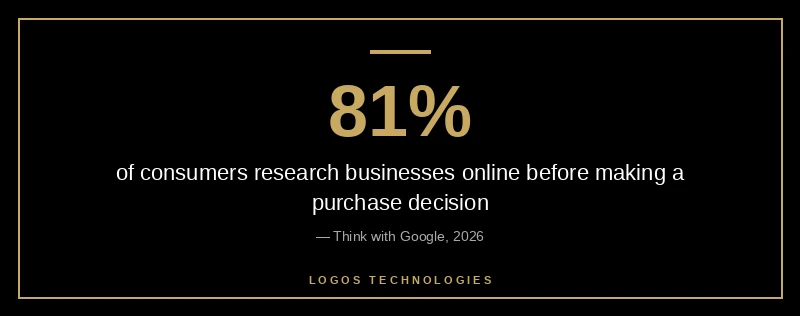
According to Think with Google's research on shopping behavior, a large majority of consumers research products online before making a purchase — and that behavior applies to local services just as much as it does to products. When a friend recommends a contractor, a dentist, or a lawyer, the first thing most people do is search the name. If what comes back is a bare Google Business Profile, a Facebook page that was last updated in 2022, and nothing else, the prospect silently drops out of the funnel.
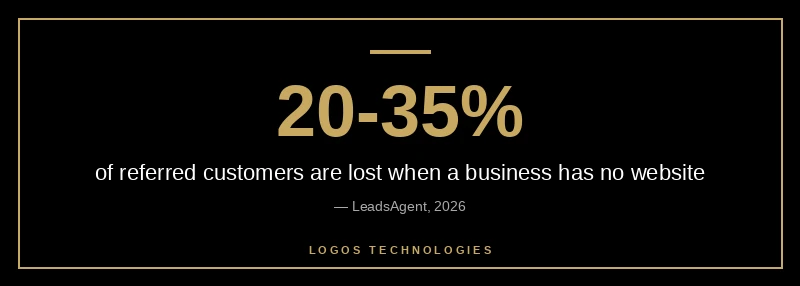
This is what industry analysts sometimes call the "verification step," and it is quantifiable. A local business without a website loses an estimated 20 to 35 percent of referred customers during that verification step — people who heard about the business from a trusted source and were ready to buy, until they couldn't verify the business looked real. That is not a tiny leak. That is a full quarter of your warmest leads disappearing before you ever knew they existed.
Contact information is a big part of this. Roughly 62 percent of consumers consider visible contact details the single most important thing on a website, and around 67 percent of users abandon a site entirely if they can't find contact information quickly. A Google listing shows a phone number, but it does not show who you are, what work you have done, what your prices look like, or whether you sound like a company that takes itself seriously. A website does all of that at once.
The revenue question: what a website is actually worth
"Does my business need a website?" is often really the question "is a website worth paying for?" It helps to separate those two.
A Google and Deloitte study of thousands of small businesses found that digitally advanced firms — the ones using a website, analytics, and online marketing as connected tools rather than standalone brochures — experienced roughly four times the revenue growth of their digitally disengaged peers. They were also nearly three times more likely to report higher customer interest and more sales inquiries year over year.
That multiplier doesn't come from the website existing. It comes from what the website lets you do: capture leads directly, measure which channels are working, rank for search terms your competitors are paying for, and build an email list that you own. We've covered the measurement side of this in our guide on how to measure website ROI for a small business — the short version is that the return on a well-built site is almost always larger than owners expect, because most of the value shows up in leads that would have otherwise gone to a competitor.
The second reason the revenue math has shifted: getting in front of people searching on Google is no longer optional. Organic search is how a huge share of local buying decisions start, and without your own site, there is nothing for Google to rank. A Google Business Profile can show up in map packs for geo-targeted searches, but it cannot rank for the long-tail informational queries that drive real organic traffic — "how much does a new roof cost," "do I need a permit for a bathroom remodel," "what's the difference between crown and bridge dental work." Those visits are how small businesses build a pipeline that isn't dependent on ads.
What about the cost objection?
Cost is the most common reason small businesses give for not having a website. It was a fair argument a decade ago. It is not a fair argument now.
Modern static websites — the kind built on generators like Eleventy, Astro, or Next.js with static export — cost dramatically less to host and maintain than the old WordPress stack most owners are picturing in their heads. Static sites don't need a database, don't require security patching every few weeks, and don't charge recurring plugin license fees. Hosting on a platform like Netlify or Cloudflare Pages is often free or in the single-digit dollars per month. We broke down the stack in more detail in our post on the best WordPress alternative for small business websites, but the takeaway is straightforward: the ongoing cost of a modern static site is a fraction of what WordPress hosting ran in 2019.
Performance is the other side of the same coin. The average WordPress site loads in 3.5 to 5 seconds on mobile. A well-built static site loads in under a second and routinely scores 95 to 100 on Core Web Vitals. That speed difference is not cosmetic — it is the difference between the prospect reading your pitch and the prospect bouncing before the page even finishes. We dug into the numbers behind this in our post on page speed and revenue.
In other words: if your last quote for a website was several thousand dollars upfront plus ongoing hosting, plugin, and maintenance fees, that quote was built on an older, heavier architecture. The modern answer is faster, cheaper, and requires less fiddling.
When a website actually isn't worth it
I want to be honest about this, because nothing burns trust with a business owner faster than pretending every company needs the same thing. There are a few narrow cases where a website is genuinely low priority.
If you are a solo trades worker booked six months out entirely through word of mouth, and you have no interest in growing, a single-page site with contact info is probably enough. If you're running a purely B2B consulting practice where every engagement comes from LinkedIn referrals and networking, a robust LinkedIn profile may carry more weight than a marketing site. If you're selling on a platform like Etsy or Amazon exclusively and have no plans to diversify, the platform's product pages can substitute for a storefront.
But even in these cases, "no website" is a fragile position. Platforms change their rules. Referral networks age out. AI-driven search is already reshaping how people discover services, and the sites that show up in those answers are the ones with real, indexable content. A lightweight static site is cheap insurance against all of those scenarios.
What a modern small business website actually looks like
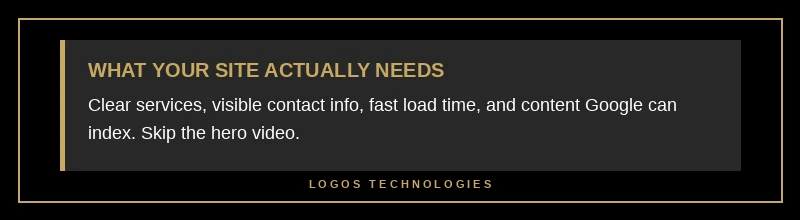
If you've decided your business does need a website, the next question is what kind. The answer, for almost every small and mid-sized service business, is "simple, fast, and built to convert."
That means clear service pages, real contact information above the fold on every page, authentic photos of your team and work, a short case study or testimonial section, and a blog or resources area that Google can index. It means a site that loads in under a second on mobile, scores green across Core Web Vitals, and is updatable without a development team for $200 every time you change a phone number. It does not mean an elaborate animated homepage with a hero video and parallax scrolling, and it does not mean a 17-plugin WordPress install that needs monthly maintenance just to stay online.
We walked through this in more depth in our guide to what drives results in small business website design, and the lead generation website piece covers the specific layout and CTA choices that actually move conversion rates. The short answer is: your site's job is to answer the three questions every prospect asks — who are you, can I trust you, and what do I do next — as fast and as clearly as possible.
So, does my business need a website? The short version.
If you are a small business that wants to grow, keep referrals from leaking out, show up in search results that aren't Google Maps, and own your marketing channel instead of renting it — yes. You need a website. Not a bloated one, not an expensive one, but a real, fast, indexable site that you control.
At LOGOS Technologies, we build hand-coded static websites for small and mid-sized businesses in Papillion, across Nebraska, and nationally. Sites that load in under a second, rank on Google, and don't need a maintenance contract to keep running. If you're trying to figure out whether a website makes sense for your business, or you've had one for years and it isn't pulling its weight, reach out through our contact page and we'll talk through it — no pressure, no sales script.
The 2026 data is clear. The hard part is deciding your business is worth showing up for.