
SEO vs Google Ads in 2026: Which Delivers Better ROI for Small Businesses?

Table of Contents
TL;DR — Quick Hits
- Google Ads wins the first 3 months; SEO almost always wins past 12 months and overtakes paid ROI around the 6–9 month mark.
- The average Google Ads cost per lead hit $70.11 in 2025, and the average cost per click is $5.26 — you pay every single time, forever.
- The #1 organic result earns roughly 39.8% of clicks; the top paid ad averages just ~2.1% of clicks.
- The smartest 2026 budget runs both: Ads for instant high-intent leads, SEO for compounding, lower-cost traffic.
- Neither channel matters if your site is slow — 53% of mobile visitors abandon a page that takes over 3 seconds to load, wasting both budgets.
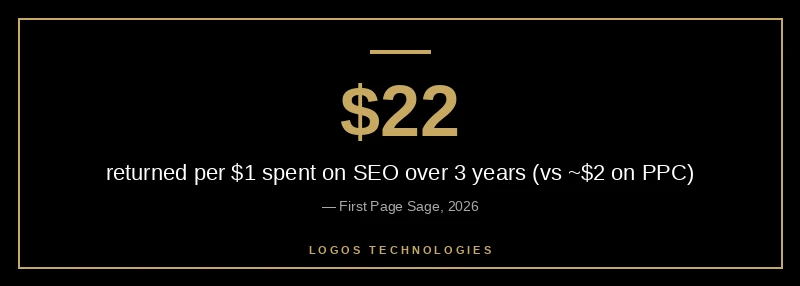
"SEO vs Google Ads" is the wrong question if you treat it as either/or — but it is the right question if you are trying to figure out where each marketing dollar earns the most. The data in 2026 is clear: paid search buys you traffic the moment your card is charged, while organic search costs more to build but returns far more over time. Industry analysis puts the median three-year ROI of SEO around 748% — roughly $22 back for every $1 spent — versus closer to $2 per $1 for pay-per-click campaigns (First Page Sage).
For a small business with a fixed budget, the decision is not philosophical. It comes down to your timeline, your margins, and — the part almost every comparison article skips — whether the website both channels point to is fast enough to convert the traffic you are paying for. Below is the honest breakdown, with real numbers and their sources.
Which has better ROI, SEO or Google Ads?
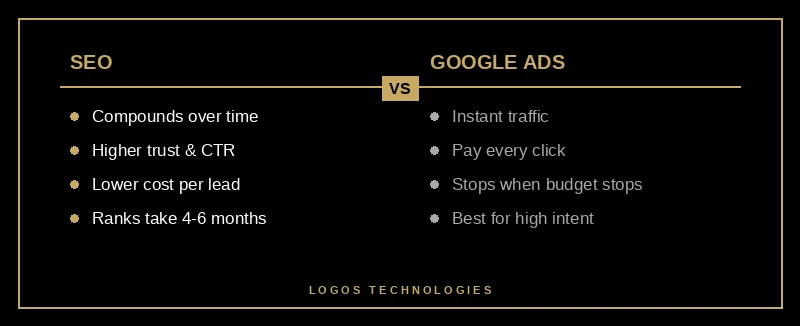
Over a 12-month-plus horizon, SEO delivers the better return on investment; over the first 3 months, Google Ads does. That is the whole answer in one sentence, and the rest of this section explains the mechanics behind it.
Google Ads is a pay-to-play auction. You bid on keywords, and your ad shows immediately — which is why it is unbeatable for speed. But the moment you stop paying, the traffic stops. SEO is the opposite: it takes four to six months of real work before rankings move, but once a page ranks, it keeps earning clicks without a per-click charge. The crossover point — where cumulative SEO returns surpass cumulative paid returns — typically lands somewhere between months six and nine for a well-run campaign. If your business needs leads this week, Ads win. If you are building an asset that pays you back for years, SEO wins. This is exactly why we treat search as a core input when measuring your website's ROI rather than a line item you can judge in a single month.
What does Google Ads actually cost in 2026?
The average cost per click in Google Ads is $5.26 and the average cost per lead is $70.11, according to WordStream's 2025 Google Ads benchmarks. Those are blended averages across industries — your real numbers depend heavily on competition. High-ticket service categories pay a steep premium: attorneys average $8.58 per click, while dentists and home-improvement businesses average $7.85.
Those numbers are not a reason to avoid Google Ads — they are a reason to respect it. Paid search is rented attention. It is excellent for testing which offers and keywords actually convert, for capturing high-intent commercial searches ("emergency plumber near me"), and for filling your pipeline while slower organic efforts mature. The catch is that the cost per lead is recurring and tends to climb year over year as more competitors bid on the same terms. You are renting the top of the page, and the rent goes up.
Why does SEO compound when Google Ads doesn't?
SEO compounds because organic rankings are an asset you own, while paid clicks are an expense you repeat. Once a page ranks on page one, it can earn clicks for months or years at no marginal cost — and the click share is enormous. Backlinko's analysis of millions of search results found the #1 organic position captures roughly 39.8% of clicks, dwarfing the ~2.1% the top paid ad typically earns. People trust organic results more, and they click them far more often.
There is a second compounding effect that is new for 2026: AI search. Google's AI Overviews now reach billions of monthly users, and well-structured, authoritative content is what those systems cite. Semrush's AI SEO research found that nearly 70% of businesses report a higher ROI from using AI in their SEO work. Paid ads do not get cited in an AI Overview — organic, trustworthy content does. The content you publish to rank today increasingly does double duty as the source AI assistants quote tomorrow. If you want the full playbook on the organic side, our guide on how to rank on Google in 2026 breaks down what actually moves the needle.
The factor both camps ignore: your website
Here is what almost no "SEO vs Google Ads" article will tell you: it barely matters which channel you pick if the website both of them point to is slow, confusing, or poorly built. Every paid click and every organic visit lands on the same place — your site — and that is where the money is actually won or lost.
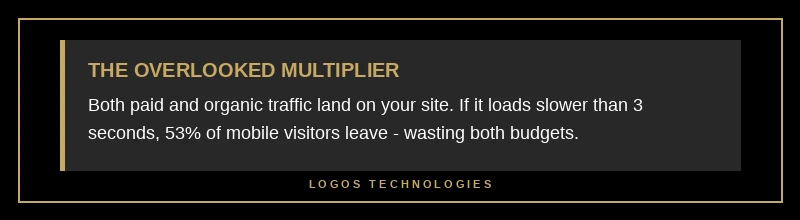
The data is brutal. Google's research found that 53% of mobile visitors abandon a page that takes longer than three seconds to load. Think about what that means for a paid campaign: if you are paying $5.26 a click and half your mobile clicks bounce before the page even renders, you are setting fire to roughly half your ad budget at the door. The same slow page also drags down your Core Web Vitals, which are a confirmed Google ranking signal — so a slow site quietly caps your organic ceiling at the same time.
This is the entire reason LOGOS Technologies builds fast, hand-coded static sites instead of bloated template stacks. A site that loads in under a second turns the traffic you already pay for into customers, which is the real lever in website conversion optimization. Speed is not a "nice to have" sitting next to your SEO-vs-Ads decision — it is the multiplier that decides how much either channel is worth. Spend on traffic only after the page that receives it is genuinely fast.
How should a small business split its budget?
If your business is brand new and needs leads immediately, weight your early budget toward Google Ads to get cash flow moving, then redirect a growing share into SEO as those organic pages start to rank. If you already have some organic traction, treat SEO as the foundation and use Ads tactically — for new product launches, seasonal pushes, and high-intent commercial keywords where the cost per lead still pencils out.
The genuinely high-performing small businesses in 2026 do not choose. They run a combined search strategy where a paid ad and an organic listing appear on the same results page, occupying more real estate and capturing more clicks together than either does alone. Whatever the split, anchor the whole plan to outcomes, not vanity metrics — the cost per lead, close rate, and lifetime value that define your true website ROI. That same discipline is what separates a real lead generation website from a digital brochure.
Frequently Asked Questions
Is SEO or Google Ads better for a brand new business?
Google Ads is usually better for a brand new business because it generates leads almost immediately, while SEO takes four to six months to gain traction. Use Ads to create cash flow and learn which keywords convert, then reinvest some of that revenue into SEO so you are not renting all of your traffic forever.
How long until SEO pays off compared to Google Ads?
SEO typically takes four to six months to show meaningful movement and overtakes Google Ads on cumulative ROI somewhere around the six-to-nine-month mark. Google Ads pays off the same day you launch a campaign, but the cost per lead recurs indefinitely, whereas an organic ranking keeps earning clicks at no per-click cost.
Can I do both SEO and Google Ads on a small budget?
Yes, and most successful small businesses do. Start with a modest Google Ads budget on your highest-intent keywords for immediate leads, while investing in foundational SEO — fast site, solid content, clean technical structure — that compounds over time. Having both a paid and an organic listing on the same page also increases your total share of clicks.
Does my website speed affect both SEO and Google Ads?
Yes, dramatically. A slow site lowers your Core Web Vitals (a Google ranking factor) and causes paid visitors to bounce before converting — 53% of mobile users leave a page that takes over three seconds. That means a slow website wastes money on both channels at the same time, which is why page speed should be fixed before you scale spend.
Get more out of every marketing dollar
The "SEO vs Google Ads" debate has a quiet third answer: build a website fast and well-structured enough that both channels actually convert. That is what we do at LOGOS Technologies, a web design studio based in Papillion, Nebraska — we hand-code fast, static, SEO-ready sites so the traffic you work hard to earn turns into customers instead of bounces. If you want a site that pulls its weight against your ad spend and your organic rankings, take a look at our web design services or contact us to talk through where your marketing budget is leaking.