
Is a Website Redesign Worth It? The 2026 ROI Math, Decoded

Table of Contents
TL;DR — Quick Hits
- A redesign is "worth it" when your current site is measurably costing you leads — slow load times, mobile friction, or a conversion rate below your industry benchmark.
- Google's research found 53% of mobile visitors abandon a page that takes longer than 3 seconds to load — that's lost revenue you're paying for every day.
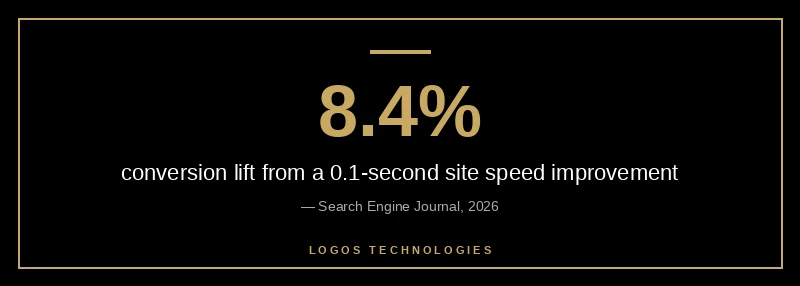
- A 0.1-second speed improvement has been shown to lift retail conversions by 8.4%, so performance gains compound fast.
- Calculate ROI before you commit: baseline traffic × projected conversion lift × customer value, divided by total cost.
- If a redesign's payback period is under 12 months, the math almost always favors doing it.
Most small business owners decide on a website redesign the wrong way — by how the site looks to them. The number that actually matters is what the current site is costing you in lost customers. And that number is rarely zero. Google's machine-learning analysis found that as a page's load time climbs from one to three seconds, the probability a mobile visitor bounces rises by 32% — and 53% of mobile users leave entirely once a page crosses the three-second mark.
So the real question isn't "does my site look dated?" It's "is my site quietly leaking revenue, and would a rebuild plug the leak faster than it costs?" This guide walks through how to answer that with numbers instead of opinions. (If you want the broader framework first, start with our pillar on how to measure website ROI — redesign ROI is one slice of it.)
When is a website redesign worth it?
A website redesign is worth it when your current site is measurably underperforming on speed, mobile usability, or conversion rate — and when fixing those problems would generate more revenue than the redesign costs within roughly a year. If your site already loads fast, converts at or above your industry benchmark, and is easy to update, a full redesign is usually premature.
The clearest signals that a redesign will pay off:
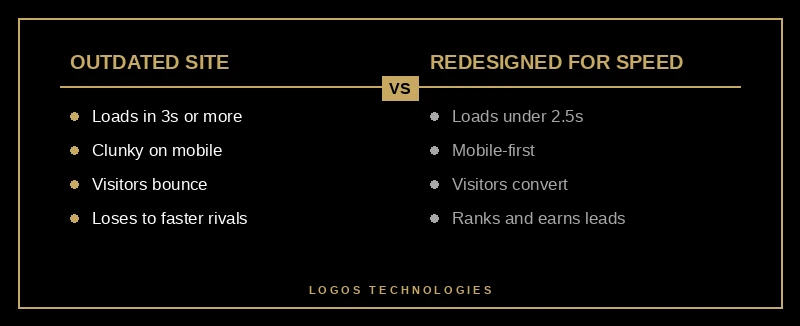
- Your pages are slow. If your largest content element takes longer than the 2.5-second "good" threshold Google uses for Largest Contentful Paint, you're losing visitors before they see your offer.
- Mobile is an afterthought. Most traffic is mobile, and 70% of consumers say page speed influences whether they buy from a retailer. A site that's clunky on a phone is a site that's bleeding sales.
- You get traffic but few leads. When visitors arrive and don't call or fill out a form, the problem is usually structure and clarity, not traffic volume. Compare your numbers against real conversion rate benchmarks for small business before blaming your ad budget.
- The site is hard to update or keeps breaking. Maintenance drag is a hidden cost that compounds every month.
If two or more of those apply, a redesign is likely worth costing out. If none do, spend your money on content and ongoing optimization instead.
The real cost of keeping an outdated website
An outdated website rarely fails dramatically — it underperforms quietly. The cost shows up as visitors who never convert, search rankings you never earn, and a first impression that makes you look smaller than your competitors. Because none of that appears as a line item, owners routinely underestimate it.
Speed is the most quantifiable piece. Search Engine Journal reports that a 0.1-second improvement in load time can raise conversions by 8.4% for retail sites — which means a slow site isn't just annoying, it's a direct multiplier working against you. Page speed also feeds Google's Core Web Vitals, so a sluggish site loses on rankings and on the visitors who do arrive. We break the technical side down in our website speed optimization guide, but the business takeaway is simple: every second of delay is a tax on revenue.
The second hidden cost is trust. A site that looks like it hasn't changed since 2012 signals neglect, and visitors transfer that judgment to your business. That's part of why high bounce rates so often trace back to design and performance rather than bad traffic — something we cover in how to reduce bounce rate.
How to calculate website redesign ROI in 4 steps
You can estimate redesign ROI on a napkin before talking to a single designer — it's the same logic behind any website ROI calculation, narrowed to a single project. Here's the framework.
1. Set your baseline numbers
Pull three figures from your analytics: monthly visitors, current conversion rate, and average value of a customer. Say you get 2,000 visitors a month, convert 1.5% of them, and each customer is worth $1,000. That's 30 customers and $30,000 in monthly revenue from the site.
2. Estimate the conversion lift
Use conservative, sourced benchmarks rather than vendor promises. Performance and clarity improvements typically move conversion rates by a meaningful but not magical amount. If a redesign takes you from 1.5% to 2.2%, that's a realistic lift for a site that's currently slow and mobile-unfriendly — and it's grounded in the speed-to-conversion relationship Google and the Core Web Vitals data document.
3. Translate the lift into revenue
At 2,000 monthly visitors and a 2.2% conversion rate, you'd close 44 customers instead of 30 — 14 more per month. At $1,000 each, that's $14,000 in additional monthly revenue, or $168,000 a year.
4. Compare against total cost
Divide the projected annual gain by the all-in redesign cost (use our breakdown of what a small business website actually costs for a realistic figure). If a redesign runs $10,000 and conservatively adds even a fraction of that $168,000, the payback period is well under a year. When payback lands under 12 months, the math almost always says go.
The point of this exercise isn't precision — it's discipline. Running the numbers stops you from redesigning for vanity and forces the project to justify itself.
Redesign vs. rebuild: should you start over?
If your site's problems are cosmetic, a redesign on your existing platform may be enough. If the problems are structural — slow no matter what you do, impossible to maintain, built on a bloated template — rebuilding on a faster foundation usually delivers better ROI than patching. Google's own interactivity benchmark for Interaction to Next Paint is 200 milliseconds, and heavy plugin-driven sites routinely fail it.
This is where the platform decision matters. A static, hand-coded site loads faster and costs less to maintain than a plugin-heavy CMS, which is why so many performance-driven rebuilds end up moving off WordPress — we make the full case in our guide to the best WordPress alternative for small business. Whatever you choose, treat the rebuild as an SEO project too, not just a visual one; Search Engine Land's site redesign SEO checklist is the standard reference for migrating without torching your rankings.
Pro Tip: Measure your current site's conversion rate and load time before you redesign. Without a baseline, you can't prove the redesign worked — and you can't tell vanity changes from revenue changes.
Frequently Asked Questions
How often should you redesign your website?
Most businesses benefit from a meaningful redesign every three to five years, with smaller, ongoing optimizations in between. But age alone isn't the trigger — performance is. If your site still loads fast, ranks, and converts, leave it alone. If it's slow or losing leads at two years old, redesign sooner.
How long before a website redesign shows ROI?
Expect three to six months for statistically meaningful results. SEO gains and conversion improvements take time to compound as Google re-crawls the site and visitor behavior shifts. Track conversion rate and load time monthly so you can see the trend rather than reacting to a single slow week.
Does a redesign hurt my Google rankings?
It can, if you redesign without an SEO plan. URL changes, removed pages, and broken redirects are the usual culprits. Following a proper migration checklist — preserving URLs, mapping redirects, and keeping your best content — protects your rankings and often improves them once the faster site is live.
What's the most important thing to fix in a redesign?
Speed and mobile usability, in that order. They're the most measurable, they directly affect both rankings and conversions, and they're where outdated sites lose the most. A beautiful site that loads in five seconds still loses to a plain one that loads in one.
Deciding whether to redesign comes down to one honest question: is your current website helping your business grow, or quietly holding it back? If you've run the numbers and a faster, clearer site would pay for itself, the redesign is worth it. At LOGOS Technologies, we build fast, static, SEO-optimized websites for small businesses from our home base in Papillion, Nebraska — and we'll tell you honestly whether a redesign makes sense for your numbers before you spend anything. Take a look at our web design services, or contact us for a straight answer on what a rebuild could return for your business.