Shopify vs WooCommerce in 2026: What Nearly 1 Million Real Stores Say About Speed and Cost

Table of Contents
TL;DR — Quick Hits
- On mobile, 76.2% of Shopify stores pass all three Core Web Vitals versus 39.3% of WooCommerce stores (HTTP Archive, September 2026).
- WooCommerce's gap is server response: only 12.1% of its mobile origins have a good Time to First Byte, against 83.8% for Shopify.
- Shopify Basic costs $29 a month billed yearly; WooCommerce is free software, but hosting alone runs $36 to $5,400 a year.
- Pick Shopify to sell fast with no technical staff; pick WooCommerce only if you need WordPress content or full code ownership.
Most Shopify vs WooCommerce comparisons argue from feature lists and affiliate pricing tables. The more useful evidence is how each platform performs for real shoppers. The HTTP Archive Core Web Vitals Technology Report aggregates Chrome field data from every detected site on a platform, and the September 2026 numbers are lopsided: 76.2% of roughly 445,000 Shopify origins pass all three Core Web Vitals on mobile, compared with 39.3% of roughly 543,000 WooCommerce origins.
That gap matters because Google uses Core Web Vitals as part of its page experience signals, and because speed feeds directly into conversion. It is also not the whole story. This guide compares the two platforms on speed, true cost, SEO control, and maintenance, then says plainly who should pick which. It sits under our broader best ecommerce platform 2026 comparison, which also covers custom and headless builds.
Which Is Faster, Shopify or WooCommerce?
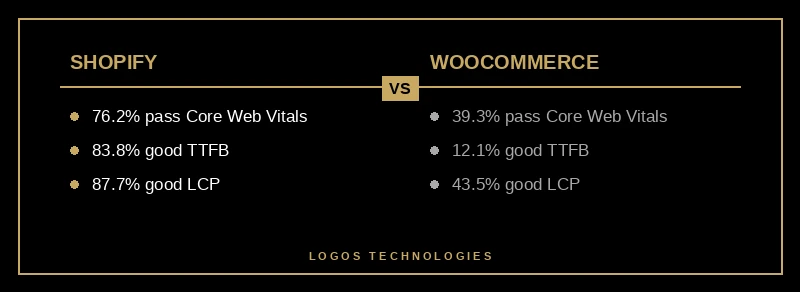
Shopify is faster in aggregate: 76.2% of Shopify stores pass all three Core Web Vitals on mobile, while only 39.3% of WooCommerce stores do. Both figures come from the HTTP Archive technology report, which counts the share of origins with good scores at the 75th percentile of real Chrome visits.
The split by metric is more interesting than the headline:
| Mobile metric (share of stores rated good) | Shopify | WooCommerce |
|---|---|---|
| Overall (all three vitals) | 76.2% | 39.3% |
| Largest Contentful Paint | 87.7% | 43.5% |
| Time to First Byte | 83.8% | 12.1% |
| Cumulative Layout Shift | 92.4% | 88.7% |
| Interaction to Next Paint | 86.7% | 91.4% |
Two findings stand out. First, WooCommerce actually beats Shopify on Interaction to Next Paint, so the common claim that WordPress stores are sluggish to interact with does not hold up. Second, almost the entire gap comes from loading: a good Time to First Byte on only 12.1% of WooCommerce mobile origins means most stores wait on a slow server before the browser can paint anything, and Largest Contentful Paint inherits that delay. Shopify controls the hosting stack, so every merchant starts from the same fast baseline. On WooCommerce, you buy your own server and your results are only as good as that purchase. We explain the mechanics in our post on why WordPress is so slow.
One caution: these are platform-wide averages with large sample sizes, not guarantees. A well-configured WooCommerce store on quality hosting can pass, and a Shopify store stuffed with apps can fail. Our guide to speeding up a Shopify store covers the app-sprawl problem in detail.
How Much Does Shopify Cost vs WooCommerce?
Shopify Basic costs $29 a month billed annually ($39 month to month), Grow is $79 ($105), and Advanced is $299 ($399), according to NerdWallet's March 2026 pricing review. WooCommerce itself is a free plugin, but running it is not free.
Per Website Builder Expert's March 2026 comparison, WooCommerce hosting ranges from $36 to $5,400 per year, plus $10 to $20 for a domain, up to $130 a year for a theme, and up to $129 a year for plugins. Their all-in estimate for WooCommerce is $4 to $480 a month, a range wide enough to show how much depends on your choices.
Payment processing is nearly a wash. Shopify's online card rate is 2.9% + 30 cents on Basic, falling to 2.7% on Grow and 2.5% on Advanced. WooCommerce Payments charges 2.9% + 30 cents, with an extra 1.5% on non-US cards. If you use a third-party gateway on Shopify instead of Shopify Payments, check Shopify's current extra transaction fee before you commit, because it varies by plan.
The line items that surprise people sit outside both price lists: paid apps on Shopify, and on WooCommerce, security, backups, and developer time when an update breaks checkout. We break the full picture down in how much an ecommerce website costs.
Which Platform Is Better for SEO?
Neither platform wins on SEO by default. Shopify gives you clean technical SEO out of the box (sitemaps, canonical tags, a fast server) but locks URL structures such as /products/ and /collections/. WooCommerce gives you total control over URLs and markup, but you must build and maintain that technical foundation yourself.
Because speed is a ranking input and a conversion input, Shopify's higher pass rate is a real advantage for stores with no technical help. WooCommerce's advantage is content: it runs inside WordPress, which is built for publishing, so a store that depends on guides, comparisons, and long-form content can keep everything on one domain. For product pages specifically, see our ecommerce SEO strategy guide. The principle that connects both platforms is the one Semrush's page speed guide makes: load time shapes how both users and search engines treat your pages.

Who Should Choose Shopify and Who Should Choose WooCommerce?
Choose Shopify if you want to be selling within weeks, have no developer, and want hosting, security, and checkout handled for you. Choose WooCommerce if content is central to your business, you need to own and customize every template, and someone on your team can maintain WordPress updates and security.
Shopify fits best when:
- Your catalog is under a few thousand products and your team is non-technical.
- You want predictable monthly costs and built-in checkout.
- You would rather pay a platform fee than manage servers.
WooCommerce fits best when:
- You already run a content-heavy WordPress site and want commerce on the same domain.
- You need custom product logic that hosted themes and apps cannot deliver.
- You will pay for quality hosting; a budget shared server is exactly where the 12.1% Time to First Byte figure comes from.
There is a third path when neither fits: a fast static front end paired with a commerce API. That is what we build at LOGOS Technologies, and it is covered in the pillar guide linked above. It trades the lowest launch cost for the best performance ceiling, so it suits stores where every tenth of a second of load time is worth real revenue. For the conversion side of the equation, see our guide to reducing cart abandonment at checkout.
Frequently Asked Questions
Is Shopify better than WooCommerce for beginners?
Yes, for most beginners. Shopify bundles hosting, SSL, checkout, and security into one monthly fee, so there is nothing to configure on a server. WooCommerce requires you to choose a host, install WordPress, and keep plugins updated, which takes longer and carries more risk.
Is WooCommerce cheaper than Shopify?
It can be, but only at the low end. WooCommerce software is free and a budget host can keep costs near $4 a month, but that setup is the one most likely to be slow. Once you add quality hosting, security, and backups, costs usually land close to a mid-tier Shopify plan.
Does Shopify or WooCommerce rank better on Google?
Neither ranks better by default. Rankings depend on content, links, and page experience. Shopify's faster average Core Web Vitals help, while WooCommerce's WordPress base gives more control over content and URLs.
Can I switch from WooCommerce to Shopify later?
Yes. Products, customers, and orders can be migrated with import tools or a developer, but you should plan redirects for every product and category URL so you keep your search rankings through the move.
Choosing Based on Evidence, Not Affiliate Tables
The data points in one direction on speed and the answer on cost is "it depends on your hosting and app choices." If you want help deciding between Shopify, WooCommerce, or a custom static build, LOGOS Technologies in Papillion, Nebraska builds fast, search-ready sites for businesses of every size. Look at our web design services or contact us for an honest recommendation.