
Best Ecommerce Platform 2026: Shopify, WooCommerce, or Custom — What Small Businesses Should Actually Pick

Table of Contents
TL;DR — Quick Hits
- Shopify holds a 26.2% ecommerce platform market share and dominates the top 1 million ecommerce sites at 28.8%, but WooCommerce powers more total stores at 4.5 million-plus.
- Shopify costs $29 to $2,300 per month plus apps and transaction fees; a custom-built store costs $6,000 to $25,000 once and roughly $50 to $200 per month to host.
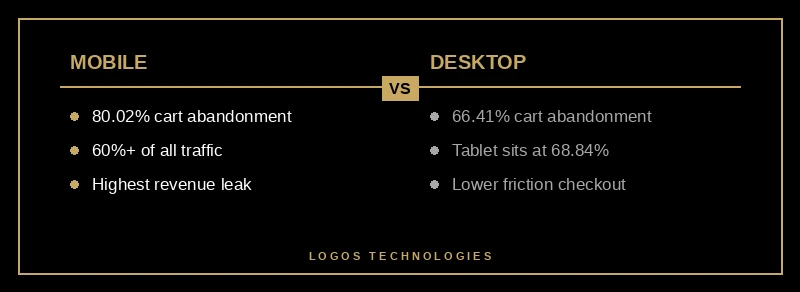
- Cart abandonment hits 80.02% on mobile versus 66.41% on desktop — and platform-imposed checkout patterns are a big reason why.
- A one-second delay in page load cuts conversions by 7%, which is why static and headless ecommerce architectures keep winning revenue battles against bloated SaaS themes.
- For most growing small businesses, custom or headless ecommerce becomes cheaper than Shopify after roughly 18 to 24 months once recurring fees are added up.
The hardest decision a small business owner makes about their online store usually has nothing to do with products or pricing. It is the platform. Pick wrong and you lock in a recurring cost structure, a checkout flow, and a performance ceiling that quietly cap your revenue for years. Pick right and the platform fades into the background where it belongs.
Cart abandonment alone tells you how high the stakes are. The 2026 average sits at 70.22% across all studies, and on mobile the number climbs to 80.02% according to Baymard Institute's analysis of more than 50 abandonment studies. Mobile now drives more than 60% of ecommerce traffic. That means every platform decision that affects mobile checkout speed, payment friction, or trust signals is compounding revenue loss across your largest channel.
This guide breaks down the three real options for small business ecommerce in 2026 — Shopify, WooCommerce, and custom-built stores — and shows where each one wins, where each one fails, and how the math actually shakes out over a three-year window. The answer is rarely the one the loudest marketing department wants you to pick.
What Are the Three Real Ecommerce Platform Options for Small Business?
The three serious paths for a small business online store in 2026 are hosted SaaS (Shopify being the dominant example), self-hosted open-source (WooCommerce on WordPress, the dominant example), and custom-built or headless commerce (often a static front end like Eleventy or Next.js paired with a commerce API like Shopify Storefront, Snipcart, or Stripe). Every other platform — BigCommerce, Squarespace Commerce, Wix Stores, Magento — fits one of those three buckets architecturally.
The differences between them are not cosmetic. They show up in three places that determine whether your store grows or stalls: monthly cost, page speed ceiling, and how much control you have over checkout and SEO. We will walk through each one with the actual 2026 pricing and the trade-offs that don't usually make it into the comparison tables on platform vendors' own blogs.

Shopify: When Hosted SaaS Is the Right Call
Shopify is the default recommendation in most small business ecommerce articles, and for predictable reasons — it has roughly 26.2% global ecommerce platform market share, powers between 4.8 and 6.5 million active stores, and processed $292 billion in gross merchandise volume in 2024. Among the top one million ecommerce sites, Shopify's share rises to 28.8%. The platform is genuinely good at what it does.
The 2026 pricing structure has four tiers. Basic is $29 per month, Shopify is $79, Advanced is $299, and Shopify Plus starts at $2,300. Those numbers do not tell the whole story. On top of platform fees you pay for apps (the average mature Shopify store runs 10 to 20 paid apps at $5 to $50 each per month), premium themes ($150 to $400 one-time, often more for niche themes), and transaction fees (0.5% to 2% on every sale unless you use Shopify Payments). Real all-in monthly costs for a working small business store typically run $200 to $700 depending on app stack.
Shopify wins clearly in three situations. The first is when you are launching fast and need to be selling within two to three weeks. The second is when your team has zero technical skill and no plans to hire any. The third is when you need built-in fraud screening, multi-channel selling (Instagram, TikTok Shop, Amazon), and shipping label workflows that just work. None of those are trivial to replicate on a custom build.
Where Shopify quietly underperforms is page speed and SEO control. Shopify themes are heavy by default — even the platform's own Dawn theme ships meaningful JavaScript that affects Core Web Vitals. Shopify also restricts URL structure (you cannot remove /products/, /collections/, or /pages/ from your URLs), limits how you can implement schema markup beyond what the theme provides, and serves checkout from a domain you do not fully control. For stores under $500K in annual revenue this rarely matters. Past that threshold, every percentage point of conversion lost to slow product pages starts to dwarf the recurring platform fees.
WooCommerce: The WordPress Path and Its Hidden Costs
WooCommerce sits in a strange spot. By store count, it is the largest ecommerce platform on the internet — somewhere between 20% and 33% global market share depending on methodology, with 4.5 million-plus tracked active stores. It runs as a plugin on WordPress, which itself powers about 43% of all websites on the open web. On paper this looks like the obvious value pick: open source, no platform fees, full control.
In practice the cost shifts rather than disappearing. A working WooCommerce store needs hosting that can handle ecommerce loads ($30 to $100 per month for managed WordPress hosting), an SSL certificate, a payment gateway, security plugins (Wordfence or similar), backup tooling, performance plugins (LiteSpeed Cache or WP Rocket — typically $50 to $150 per year), and a developer on retainer or call. Real all-in monthly costs end up at $150 to $400, comparable to a mid-tier Shopify store but with significantly more maintenance friction.
The performance story is harder. WordPress with WooCommerce is the most-attacked stack on the internet, so security maintenance is non-negotiable. Plugin conflicts cause real outages. The default architecture is dynamic PHP rendering, which means every page load executes database queries — a structural disadvantage compared to static or hybrid alternatives. We covered this in depth in our WordPress alternative for small business guide, which lays out why we generally do not recommend WordPress for new builds even though we will happily maintain existing ones.
WooCommerce wins when you genuinely need WordPress for content (a blog-heavy site that also sells, like a publication or a course business), when you want true ownership of your data and templates, or when an internal team already knows WordPress well enough to run it without breaking things. Outside those three cases, the maintenance tax is hard to justify in 2026.
Custom and Headless Ecommerce: The Path Most Listicles Skip
The third path almost never makes it into the "best ecommerce platform" lists, because the platforms publishing those lists have nothing to sell you here. Custom and headless ecommerce means a hand-coded or statically generated front end that talks to a commerce backend via API. The front end can be Eleventy, Next.js, Astro, or any modern framework. The backend can be Shopify (using its Storefront API in headless mode), Snipcart, Stripe Checkout, Foxy.io, or a fully custom Node/Python service.
The pricing model is fundamentally different. Custom small starter stores cost $3,500 to $6,000 once. Medium stores with 500-plus products land at $6,000 to $12,000. Larger or highly complex builds run $12,000 to $25,000-plus. Ongoing hosting is typically $50 to $200 per month — most JAMstack-style ecommerce sites run on Netlify, Vercel, or Cloudflare Pages where the static front end is essentially free to serve.
The performance ceiling is also fundamentally different. Static front ends serve from a CDN edge — the page is already built and waiting to be sent the moment a request arrives. The 2026 data on what that buys you is ruthless. Every 100 milliseconds of additional load time costs roughly 1% in conversions according to Akamai and Walmart's joint research summarized by Think with Google, and a one-second delay produces a 7% drop in conversions. A site loading in one second has a conversion rate roughly 5x higher than a site loading in ten seconds. We have broken this out in our page speed and revenue analysis, but the short version is: speed is revenue, and architecture caps speed.
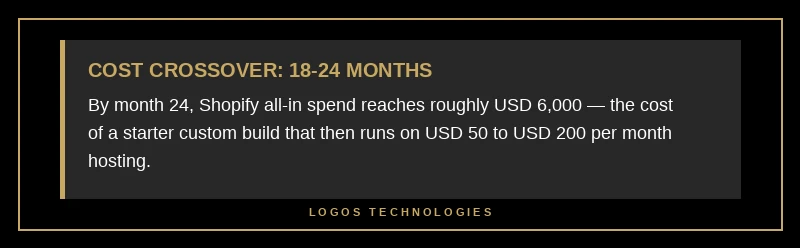
The cost crossover happens around the 18- to 24-month mark for most growing small businesses. By month 24, total Shopify spend at a realistic $250 per month all-in has reached $6,000 — the cost of a starter custom build that then keeps running for years on $50 to $200 per month of hosting. By year five the gap is significant. By year ten it is enormous.
Which Ecommerce Platform Is Best for a Small Business in 2026?
The honest answer is that the right platform depends on three numbers: your annual revenue, how many products you sell, and how much technical capacity you have on or near your team. We can be more concrete than that.
Under $100K in annual revenue, with 50 products or fewer, and no technical resources — Shopify Basic is the clear winner. The recurring cost is small enough relative to revenue that the trade-off in performance and control does not matter yet. Get something selling, learn what your customers want, and revisit the decision in 18 months.
Between $100K and $500K in annual revenue, with a growing product catalog and at least a marketing person who understands SEO — the decision gets interesting. This is where Shopify's recurring fees start to compound and where the page speed ceiling starts to bite. A custom or headless build done right almost always wins on a three-year total cost of ownership basis at this revenue level. Hand-coded sites also tend to outperform on SEO foundations because every architectural decision is yours to make.
Above $500K, regardless of catalog size, the math almost never favors staying on Shopify Basic or Shopify itself. You either move up to Shopify Plus at $2,300 per month (which is fine if Shopify's app ecosystem is genuinely indispensable to your operation) or you invest in a custom build that will pay for itself within a single year of recovered transaction fees and conversion lift. Both are defensible. Neither path is "easy," but neither is running at $500K-plus in revenue on a platform you are aggressively outgrowing.
For brands where the website is also a content engine — a blog-heavy site, a course business, a publication that sells — WooCommerce remains a defensible pick despite the maintenance burden. The WordPress editing experience is still better than anything else for content-heavy operations, and that may be worth the structural performance disadvantage.
How Should I Compare Ecommerce Platforms — What Actually Matters?
Vendor comparison tables emphasize features. Real ecommerce platform decisions hinge on a much shorter list of things that actually move revenue. The five questions that matter in 2026:
- What is the all-in monthly cost at year three? Not month one. Apps, themes, transaction fees, premium support, and app price increases compound. Build a spreadsheet that projects 36 months. Then double it for safety.
- What is the realistic page load time on mobile, with your real product images and your real app stack? Test it on a real entry-level Android phone over a throttled 4G connection, not on the platform's marketing site. Aim for under 2.5 seconds Largest Contentful Paint. Anything over 4 seconds will lose 63% of mobile shoppers before they even see your products.
- How much of the checkout flow can I customize? Shopify gives you a lot but not everything (without Plus). WooCommerce gives you essentially total control. A custom build gives you everything by definition. Checkout is where conversions are won and lost — read our breakdown of what actually drives ecommerce sales for the data.
- What does migrating off the platform look like? Every platform has a migration story. Shopify's data export is decent but URL structure changes will tank your SEO during the move. WooCommerce migration is messy in practice. Custom builds let you migrate piece by piece without breaking anything because you own all the components. The platform you can leave is the platform you can stay on.
- What is the SEO ceiling? This is the one that kills more ecommerce stores than any other factor. Shopify limits URL structure and schema markup. WooCommerce can be pushed pretty far with the right plugins. Custom builds have no ceiling. If your acquisition strategy depends on organic search, this question alone may decide your platform.
Frequently Asked Questions
What is the cheapest ecommerce platform for a small business in 2026?
Shopify Basic at $29 per month is the cheapest legitimate hosted option, but realistic all-in monthly cost lands closer to $200 to $250 once apps and transaction fees are added. WooCommerce is technically free as software but requires hosting and plugins that bring monthly cost to $150 to $400. Custom-built starter stores have a higher upfront cost ($3,500 to $6,000) but the lowest ongoing cost at $50 to $200 per month — so cheapest depends entirely on your time horizon.
Is Shopify better than a custom-built ecommerce website?
For stores under $100,000 in annual revenue with no technical resources, Shopify is usually better because of speed-to-launch and built-in operational features. For stores above $500,000 in revenue, a custom or headless build almost always wins on three-year total cost of ownership and on conversion lift from better page speed. Between those two thresholds the answer depends on how much control you need over checkout, URLs, and schema markup.
How much should a small business pay for an ecommerce website in 2026?
A reasonable budget for a small business ecommerce site in 2026 is $3,500 to $12,000 for the build, plus $50 to $300 per month for hosting and platform fees depending on the path you choose. Hosted SaaS like Shopify shifts the cost from upfront to recurring; custom builds front-load the cost but produce far lower monthly burn after launch. Avoid quotes under $1,000 — that price point virtually always means a recycled template with no real conversion or SEO work.
Will a static or JAMstack ecommerce site rank better in Google than Shopify?
Static and JAMstack ecommerce sites have a structural advantage on Core Web Vitals because they serve from a CDN edge with no server rendering on the critical path. Faster pages tend to rank better, all else being equal, and they convert better — every 100 milliseconds of load time saved is roughly a 1% lift in conversions. Whether you actually outrank specific Shopify competitors depends on content, backlinks, and on-page SEO too, but the architectural ceiling is higher with static.
What is the best ecommerce platform if I need to launch fast?
Shopify is the fastest path to a real, working ecommerce store. A focused team can have a Shopify store live and selling within seven to fourteen days. WooCommerce is the next fastest at two to four weeks for a basic build. A custom or headless store is the slowest at four to twelve weeks depending on scope. If launch speed is the dominant constraint, Shopify wins by a wide margin — and you can always migrate later once revenue justifies it.
Build the Right Ecommerce Platform From Day One
Picking the wrong ecommerce platform is one of the most expensive mistakes a small business can make, and the cost compounds quietly month after month. The right platform for your business depends on revenue, technical capacity, and how much control you need over the parts of the customer experience that actually drive conversions — checkout, page speed, and SEO. There is no universal best.
LOGOS Technologies builds fast, hand-coded ecommerce websites for small businesses in Papillion, Nebraska and across the country. We design custom and headless commerce stores that load fast, rank well, and do not lock you into recurring platform fees that grow with your revenue. If you are trying to decide between Shopify, WooCommerce, and a custom build — or you are hitting the ceiling on one of those platforms — take a look at our web design services or contact us for a straight conversation about which path actually fits your business.