
Ecommerce Website Design: What Actually Drives Sales in 2026

Table of Contents
Seven out of ten shoppers who add something to their cart never buy it. That figure — a 70.22% average cart abandonment rate according to Baymard Institute's analysis of 50 studies — tells you everything about where most ecommerce websites fall short. The problem is rarely the product. It's the experience surrounding it.
Ecommerce website design in 2026 isn't about picking a pretty theme and loading it up with products. The stores that actually sell are built around a handful of measurable principles: speed, trust, friction reduction, and mobile-first architecture. If your online store misses on any of these, you're handing revenue to competitors who got them right.
This post breaks down what the data says about ecommerce design that converts — and where most small business online stores leave money on the table.
Why Product Page Design Matters More Than Your Homepage
Most store owners obsess over their homepage. But the product page is where purchasing decisions actually happen, and it's where the highest-leverage design improvements live. According to BigCommerce's ecommerce design research, product pages, checkout flow, and mobile experience account for 73% of conversion lift opportunities in established ecommerce stores.
Here's what that looks like in practice. Ecommerce brands that optimize product pages with high-quality imagery see conversion lifts of up to 40%. Products with 11 to 30 reviews convert roughly 68% higher than products with zero reviews. User-generated content on product pages — photos, testimonials, Q&A sections — increases conversions by 34%.

None of that requires a massive budget. It requires intentional product page design: clean layouts that put the product front and center, real social proof positioned where buyers actually look, and imagery that loads fast without sacrificing quality. If you've been putting all your design energy into the homepage banner, redirect it to the pages where people actually decide to buy.
We covered the broader principles of turning visitors into customers in our guide to website conversion optimization, and every single one of those principles applies double for ecommerce.
How Does Page Speed Affect Ecommerce Revenue?
Speed is the silent conversion killer. A page that loads in 2.4 seconds converts at roughly 1.9%. Push that load time to 5.7 seconds and conversion drops to 0.6% — a 68% decline for just three extra seconds of waiting. On a store doing $10,000 per month in revenue, that speed gap represents roughly $6,800 in lost sales every single month.
Mobile makes this even more critical. Mobile traffic now accounts for over 70% of ecommerce visits, but mobile devices convert at 1.8–2.5% compared to desktop's 3.5–4.0%. Part of that gap is screen size and intent, but a significant chunk is speed. Mobile connections are less reliable, and heavy, bloated store templates amplify every millisecond of latency.

This is where architecture decisions made before you ever pick a color palette determine your store's revenue ceiling. We've written extensively about what page speed data actually shows for revenue and how Core Web Vitals scores directly affect your Google rankings. For ecommerce specifically, every performance optimization compounds — faster pages mean higher conversion rates, better search rankings, and lower ad costs because Google rewards speed in Quality Score calculations.
The stores that consistently load in under two seconds aren't running heavyweight SaaS platforms loaded with 40 plugins. They're built on lean, static-first architectures where speed is structural, not an afterthought bolted on with caching layers. That's the same mobile-first design philosophy we apply to every site we build at LOGOS Technologies.
Checkout Flow: Where Most Stores Lose the Sale
Baymard Institute estimates that $260 billion in US and EU ecommerce revenue is recoverable through better checkout design alone. That's not a typo — billions sitting on the table because checkout experiences are unnecessarily painful.
The top reasons shoppers abandon checkout aren't mysterious. Extra costs like unexpected shipping fees cause 39% of abandonments. Required account creation kills 24%. A checkout process that feels too long or complicated loses 18%. Not trusting the site with credit card information stops 19%.
Every one of those is a design problem with a design solution. Guest checkout options, transparent pricing displayed before the final step, clear security badges, and a streamlined single-page or two-step checkout flow address the vast majority of abandonment triggers.
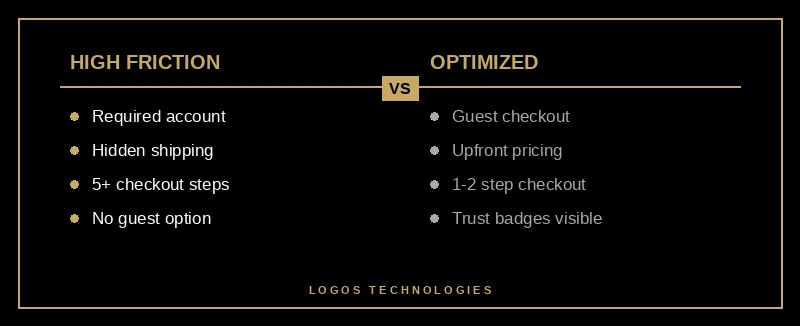
Fixing major checkout UX issues can increase conversions by up to 35.26%, according to Baymard's decade of large-scale testing data. For a store averaging $15,000 per month, that's an additional $5,289 in monthly revenue from design changes alone — no additional traffic required.
The lesson here: if you're spending money driving traffic to your store but haven't optimized your checkout in the last year, you're filling a leaky bucket.
Custom Ecommerce vs. Shopify: What the Performance Data Says
The platform question comes up in every ecommerce conversation. Shopify makes it easy to launch quickly — and for some businesses, that speed to market matters. But the performance tradeoffs are real and measurable.
Shopify sites typically load in 2 to 4 seconds. Custom-built ecommerce sites, when properly architected, consistently load in under 1.5 seconds. That gap directly maps to the conversion data above. Beyond raw speed, custom builds give you complete control over URL structure, schema markup, internal linking, and every Core Web Vitals metric — the exact technical SEO levers that determine whether Google sends you organic traffic or buries you on page three.
Shopify also charges transaction fees on every sale unless you use Shopify Payments exclusively. On a store doing $50,000 per month, those fees add up to real money over a year. A custom build has higher upfront costs, but zero platform transaction fees, no monthly subscription that scales with your feature needs, and full ownership of your data and codebase.
We broke down the broader custom website design vs. templates comparison recently, and the same principles apply here. Templates get you to launch day faster. Custom gets you to profitability faster.
For small businesses just testing the waters with a handful of products, a lean Shopify setup can make sense as a starting point. But the moment your store becomes a meaningful revenue channel, the performance ceiling of a template-based platform starts costing you real money — in slower speeds, in transaction fees, and in SEO limitations you can't engineer around.
What a High-Converting Ecommerce Site Actually Looks Like
The average ecommerce conversion rate sits between 2.5% and 3.2% globally. Most stores fall well below that. A 1% improvement in conversion rate translates to a 10–20% revenue increase, which means the design details that push you from average to above-average have an outsized financial impact.
Here's what the top-performing ecommerce sites get right in 2026. They lead with mobile — not responsive-as-an-afterthought, but mobile-first from the wireframe stage. Navigation is flat and obvious, with product filtering that actually works on a phone screen. Product images are high-resolution but optimized, loading progressively so the page doesn't stall. Trust signals — reviews, security badges, return policy summaries — appear on every product page, not buried in the footer.
They also invest in accessibility. ADA-compliant website design isn't just about avoiding lawsuits — accessible ecommerce sites reach more customers. Readable fonts, proper color contrast, keyboard navigation support, and screen-reader-friendly markup expand your addressable audience. That's revenue you're leaving behind if your store isn't accessible.
And critically, every high-converting ecommerce site treats SEO as architecture, not afterthought. Proper schema markup on product pages gets you rich snippets in search results — those star ratings, prices, and availability badges that dramatically increase click-through rates from Google.
Where to Start if Your Store Isn't Converting
If your ecommerce site isn't hitting at least a 2% conversion rate, start with the three areas that move the needle fastest: page speed, product page layout, and checkout friction.
Run your store through Google PageSpeed Insights. If your mobile score is below 80, you have a speed problem that's actively costing you sales. Check your product pages — do they have reviews, quality images, and clear CTAs above the fold? Walk through your own checkout process on a phone. If it takes more than two minutes or requires creating an account, you've found your biggest leak.
These aren't cosmetic changes. They're structural improvements that compound over time. A faster store ranks higher, converts better, and costs less to advertise — every metric moves in the right direction simultaneously.
At LOGOS Technologies, we build ecommerce sites on static-first architecture specifically because speed and SEO aren't negotiable for online stores. If your current platform is holding back your conversion rates, check out our ecommerce web design services or reach out directly — we'll walk through what a performance-focused rebuild could look like for your store.