
Ecommerce SEO in 2026: A Strategy That Actually Ranks Product Pages

Table of Contents
TL;DR — Quick Hits
- Ecommerce SEO in 2026 is product-schema-first: attribute-rich Product markup now drives a measurable lift, while generic Product schema gives no AI citation advantage.
- Google AI Overviews appear on roughly 50–60% of US searches, and only 38% of AI-cited pages rank in the top 10 organic results — the citation game and the ranking game are now two different games.
- Average cart abandonment is 70.22% (Baymard); a 1-second mobile speed improvement lifts conversion ~7%, so site speed is an SEO and a revenue lever.
- Build category pages and pillar content around buyer intent, not your product taxonomy — Google's March 2026 update demoted thin pages that restated product feeds without insight.
- Cluster strategy beats sprawl: one canonical buyer's guide per category, supported by product, comparison, and how-to pages that link upward.
Ecommerce SEO in 2026 looks almost nothing like the keyword-stuffed product-description playbook that worked in 2020. Google's March 2026 core update finished rolling out on April 8, 2026, and the pattern in the winners-and-losers data is consistent: lightweight pages that rephrased product feeds got demoted, while pages with accurate, structured, attribute-rich content — and clear topical authority — held or gained ground. On top of that, AI Overviews now appear on roughly half of US searches, and the search results page itself is being rewritten. If you sell online, the ranking equation has shifted enough that the old SEO checklist is now mostly noise.
This guide is the cluster post under our pillar on the best ecommerce platform in 2026. It is the practical strategy — not the philosophy — for ranking product, category, and buying-guide pages on a real ecommerce site in 2026.
What is ecommerce SEO in 2026?
Ecommerce SEO in 2026 is the practice of optimizing an online store so that real buyers — and the AI systems that increasingly answer their questions — can find, trust, and convert through your pages. It combines four pillars: technical performance (Core Web Vitals, mobile, INP), structured data (attribute-rich Product, Offer, Review, FAQ schemas), buyer-intent content (category pages, comparison guides, how-to and use-case pages), and trust signals (real reviews, transparent pricing, identifiable brand). Pages that do all four win. Pages that lean on one pillar — the schema-only or the speed-only strategy — are not enough anymore.
The shift from 2024–2025 is real: AI Overviews are cited from a much wider source pool, Google AI Mode launched on January 27, 2026, and only 38% of AI-cited pages rank in the top 10 of the underlying SERP. You can show up in an AI answer without ranking #1 — and you can rank #1 and still be missing from the AI box. The rest of this guide is how to win both.
How do you do keyword research for an ecommerce store?
Ecommerce keyword research in 2026 starts with intent buckets, not a keyword list. For every product line, map four buckets: informational ("how does X work"), navigational ("brand name product"), commercial-investigation ("best X for Y, X vs Y, X reviews"), and transactional ("buy X, X near me, X with free shipping"). Each bucket gets a different page type. Conflating them — building one page to rank for "best office chair" AND "buy ergonomic office chair" — is the single most common reason ecommerce sites underperform their authority.
For tools, our keyword research guide for small business walks through Ahrefs, Semrush, and a handful of free alternatives. The ecommerce-specific addition: pull data from your own search bar, your support tickets, and your competitors' breadcrumb URLs. Those three internal signals out-predict any external keyword tool on what your customers actually call your products.
Product schema is not optional — but generic schema is no longer enough
Product schema is the line between an ecommerce page that Google understands and one that it does not. The Google product structured data documentation lists name, image, and offers (with price, priceCurrency, and availability) as required for product rich results. That is the floor. The 2026 ceiling is much higher.
A February 2026 study cited in several post-update recaps found that generic Product schema produced no measurable lift in AI Overview citations, while attribute-rich Product schema — including gtin, mpn, brand, aggregateRating, review, complete offers arrays, and additionalProperty for spec tables — appeared in AI-generated shopping recommendations 3–5x more frequently. The same patterns appear in standard rich result eligibility.
Concrete checklist for a 2026 product page schema implementation:
- Required Product fields:
name,image(multiple, square + landscape),description,sku. - Identifier:
gtin13for retail goods,mpnfor parts,isbnfor books — at least one. AI shopping graphs use these to deduplicate. - Brand: a real
Brandnode withnamematching your registered brand, not the manufacturer. - Offers:
Offer(orAggregateOffer) withprice,priceCurrency,availability(InStock/OutOfStock/PreOrder),priceValidUntil,shippingDetails, andhasMerchantReturnPolicy. These last two are required for shopping rich results in 2026. - Reviews:
aggregateRatingplus at least three first-partyReviewnodes — never aggregated or scraped from elsewhere; Google's spam guidelines now flag both. - Additional properties: a
PropertyValuearray for the spec table (dimensions, materials, voltage, etc.). This is where attribute-richness comes from. - FAQ section embedded on the page with matching
FAQPageschema — only if the FAQs are unique to that product, not boilerplate.
For the wider technical context — sitewide schema, breadcrumb markup, and Organization nodes — see our schema markup SEO guide for 2026. For the broader ranking framework, the methodology is the same one we laid out in how to rank on Google in 2026.
How fast does an ecommerce site need to be in 2026?
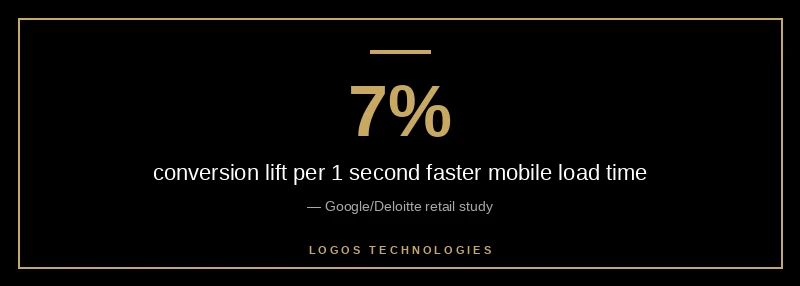
Fast enough that speed is not the reason you lose. The benchmark from Google/Deloitte's retail study has held up across re-tests: every 1-second improvement in mobile page load increases conversion roughly 7%. Baymard's cart abandonment dataset puts the 2026 average abandonment rate at 70.22%, with mobile higher than desktop, and slow load times consistently ranking in the top five abandonment reasons given by real shoppers. Speed is not a ranking detail — it is a revenue detail with an SEO bonus.
In practical numbers for 2026 ecommerce:
- LCP under 2.5 seconds on the median mobile session. Hero product image must be preloaded with
fetchpriority="high"and served as AVIF or WebP. - INP under 200ms. This is the killer metric for product pages, because gallery swiping, size selectors, and "add to cart" buttons all bind heavy event handlers. We covered the fix pattern in detail in how to fix INP in 2026.
- CLS under 0.1. Reserve space for product images, review stars, and the price block so they do not jump as the page hydrates.
If you are on Shopify, BigCommerce, or any platform that ships a heavy JavaScript runtime, the realistic 2026 ceiling on LCP is around 2.0–2.4 seconds on a mid-range Android — and you are paying for it with conversion. The static-site ecommerce stacks we build at LOGOS hit sub-1.5s LCP routinely because the HTML is pre-rendered, the cart layer is the only JS island, and the image pipeline is built-in. That is the architectural argument for moving off WordPress and other heavyweight stacks — it is not theology, it is benchmarks.
Category pages do more SEO work than product pages
This is the counterintuitive lever most ecommerce sites miss. Product pages convert; category pages rank. Buyers search for categories ("standing desks for small offices"), not SKUs. A great category page in 2026 has:
- A real 200–400 word intro that answers the buyer's question — not 80 words of keyword-stuffed boilerplate.
- A sorted, filterable grid of products with structured
ItemListschema. - An "FAQ for this category" section with 3–6 questions sourced from People Also Ask.
- Internal links up to buyer's guides and across to adjacent categories.
- A clear breadcrumb with
BreadcrumbListschema all the way to the homepage.
The post-March-2026 winners in ecommerce are sites that treated category pages as primary content, not as a filter UI. Our companion post on product page design that converts in 2026 covers the on-page conversion layer; treat that and this category-page playbook as a paired strategy.
Trust and brand signals are now ranking inputs
Google's December 2025 spam-update guidance and the March 2026 core update both leaned harder on what insiders call the "is this a real business" signal. For ecommerce, that operationalizes as: shipping and returns pages with real policies (not legalese templates), an Organization schema node that links to your real social profiles and sameAs references, identifiable founders and a real /about/ page, and reviews that are tied to verified purchases. Lightweight dropshipping pages with stock product descriptions and generic stock photos got hammered in the update — the pattern in the winners-and-losers data is unmistakable.
AI Overviews amplify this. The AI Mode synthesis layer uses schema and on-page citations to verify claims, and pages that "explain, prove, and support" their claims are over-indexed in the citation set. The corollary: an ecommerce page that just lists features rarely gets cited; one that explains use cases, trade-offs, and edge cases routinely does. This is the same pattern we covered in our generative engine optimization (GEO) guide for AI Overviews.
Frequently Asked Questions
How long does ecommerce SEO take to show results in 2026?
Most ecommerce sites see meaningful movement in 3–6 months after fixing the technical foundation (schema, speed, mobile) and another 3–6 months for content-driven gains (category pages, buyer guides). High-authority sites move faster; brand-new domains usually need a full year to build the entity signals Google's AI systems trust. The biggest accelerator is targeted internal linking from existing high-traffic pages to your money pages.
Do I still need to write unique product descriptions?
Yes — and the bar is higher than it used to be. Google's March 2026 update specifically demoted pages that rephrased manufacturer feeds with minimal added insight. Unique product descriptions in 2026 should answer at minimum: who is this for, what problem does it solve, what are the trade-offs, what does the buyer typically pair it with. That is the framework that produces content Google treats as additive, not duplicative.
Is Shopify SEO different from WordPress or custom-built ecommerce SEO?
The fundamentals are identical: schema, speed, content, trust. The implementation differs because Shopify's templating and app ecosystem constrain how cleanly you can ship structured data and how thin your JS payload can be. Shopify SEO in 2026 is mostly about disciplined theme customization, app pruning, and offloading anything heavy. WordPress WooCommerce has the same story with a slower default core. Statically generated ecommerce stacks (Eleventy, Astro, Next.js static export) skip both bottlenecks but require engineering effort. There is no platform that fixes ecommerce SEO for you.
Should I be on Google Merchant Center if I am doing organic SEO?
Yes. Even if you are not running paid Shopping ads, a complete and current Merchant Center feed is now an input to organic shopping rich results and AI Mode shopping recommendations. The feed becomes a second-tier source of truth Google uses to verify your on-page Product schema. Mismatches between feed and page get demoted — keep them aligned.
What is the single biggest ecommerce SEO mistake in 2026?
Treating SEO as a marketing-team checklist instead of an architectural decision. The sites that win in 2026 made their platform, speed, and schema decisions first; the keyword and content work was layered on top. Sites that picked a slow platform and tried to compensate with content are losing market share to faster competitors with weaker copy.
Ready to make your ecommerce site one of the fast ones?
LOGOS Technologies, based in Papillion, Nebraska, builds static-first ecommerce websites that ship attribute-rich Product schema, sub-2-second mobile LCP, and the category and buyer-guide content architecture that actually ranks in 2026. If your store is fighting platform overhead or running on a theme that has been "optimized" three times and still scores in the 60s on PageSpeed, the architecture is the problem — not the content team. See our web design services for the full stack we ship, or contact us for a free audit of your current ecommerce stack against the 2026 ranking playbook.