
How Much Does an Ecommerce Website Cost in 2026? The Real Numbers (Including the Fees Nobody Quotes You)

Table of Contents
TL;DR — Quick Hits
- A small-business ecommerce website costs roughly $29–$300/month on a hosted platform, $1,500–$10,000 for a mid-tier build, or $25,000–$150,000+ fully custom.
- The sticker price is the smallest part. Recurring platform fees, app subscriptions, and per-sale charges are where the real spend hides.
- Shopify's Basic plan is $39/month plus 2.9% + 30¢ per sale — and an extra 0.2%–2% if you don't use Shopify Payments.
- Card processing (~2.9% + 30¢) costs about the same everywhere. What diverges is the monthly platform fee, the app stack, and the surcharge.
- Over three years, a recurring-fee platform can quietly out-cost a one-time custom build — so budget for total cost of ownership, not day one.
"How much does an ecommerce website cost?" is the wrong question if you only ask it about day one. The honest answer is that an online store for a small business runs anywhere from about $29 to $300 per month on a hosted platform, $1,500 to $10,000 for a mid-tier build, or $25,000 to $150,000+ for a fully custom store, depending on how it's built. But the number on the invoice is rarely the number you actually pay. The fees that compound month after month — platform subscriptions, app add-ons, and per-transaction cuts — are what determine your real ecommerce website cost over the life of the store.
That matters because the stakes are high. Baymard Institute's analysis of US and EU sales found that roughly $260 billion in lost orders are recoverable through better checkout and design alone. A cheap store that converts poorly is the most expensive option on the table. Below is what each path really costs in 2026, and the line items the platform-published "cost guides" tend to skip.
How much does an ecommerce website cost in 2026?
For a small business, plan on one of three tiers. A DIY hosted store on a builder like Shopify, Wix, or BigCommerce runs $29 to $300 per month depending on the plan and apps. A mid-tier build with a designer, custom theme work, and integrations typically lands between $1,500 and $10,000 up front. A fully custom or headless build runs $25,000 to $150,000+, with enterprise catalogs and multi-store operations going higher.
Most small businesses don't need the top tier. The real decision is between renting a hosted platform with low upfront cost and ongoing fees, or paying more once for a build you own outright. Which is cheaper depends entirely on your sales volume and how long you keep the site — which is exactly why a monthly price tag tells you so little. We compared the platforms themselves in our guide to the best ecommerce platform for 2026: Shopify, WooCommerce, or custom; this post is about what each one actually costs you.
What actually drives the cost of an ecommerce website?
Five things move the number more than anything else: the number of products and how often the catalog changes, custom design versus a stock theme, third-party integrations (inventory, shipping, CRM, email), payment and checkout complexity, and ongoing content and SEO work. A ten-product boutique on a template is a different animal from a 2,000-SKU catalog wired into an ERP.
Performance belongs on that list too, even though it rarely appears on a quote. Speed is a direct revenue lever, not a nicety — Google's own case studies show Rakuten 24 lifting conversions 33% and revenue per visitor 53% after improving Core Web Vitals. A store built on a bloated, plugin-heavy stack carries a hidden cost in lost sales that no line item captures. If you want the mechanics, our website speed optimization guide breaks down the fixes that actually move conversion.
The recurring costs nobody quotes you
Here's what the platform-published cost guides leave out, because they're written by the platforms. On Shopify, the Basic plan is $39/month, plus 2.9% + 30¢ on every online sale, plus an extra 0.2%–2% surcharge if you don't use Shopify Payments. Then come the apps. A typical store stacks six to ten paid apps — reviews, email, upsells, shipping — and that easily runs $100–$200/month on its own.
To be fair about it: the card processing fee of roughly 2.9% + 30¢ costs about the same wherever you sell. Stripe, Shopify Payments, and most gateways cluster right there, so that line isn't really a platform-versus-custom difference. What does diverge is the monthly platform subscription, the app subscriptions, and the surcharge a platform adds when you bring your own payment gateway. Those are the costs that compound.
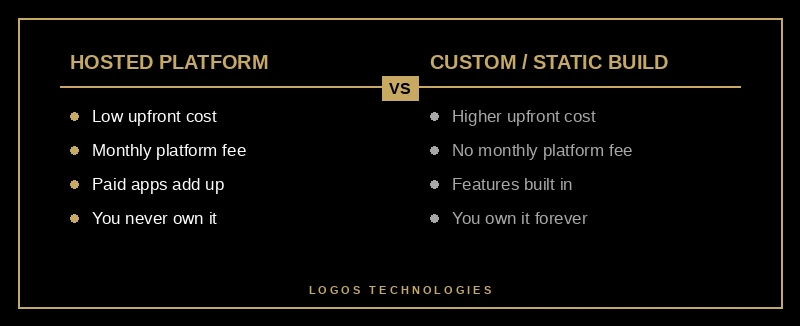
Run the math over three years on a store doing $120,000 a year. The platform subscription, the app stack, and the surcharge can total $15,000–$18,000 in recurring spend — money that buys you no equity in the site. A one-time custom build at, say, $10,000–$15,000 front-loads the cost but removes the subscription, folds common features into the code instead of paid apps, and leaves you owning the asset. The longer you run the store, the more the recurring model costs. This is the same trade-off behind moving off page-builders entirely, which we cover in our look at the best WordPress alternative for small business websites.
Is a custom build worth the higher upfront cost?
Sometimes yes, often no — and the deciding factor is sales volume, not preference. A custom build pays for itself when recurring platform and app fees would otherwise exceed the build cost over the time you plan to run the site, or when speed and conversion gains move enough revenue to cover the difference. Below a few thousand dollars of monthly sales, a hosted platform is usually the smarter spend. Above it, the recurring math starts favoring ownership. If you're still weighing platforms, our best ecommerce platform 2026 comparison puts Shopify, WooCommerce, and a custom build side by side.

The conversion angle is where the cost question quietly flips. Baymard's testing shows the average large ecommerce site can gain a 35.26% conversion lift from better checkout design, and Semrush's own ecommerce optimization research reaches the same conclusion: the build quality, not the platform logo, drives sales. A faster, cleaner store that you control — and that ships proper product structured data per Google's ecommerce documentation — can earn back a higher build cost through traffic and conversion that a template store leaves on the table. For the full framework, see our guide to how to measure website ROI for a small business.
How do you budget for an ecommerce website?
Budget for the three-year total, not the launch invoice. Work through it in order:
- Estimate your annual sales volume. Per-sale and percentage fees scale with revenue, so this number drives everything else.
- Add up the recurring stack. Platform subscription + app subscriptions + any payment surcharge, multiplied by 36 months.
- Compare that total to a one-time build plus cheap static hosting (often $0–$20/month) over the same window.
- Weigh conversion. A build that loads faster and checks out cleaner can be worth more than its price gap — abandoned carts are a cost too, which is why we wrote a full guide to reducing cart abandonment at checkout.
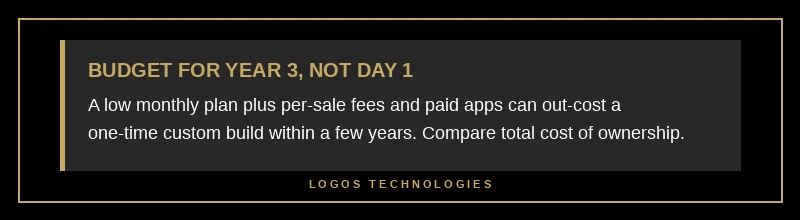
The cheapest store on day one is frequently the most expensive store by year three. Pricing the whole timeline is the only way to see that.
Frequently Asked Questions
How much does a small business ecommerce website cost per month?
A hosted ecommerce store typically costs $29 to $300 per month before apps and per-sale fees. Add a realistic app stack and transaction charges, and the effective monthly cost is usually higher than the advertised plan price.
Is Shopify cheaper than a custom website?
In the short term, yes — Shopify's Basic plan starts at $39/month with no upfront build cost. Over several years, the subscription, app, and surcharge fees can exceed the one-time cost of a custom build, so the cheaper option depends on your sales volume and how long you'll run the store.
Why is my ecommerce website more expensive than the quoted price?
Quotes usually cover the build only. The ongoing cost — platform subscription, paid apps, payment processing, and per-sale fees — is separate and recurring. The single most common reason shoppers abandon a cart is unexpected extra costs like shipping, and the same surprise-cost problem applies to store owners reading their first monthly statement.
Can a fast, low-cost ecommerce site still rank on Google?
Yes. Ranking depends on speed, structured data, and content quality far more than on which platform you pay for. A lightweight, custom-built store with proper product markup often outranks a heavier template store on a pricier plan.
Get an honest estimate for your store
Most ecommerce cost guides are written by the companies selling you the platform, so they quote the monthly price and stop there. At LOGOS Technologies, based in Papillion, Nebraska, we build fast, custom online stores and we'll show you the real three-year number — including the recurring fees — before you spend anything. If you'd rather know your true ecommerce website cost up front than discover it on a monthly invoice, take a look at our web design services and contact us for a straight estimate built around your actual sales volume.