

Chiropractor Website Design That Books New Patients in 2026

Table of Contents
TL;DR: Quick Hits
- 55% of patients start a provider search with "specialty near me," so your site has to win a local search, not a brand search.
- 75% of patients will not book a provider rated below 4.0 stars. Show recent reviews right next to the booking button.
- Only 49% of WordPress sites pass Core Web Vitals on mobile. Overloaded practice templates lose patients before the page loads.
- Ad trackers on a booking page can expose patient information. Audit every tag before you run a single ad.
- 47% of patients have used AI to research a provider. Keep hours, services and insurance in plain HTML so AI quotes them correctly.
About 14% of U.S. adults, an estimated 33.5 million people, saw a chiropractor in a single year, according to Gallup's national survey with Palmer College of Chiropractic (2015, 5,442 adults). That is a large pool of patients, and the way they choose a practice has changed. In rater8's 2026 Patient Choice Report, a survey of 992 U.S. patients, 55% said their first search for a new provider is "specialty near me," and 47% said they have used an AI tool to research a provider, up from 31% a year earlier.
Good chiropractor website design in 2026 has one job: turn that local, review-driven, increasingly AI-assisted search into a booked first visit. This guide covers what the site needs, where most practice sites fall short, and one privacy issue that chiropractic marketing guides rarely mention. It is part of our broader series on industry-specific website design.
Why Does a Chiropractor Website Decide Who Gets the Booking?
A chiropractor website decides who gets the booking because patients compare several practices in a few minutes, and your site is where they confirm that the reviews, the doctor and the first-visit details hold up. Someone with back pain is not browsing. They want a reason to call one office and stop looking.
Reviews set the bar before anyone reads your homepage. In the rater8 survey, 75% of patients said they will not book a provider rated below 4.0 stars, 44% will not book below 4.5, and 55% have canceled or avoided an appointment because of online reviews. BrightLocal's 2026 Local Consumer Review Survey of 1,002 U.S. consumers adds that 74% only care about reviews written in the last three months, and 89% expect the business owner to respond.
That makes two things required: recent reviews shown where the booking decision happens, and a complete, current Google Business Profile. Google says local prominence is based partly on "how many websites link to your business and how many reviews you have." One caution for any healthcare practice: a public reply that confirms someone is your patient can create a privacy problem of its own. Search Engine Land's guide to staying compliant with healthcare reviews is worth reading before you write your first response.

What Should a Chiropractor Website Include?
A chiropractor website should include a dedicated page for each service and condition you treat, a doctor bio with real credentials, a new-patient page that explains the first visit, tap-to-call and online booking on every page, and recent reviews. Those five elements are the core of chiropractor website design, because they cover what patients look for and what search engines reward.
A page for each service. In Whitespark's 2026 Local Search Ranking Factors report, where 47 local search experts scored 187 factors, "Dedicated Page for Each Service" ranked first for local organic results. One "Services" page that lists adjustments, sciatica, sports injuries, prenatal care and auto accident care will struggle to rank for any of them. Give each its own page. The same report notes that long, padded service pages no longer help, so answer the patient's question directly and stop.
A doctor bio that earns trust. Health is what Google calls a "Your Money or Your Life" topic, where its systems give more weight to experience, expertise, authoritativeness and trust. Google's guidance on creating helpful, reliable, people-first content states that "trust is most important." List the doctor's degree, license, years in practice and techniques, use a real photo, and avoid treatment claims you cannot support.
A new-patient page. Explain what happens at the first visit, how long it takes, which insurance you accept and what a visit costs without insurance. Uncertainty about the first appointment is the easiest objection to remove.
Booking and phone on every screen. A tap-to-call button and a booking link belong in the header on mobile, not three scrolls down. Offer both, because some patients will never call and others will never fill out a form.
Recent reviews, in context. Place them beside the booking button and on each service page. We covered the same pattern for another appointment-based practice in our guide to dental website design.
Speed: Why Overloaded Practice Sites Lose Patients on Mobile
Overloaded practice sites lose patients because a "near me" search happens on a phone, often on a cellular connection, and a page that stalls sends the patient back to the results. Field data shows how common the problem is. In the HTTP Archive Core Web Vitals Technology Report for October 2026, 49.0% of 2,513,839 WordPress sites passed all three Core Web Vitals on mobile, below the 53.0% average across the 8.3 million sites tested.
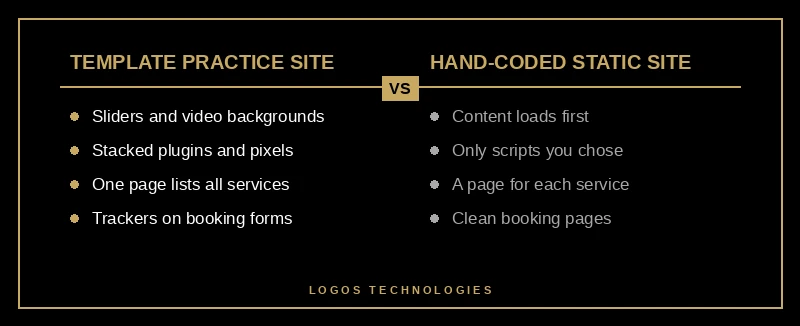
The platform is not the whole story. Some hosted builders score well above that average in the same dataset. What drags a practice site down is what gets added to it: sliders, video backgrounds, chat widgets, booking embeds, review carousels and marketing pixels. Each one is a script the phone has to download and run before the patient can tap "Book." We broke down that cost in our guide to third-party scripts and website speed.
A hand-coded static site starts from the other direction. Nothing loads unless someone chose to put it there. Eleventy, the static site generator we build with, passed at 84.3% in the same October data, although that sample is small at 172 sites. This is the central argument of our industry-specific website design guide: a template built to serve every practice carries code that your practice never uses.
One timing note. Google began rolling out its November 2026 core update on November 10, and says the rollout may take up to two weeks. If your rankings move this month, wait until it finishes before you judge the result or change the site.
The Privacy Problem Most Chiropractic Websites Ignore
Most chiropractic practices that bill insurance electronically are covered by HIPAA, and that coverage can extend to the tracking code on the practice website. Ad pixels and session-recording tools on a booking or intake page can send a patient's details to a third party.
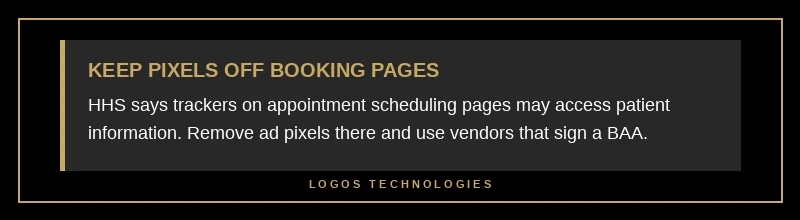
The U.S. Department of Health and Human Services addresses this in its bulletin on online tracking technologies. It says tracking technologies on a page that lets people schedule appointments "may have access to PHI in certain circumstances," and that a practice needs a business associate agreement with any tracking vendor that receives protected health information. A federal court vacated one part of that bulletin in June 2024, the part covering visits to public informational pages. The sections on scheduling, login and patient portal pages still stand.
In practice, that means three checks:
- Keep advertising pixels and session replay tools off booking, intake and patient portal pages.
- Use a scheduling and forms vendor that will sign a business associate agreement.
- Do not let intake forms send health details to a regular email inbox.
This is general information, not legal advice. Ask your compliance contact or attorney how the rules apply to your practice.
AI Search Is Already Recommending Chiropractors
AI tools now answer a large share of local health searches, and they assemble facts about your practice from your website, your Google Business Profile and review sites. If those sources disagree, the AI answer can be wrong, and the patient has no way to know.
The scale is hard to ignore. A Whitespark study reported by Search Engine Journal found AI Overviews on 68% of local business queries, while the traditional local pack appeared on 39%. BrightEdge data summarized by Search Engine Journal shows 88% of healthcare queries triggered an AI Overview by December 2025. Accuracy is the weak point: among patients in the rater8 survey who used AI to research a provider, 66% ran into incorrect provider information.
The fix is plain and consistent facts. Put your name, address, phone, hours, services and accepted insurance in real HTML text, not inside images or scripts, and match them exactly to your Google Business Profile. Then describe the practice in structured data. Google's LocalBusiness structured data documentation says to use the most specific business type available, and schema.org provides a dedicated Chiropractic type. Our schema markup guide walks through the setup.
Frequently Asked Questions
How much does a chiropractor website cost?
Cost depends on who builds it and how. Our hand-coded chiropractor web design starts at $150 per month. Template platforms can cost less up front, but compare the full picture: page speed, who owns the site, and how much each change costs later.
Do chiropractors need online booking on their website?
Yes. Many patients search outside office hours, and a booking link lets them commit while the pain and the motivation are fresh. Keep the phone number just as visible, since some patients prefer to call. Make sure the booking tool comes from a vendor that will sign a business associate agreement.
Does a chiropractor website need to be HIPAA compliant?
If your practice is a HIPAA covered entity, any page that collects or exposes patient information has to follow the rules. That includes booking forms, intake forms and patient portals. Public pages such as your homepage and service pages carry far less risk, but the trackers and forms on the site still need a review.
How do I get my chiropractic practice to show up in AI search?
Publish clear, consistent facts in plain HTML: services, conditions treated, hours, location, insurance and doctor credentials. Keep your Google Business Profile matched to the site, earn recent reviews, and add Chiropractic structured data. AI tools quote sources they can read easily and that agree with each other.
A Website That Works as Hard as Your Front Desk
Chiropractor website design comes down to a short list: fast pages, a page for every service, proof that the doctor is qualified, recent reviews, easy booking and clean handling of patient information. Get those right and the site does its job at 9 p.m. on a Sunday, when the front desk is closed and someone's back has just gone out.
LOGOS Technologies builds hand-coded, static websites for practices and small businesses from our home base in Papillion, Nebraska. Take a look at our web design services, or contact us and we will review your current site and show you where new patients are dropping off.