
ADA Website Lawsuits in 2026: What's Driving the Surge and How to Lower Your Risk

Table of Contents
TL;DR — Quick Hits
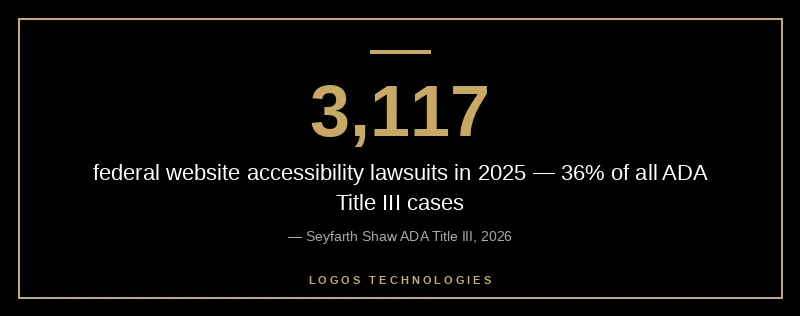
- Federal courts saw 8,667 ADA Title III lawsuits in 2025, and 3,117 of them — 36% — targeted inaccessible websites.
- Web accessibility cases jumped from 28% of filings in 2024 to 36% in 2025, the highest share on record.
- 40% of 2025 filings came from self-represented plaintiffs, a trend lawyers tie to AI tools that auto-draft complaints.
- 94.8% of the top one million home pages still fail basic WCAG checks — most sites are exposed, not compliant.
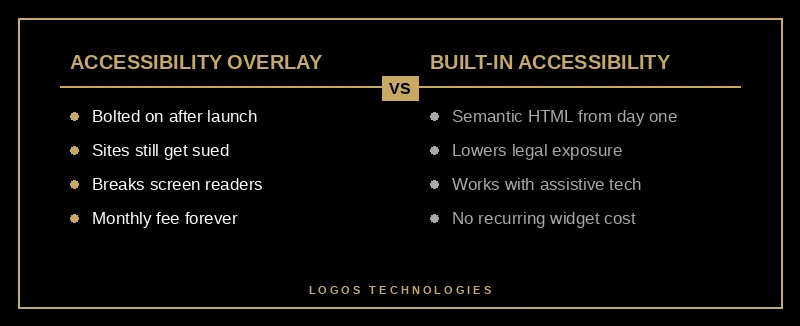
- Accessibility overlays don't grant immunity; sites running them still get sued. Build accessibility into the markup instead.
Web accessibility stopped being a niche legal worry the moment it became a third of every disability-access case in federal court. In 2025, plaintiffs filed 8,667 ADA Title III lawsuits, and 3,117 of them targeted websites — 36% of the total, up from 28% a year earlier. For a small business owner who has never thought about screen readers or color contrast, that shift is the whole story: the website you treated as a digital brochure is now the single most-litigated asset your company owns.
This is no longer just a coastal-enterprise problem. Most of these suits begin with a templated demand letter, target sites that fail automated checks in seconds, and never require the plaintiff to prove much beyond "I couldn't use it." If your site runs on a page builder or a stock theme, it almost certainly fails those checks today. Here's what's actually driving the surge — and the build decisions that lower your exposure.
What is an ADA website lawsuit?
An ADA website lawsuit is a claim that a business's website is a "place of public accommodation" under Title III of the Americans with Disabilities Act and is inaccessible to people with disabilities — usually because it fails Web Content Accessibility Guidelines (WCAG) 2.1 Level AA. Plaintiffs typically allege they couldn't complete a task — buy a product, book an appointment, read a menu — using a screen reader or a keyboard alone.
The ADA itself never mentions websites; it was signed in 1990. But courts and the Department of Justice have repeatedly applied it to digital storefronts, and the DOJ has aligned its expectations with WCAG 2.1 Level AA, the standard the W3C maintains and the benchmark nearly every settlement references. That is why "we didn't know websites counted" has never been a winning defense, and why the safest posture is to assume your public-facing site is in scope.
Why are ADA website lawsuits surging in 2026?
Three forces are stacking on top of each other. First, web cases keep climbing as a share of all disability filings — from roughly a quarter of cases to better than a third in a single year. Second, a wave of self-represented plaintiffs has flooded the docket: 40% of 2025 federal filings came from pro se plaintiffs, and defense attorneys attribute the spike to AI tools that draft complaints in minutes. When the cost of filing collapses, volume explodes.
Third, the legal map got bigger. The European Accessibility Act became enforceable on June 28, 2025, and it reaches any business — including US companies — that sells digital products or services to customers in the EU. Penalties can run as high as €3 million depending on the member state, and enforcement bodies issued their first formal notices within days of the deadline. If you ship or sell anywhere in Europe, "I'm a US business" is no longer a shield. The filings also stay geographically concentrated: California led with 3,252 cases in 2025, with Florida and New York close behind, but serial plaintiffs in those states routinely pursue businesses nationwide whose sites they can open from anywhere.
How exposed is the average small business website?
Most sites are wide open. The WebAIM Million found that 94.8% of the top one million home pages had detectable WCAG failures in 2025, averaging 51 distinct errors per page. These aren't obscure edge cases. The most common failures — low-contrast text, missing image alt text, empty links and buttons, and unlabeled form fields — are exactly what an automated scanner (and a plaintiff's attorney) checks first. And the trend line is barely moving — homepage accessibility has improved only marginally over the past six years — so the vast majority of the web stays litigable even as the filing rate climbs.
The uncomfortable part for small businesses is that template-driven platforms manufacture these errors at scale. A WordPress theme stacked with a dozen plugins, a drag-and-drop builder that ships div soup instead of semantic HTML, an auto-generated mega-menu with no keyboard support — each one bakes failures into every page you publish. We dug into why the quick-fix widgets don't save you in our breakdown of why accessibility overlays fail, and the litigation record agrees: businesses running overlay widgets have still been named in suits.
How do you lower your ADA website lawsuit risk?
The durable fix is architectural, not cosmetic. Accessibility that's compiled into the HTML — real headings, true button and link elements, labeled form fields, sufficient color contrast, visible focus states — is the same foundation that makes a site fast and search-friendly. Google's own Learn Accessibility course teaches accessibility as core front-end craft rather than an add-on, and Search Engine Journal has long argued that meeting WCAG, ADA, and Section 508 standards protects you from penalties while improving usability.
In practice that means starting from semantic, hand-written markup instead of retrofitting a bloated template, and testing with a keyboard and a screen reader before launch — not after a demand letter arrives. It also means knowing exactly where you stand. The fastest way to find your gaps is to run a full website accessibility audit against WCAG 2.1 AA, fix the high-severity issues first, and document the work you did. For the specific pass/fail criteria, our WCAG 2.2 compliance checklist walks through each one, and our guide to what an ADA compliant website actually requires covers the legal baseline in plain English.

Frequently Asked Questions
Can a small business really get sued over its website?
Yes. Plaintiffs frequently target small and mid-sized businesses precisely because they're less likely to have an accessible site or in-house counsel. Most cases settle for thousands of dollars plus remediation costs, which means volume — not company size — drives the filings.
Does an accessibility overlay protect me from a lawsuit?
No. Overlay widgets that promise instant compliance do not make a site WCAG-conformant, and businesses using them have still been named in lawsuits. Real protection comes from accessible markup, which you can plan for with accessible website design from day one.
What WCAG standard do courts use?
Settlements and the DOJ overwhelmingly reference WCAG 2.1 Level AA, and WCAG 2.2 adds further success criteria on top of it. Building to 2.2 AA keeps you ahead of the standard most commonly cited in complaints.
Do US businesses have to follow the European Accessibility Act?
If you sell digital products or services to customers in the EU, yes. The EAA's requirements apply based on where your customers are located, not where your company is headquartered.
How fast can I find out if my site is at risk?
An automated scan flags the obvious failures in minutes, but it catches only a fraction of WCAG criteria. A combined automated-plus-manual website accessibility audit gives you the real picture and a prioritized fix list you can actually act on.
Build accessibility in, not on
ADA website lawsuits aren't slowing down, and the cheapest time to deal with accessibility is before a complaint lands — built into the code, not bolted on with a widget. At LOGOS Technologies, we hand-code fast, static, WCAG-aligned websites for small and growing businesses from our home base in Papillion, Nebraska, so accessibility and performance come standard instead of as an expensive retrofit. If you're not sure where your site stands, take a look at our web design services or contact us for a straight answer on your risk and what it would take to fix.