
Can ChatGPT Build a Website? What It Gets Right — and Where It Costs You Rankings

Table of Contents
TL;DR — Quick Hits
- Yes, ChatGPT can build a website — it writes solid HTML and CSS, and as of 2026 the Wix and Jimdo ChatGPT apps generate full sites inside a chat.
- The catch: most AI-generated sites ship as JavaScript-rendered single-page apps, and crawlers plus AI engines often can't read content that only appears after JavaScript runs.
- Google doesn't penalize AI content for being AI — it judges quality, originality, and whether the page meets Core Web Vitals (2.5s LCP, 200ms INP, 0.1 CLS).
- ChatGPT is a great scaffolding tool and a poor growth engine: use it to draft, not to publish your money pages unedited.
- With ChatGPT drawing 5.4 billion monthly visits, your site now has to be readable by AI engines too — and JS-only pages are invisible to them.
"Can ChatGPT build a website?" is one of the most common questions small business owners ask in 2026, and the honest answer is more interesting than yes or no. ChatGPT will absolutely generate working HTML, CSS, and even starter copy for you, and the newest AI builders go further — Wix shipped a ChatGPT app in March 2026 and Jimdo launched one in February 2026, both of which spin up a complete site from a short conversation. The marketing makes it sound like web design is now a solved problem.
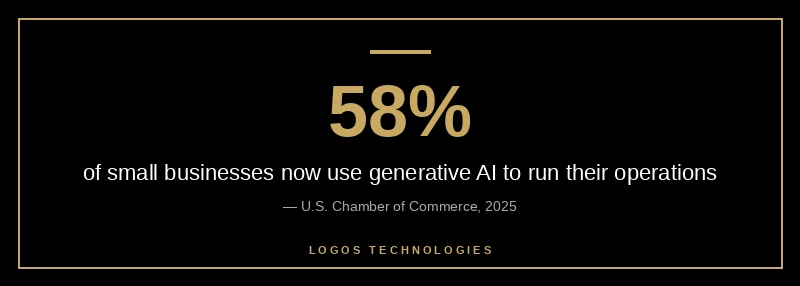
The reality is that building a website and building one that gets found and converts are two different jobs. 58% of small businesses now use generative AI to run some part of their operation, according to the U.S. Chamber of Commerce — so the question is no longer whether to use these tools, but where they help and where they quietly cost you. This post is the practical version of that answer. If you want the full landscape first, start with our guide to AI in web design for small businesses in 2026.
Can ChatGPT build a website?
Yes — ChatGPT can build a website, but not entirely on its own and not one that is ready to rank without work. It can generate a site's structure, write clean HTML and CSS for headers, sections, and footers, draft your copy, and even suggest meta descriptions and headings. With the Wix and Jimdo ChatGPT apps, it can now assemble and publish a live site from a few prompts. What it cannot do reliably is make the dozens of strategic decisions — information architecture, performance budgets, schema, conversion design — that determine whether the finished site earns customers or just exists.
Think of ChatGPT as an extremely fast junior developer who has never seen your business. It produces a competent first draft in minutes, which is genuinely useful. But it does not know that your strongest selling point is your 24-hour turnaround, that your buyers compare you to three specific competitors, or that your phone number needs to be the most tappable element on mobile. That judgment is the actual work of AI in web design, and it is the part the chat window skips.
What ChatGPT gets right when building a website
ChatGPT is genuinely good at the mechanical layer of web building: generating semantic HTML, writing tidy CSS, scaffolding responsive layouts, and producing first-draft copy and metadata fast. For a simple landing page or a quick prototype, it can save hours. Google has been explicit that this is fine — its guidance on AI-generated content focuses on quality and how content is created and why, not on whether a machine helped produce it. Using AI to draft is not a shortcut to a penalty.
Where ChatGPT shines is as an accelerant for someone who already knows what "good" looks like. It is excellent for brainstorming site structure, generating boilerplate you would otherwise hand-type, and rewriting clunky paragraphs. The newer AI builders also handle the tedious setup — sitemaps, robots.txt, basic meta tags — automatically. None of this is the problem. The problem is what happens when business owners treat the first draft as the finished product. We dug into that gap in detail in what AI website builders miss, and it is exactly where rankings leak away.
Where a ChatGPT-built website quietly costs you rankings
The biggest hidden cost is rendering. Most AI builders generate React-based single-page applications that rely on client-side rendering: the server sends a nearly empty HTML shell, and JavaScript fills in the headings, text, and images after the page loads. That feels fine in your browser, but it is a real risk for visibility — search and AI crawlers struggle with content that only exists after JavaScript runs. If your headline and body copy are painted in by script, Google may index a blank page, and AI engines like ChatGPT, Perplexity, and Claude — which crawl far less patiently than Google — often see nothing at all.
That matters more every quarter. AI Overviews now appear on a majority of U.S. searches, and organic click-through can fall by more than 60% when an AI Overview is present, per Search Engine Journal. Being readable by AI engines is no longer optional — and a JavaScript-only page is the easiest way to be invisible to them. With ChatGPT alone pulling 5.4 billion monthly visits, the audience you are hiding from is enormous.
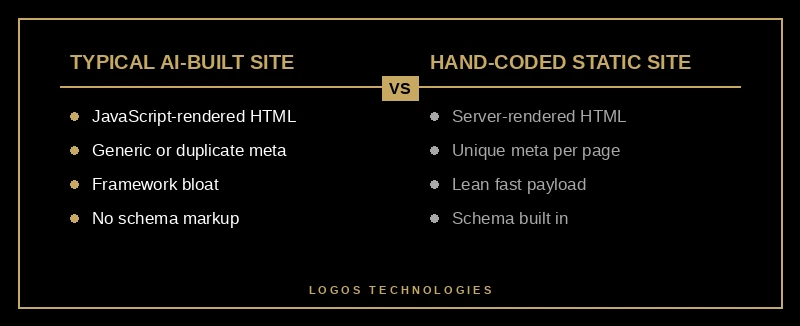
The second cost is performance. AI builders frequently add framework bloat that drags down Core Web Vitals — Google's measurable thresholds for a good page experience: Largest Contentful Paint under 2.5 seconds, Interaction to Next Paint under 200 milliseconds, and Cumulative Layout Shift under 0.1. A heavy JavaScript bundle blows past the INP budget on the first tap, and that is a ranking signal, not a vanity metric. The third cost is sameness: generic AI copy and missing schema make a site indistinguishable from thousands of others, which is the opposite of what AI-generated websites need to actually rank on Google.
How do you make a ChatGPT-built website rank? A 5-step fix
You make a ChatGPT-built site rank by closing the gap between "it loads" and "it's readable, fast, and distinct." None of these steps require throwing the AI draft away — they turn it into something Google and AI engines can actually use. Here is the order that matters.
1. Check if it renders without JavaScript
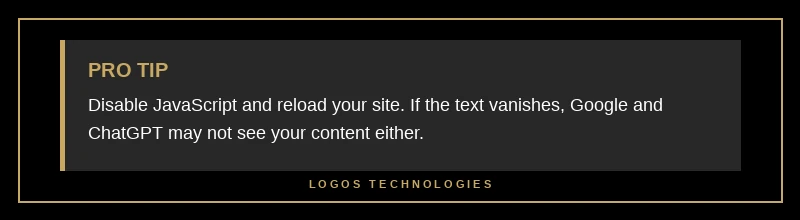
Disable JavaScript in your browser and reload the page. If your headings and paragraphs disappear, crawlers and AI engines likely can't see them either. The fix is to render critical content as server-side or static HTML so it exists before any script runs.
2. Add unique titles, meta, and schema
Give every page its own title tag and meta description — AI builders routinely duplicate or skip them — and add structured data such as Organization, LocalBusiness, and FAQPage markup. Schema is how you tell search engines and AI crawlers exactly what your page is about.
3. Fix Core Web Vitals
Strip out unused JavaScript, compress oversized images, and defer non-essential scripts until the page hits Google's 2.5s LCP, 200ms INP, and 0.1 CLS thresholds. This is usually where the most ranking is recovered.
4. Build a real internal link structure
Connect related pages with descriptive anchor text so Google can map how your topics relate. AI tools tend to ship orphaned pages with no links between them, which wastes the authority you are trying to build.
5. Add genuine, experience-based content
Replace generic AI filler with specifics only your business knows — real pricing, real process, real outcomes. Google's May 2026 resource on generative-AI optimization reiterates that unique, non-commodity content is what wins visibility in AI search.
When ChatGPT is the right tool — and when it isn't
ChatGPT is the right tool when the stakes are low and speed matters: a temporary landing page, an internal tool, a prototype to show a stakeholder, or first-draft copy you intend to edit. In those cases the trade-offs above barely register, and the time savings are real. It is also a fine starting point if you have the skills to audit and harden the output yourself — the same way a hand-coded site starts from a designer's judgment rather than a template.
It is the wrong tool when the website is the business — when your livelihood depends on ranking for competitive terms, converting paid traffic, or showing up in AI Overviews ahead of your competitors. In 2026, AI website builders are best understood as launch tools, not growth engines. If search is your primary channel, you will outgrow a chat-generated site quickly, and rebuilding later costs more than building it right once.
Frequently Asked Questions
Is a website built by ChatGPT bad for SEO?
Not inherently — Google judges content quality, not whether AI helped make it. The SEO risk comes from how AI sites are typically built: JavaScript-only rendering that crawlers can't read, duplicate meta tags, missing schema, and framework bloat that fails Core Web Vitals. Fix those and an AI-assisted site can rank fine.
Will Google penalize AI-generated content?
No. Google's guidance is explicit that appropriate use of AI is not against its policies, as long as the content isn't created primarily to manipulate rankings. What gets penalized is unhelpful, unoriginal, mass-produced content — regardless of whether a human or an AI wrote it.
Can ChatGPT build an e-commerce website?
It can scaffold one and draft product descriptions, but full e-commerce involves payment security, inventory logic, conversion-optimized product pages, and product schema that AI builders handle inconsistently. For a store you depend on, AI is a useful drafting assistant, not a replacement for deliberate design.
How much does a ChatGPT website cost?
ChatGPT access plus an AI builder subscription can run from free to roughly $30 a month, which is cheap up front. The real cost is downstream: the lost leads from a site that doesn't rank or convert, plus the eventual rebuild. A site built correctly the first time is almost always cheaper over its life.
Build a site that ranks, not just one that loads
ChatGPT is a remarkable tool, and at LOGOS Technologies we use AI every day to move faster — but we ship hand-coded, static, server-rendered sites that load instantly, pass Core Web Vitals, and are readable by both Google and the AI engines your customers now search with. That is the difference between a website that exists and one that earns. If you are weighing whether an AI-built site is enough for your business, see our web design services or contact us — we are based in Papillion, Nebraska, and we build sites designed to rank from the first line of code.