Will AI Replace Web Designers? What Small Business Owners Need to Know in 2026

Table of Contents
TL;DR — Quick Hits
- No. AI is not replacing web designers in 2026 — the U.S. Bureau of Labor Statistics projects web design and development jobs to grow 7% through 2034, faster than average.
- AI is replacing the commodity layer: generic five-page template sites. It is not replacing the strategy, performance, and conversion work that makes a site rank.
- AI website builders generate JavaScript-heavy pages that often fail Google's Interaction to Next Paint threshold of 200ms — a real, measurable ranking cost.
- 58% of small businesses now use generative AI, but the smart ones use it as a tool, not a replacement for design judgment.
- The right question is not "will AI replace designers" but "can an AI-built site rank and convert as well as a hand-coded one." Usually, not yet.
Search volume for "will AI replace web designers" has climbed steadily through 2026, and it is easy to see why. The AI-powered website builder market reached an estimated $3.41 billion in 2026, up from $2.87 billion the year before, and tools that promise a finished website in minutes are everywhere. If you run a small business and you are weighing whether to hire a designer or just let an AI tool spin one up, the marketing makes the choice sound obvious.
The data tells a more useful story. The U.S. Bureau of Labor Statistics projects employment of web developers and digital designers to grow 7% from 2024 to 2034 — much faster than the average for all occupations, with about 14,500 openings a year. AI is not killing this field. It is reshaping it, and understanding how that reshaping works is the difference between a website that quietly costs you customers and one that earns them.
Will AI replace web designers in 2026?
No — AI will not replace web designers in 2026, but it is permanently changing what the job is. The repetitive, commodity end of the market — generic brochure sites, cookie-cutter templates, boilerplate blog setups — is being absorbed by AI tools. The strategic end — understanding a business's customers, structuring a site so it ranks, and tuning it so visitors actually convert — is becoming more valuable, not less.
Think of AI the way the calculator changed accounting. Arithmetic got automated; judgment about what the numbers mean did not. A modern designer who uses AI to scaffold layouts, draft copy, and generate starter code ships faster than ever. But the parts that decide whether your site makes money — information architecture, page speed, trust signals, and search visibility — still need a human who knows what "good" looks like. We unpack the full landscape in our guide to AI in web design for small businesses, but the short version is this: AI raised the floor and the ceiling at the same time.

What AI actually does well in web design today
AI is genuinely good at the early, repetitive, and exploratory parts of building a site. Adoption proves it: 58% of small businesses now use generative AI, up from 40% in 2024 and just 23% in 2023, and the typical adopter now runs a median of five AI tools. The wins are real.
Where AI shines is first drafts and grunt work: generating layout options to react to, writing alt text and meta descriptions at scale, producing starter copy you then edit, and even scaffolding HTML and CSS. On the marketing side, AI search optimization has become its own discipline — Semrush's AI SEO research documents how fast AI Overviews and AI-driven search are reshaping how people find businesses. A designer who ignores these tools in 2026 is working with one hand tied behind their back. The mistake is assuming the first draft is the finished product. AI website builders are great at producing something; they are weak at producing something that ranks and converts, which we cover in depth in what AI website builders miss.
Where AI-built websites still fall short
AI-built websites consistently struggle on the things Google actually measures: performance, structure, and trust. The most common failure is speed. AI builders tend to ship bloated, JavaScript-heavy pages, and that directly hurts Interaction to Next Paint, which Google considers "good" only at 200 milliseconds or less at the 75th percentile. Miss that threshold and your Core Web Vitals score drops, and so does your ranking ceiling.
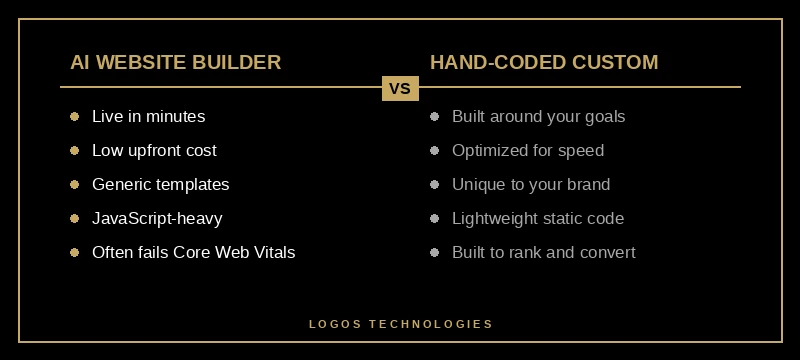
The pattern repeats across the board. AI tools optimize for "looks done," not "performs well." They reuse generic component patterns that bloat the DOM, rarely implement proper semantic structure or schema markup, and produce content that reads like every other AI-generated page — which is exactly the kind of low-information-gain content Google's recent updates demote. This is why an AI-generated website can struggle to rank on Google even when it looks polished. A site built fast and static from the ground up sidesteps all of it; that is the entire case for hand-coded custom web design, and it shows up clearly when you measure against the March 2026 Core Web Vitals standards.
How should a small business owner decide?
Decide based on the job the website has to do, not on how fast you can launch it. If you need a simple placeholder — a one-page presence for a hobby project or a temporary landing page — an AI builder is a perfectly reasonable, low-cost choice. Nobody needs to hand-code a coming-soon page.
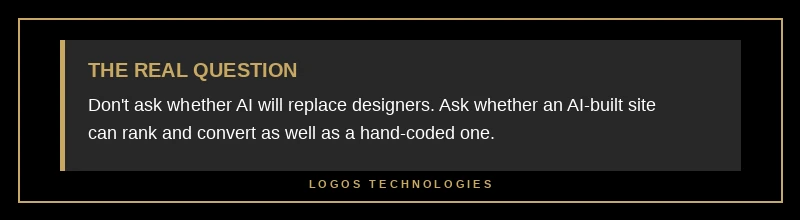
But if your website is supposed to bring in customers — if it competes in search, runs your storefront, or is the first impression a serious lead gets — the calculus flips. At that point the question is not "will AI replace web designers," it is "can an AI-built site rank, load fast, and convert as well as a professionally built one." In 2026, the honest answer is usually not yet. The cost of a slow, generic site is not the build fee you saved; it is the customers who bounced before the page finished loading. AI is a powerful tool in a skilled designer's hands. On its own, it is a fast way to produce an average website in a market where average does not rank.
Frequently Asked Questions
Will AI website builders make professional web designers obsolete?
No. AI website builders are eating the low end of the market — simple template sites — but professional designers remain essential for strategy, performance optimization, accessibility, and conversion. The Bureau of Labor Statistics still projects steady job growth for the field through 2034, which would not happen if AI were making the role obsolete.
Can a website built entirely by AI rank on Google in 2026?
It can, but it usually ranks worse than a professionally built site. AI tools tend to produce slow, JavaScript-heavy pages with thin, generic content — exactly what Google's helpful-content and Core Web Vitals signals penalize. Ranking well takes deliberate work on speed, structure, and genuine information gain that most AI builders do not do automatically.
Should I use an AI website builder for my small business?
It depends on what the site needs to accomplish. For a temporary placeholder or hobby project, an AI builder is fine. For a site that must compete in search and convert visitors into paying customers, a hand-coded, performance-first build will almost always deliver better long-term ROI.
Do real web designers use AI tools themselves?
Yes, widely. Most modern designers use AI to draft copy, generate layout options, write metadata, and scaffold code — then apply human judgment to everything that affects ranking and conversion. Using AI as an assistant is now standard practice; handing the entire job to it is not.
Will AI replace web designers eventually?
There is no evidence of that on the horizon. AI keeps getting better at production tasks, but websites that win still require human decisions about strategy, brand, trust, and how a business actually makes money. For the foreseeable future, the designers who thrive will be the ones who use AI well — not the ones it replaces. If you want the bigger picture, our overview of AI in web design for 2026 breaks down where these tools help and where they hurt.
If you are deciding between an AI builder and a site built to actually rank, that is exactly the conversation we have every week with business owners here at LOGOS Technologies in Papillion, Nebraska. We build fast, static, hand-coded websites designed to load instantly and rank on Google — the parts AI still cannot do on its own. Take a look at our web design services or contact us and we will tell you honestly whether your project needs a custom build or whether a simpler tool would serve you just fine.