
AI in Web Design 2026: What Small Business Owners Actually Need to Know

Table of Contents
TL;DR — Quick Hits
- Around 68% of U.S. small businesses now use AI regularly, up from 48% a year earlier, and 91% of SMB AI users say it has boosted revenue.
- AI Overviews now appear on roughly 50–60% of U.S. Google searches and can cut top-result click-through rates by 58% or more on affected queries.
- AI is genuinely useful for research, drafts, alt text, schema, and image compression — not for writing your whole site or building your whole site.
- AI-generated sites that skip semantic HTML, schema, and Core Web Vitals tuning are the ones losing citations in 2026, not the ones using AI carefully.
- The winning 2026 pattern for small business web design is human-led strategy plus AI-assisted execution, with a fast static site underneath.
The data on AI in web design 2026 has stopped being abstract. A QuickBooks survey found that 68% of U.S. small businesses now use AI regularly — up from 48% in mid-2024 — and 91% of the small and mid-sized businesses that use AI say it has boosted revenue. At the same time, Google's own search results have changed shape: AI Overviews now appear on roughly half of U.S. queries, and a February 2026 Ahrefs study found that only 38% of pages cited inside an AI Overview also rank in the top 10 for the same query.
That second number is the one small business owners need to sit with. Citations and rankings have decoupled. Sites that got by on generic templates, stock copy, and "good enough" SEO are not just slipping in the rankings — they are being skipped entirely by the AI layer that now sits on top of search. So the question is no longer "should I use AI for my website." The question is where to use it, where not to, and what kind of site underneath can actually benefit from the rest.
What AI in Web Design Actually Means in 2026
AI in web design 2026 means three distinct things, and confusing them is the fastest way to make a bad decision. It means AI-powered website builders that generate an entire site from a text prompt. It means AI tools embedded inside traditional design and development workflows — Figma Make, GitHub Copilot, image upscalers, schema generators, content drafting assistants. And it means the AI layer on the search side — Google's AI Overviews, Gemini, ChatGPT, and Perplexity — that now decides whether human searchers ever see your site at all.
Most of the noise you read online collapses all three into one conversation. They are not the same. A small business owner can use the second category heavily, ignore the first category entirely, and still rank and convert better than competitors who bought into the first.

The builders are the most visible layer because they are marketed the hardest. Wix ADI, Framer AI, Durable, Hostinger AI, and a wave of 2026 startups all promise a full site in under a minute. Coalition Technologies and other agencies have pointed out that these tools have improved — they now ship decent title tags, meta descriptions, and mobile layouts by default. But "SEO-safe" is not "SEO-strong," and that gap matters more in 2026 than it did in any prior year.
Where AI Genuinely Helps Small Business Websites
AI earns its keep in a small business web project wherever the work is repeatable, verifiable, and not the core brand decision. That is a surprisingly long list once you stop trying to hand the whole project off.
Research and outlining. Pulling ten competitor pages into a prompt and asking for the shared structure, the missing subtopics, and the questions the People Also Ask box surfaces will give a small business owner a sharper content brief in ten minutes than most marketing agencies produce in a week. The output still needs a human to sanity-check, but the research floor has risen.
Drafting copy that a human edits. AI is a strong first-draft writer and a mediocre final-draft writer. Used as the former, it saves hours. Used as the latter, it produces the flat, pattern-matched prose that AI Overviews now actively deprioritize as unoriginal. If you cannot tell the difference, the AI is writing your site, not helping you write it.
Alt text, schema markup, and meta descriptions. These are high-leverage SEO surfaces that most small business sites ignore. AI handles them well because the tasks are bounded and easy to verify. For schema specifically, we covered the full picture in our 2026 schema markup guide — AI is a legitimate shortcut for producing the JSON-LD, but you still need to know which types to emit and which to skip.
Image work. Upscaling hero photos, background removal, and WebP conversion used to be a real cost. In 2026 they are a prompt. The performance win is real — smaller images mean faster Largest Contentful Paint times, which is one of the ranking signals Google still weighs heavily.
Personalization and chat. A proactive on-site assistant that answers common questions, captures leads, and books appointments is within reach for a sole proprietor for the first time. According to Salesforce, 77% of SMBs say marketing and customer engagement are their top priority areas for AI solutions — not site generation.
Internal site search and FAQ generation. AI embeddings are excellent at turning a pile of service pages and blog posts into a searchable help layer. For a service business with dozens of pages, that alone can lift conversion.
Notice what is not on that list: choosing your positioning, writing the hero, picking your colors, laying out your homepage, or deciding what your site should do. Those are the strategic decisions that set the ceiling for everything else, and AI is not good at them yet.
Where AI in Web Design Quietly Costs You Money
This is the harder part to see because the costs show up months later, after the site is live.
The first cost is code bloat. Full-site AI builders generate markup that works but is far heavier than what a careful developer would ship. Extra DOM nodes, inline styles, script-heavy layouts, and fonts loaded from three CDNs add up to slower pages. Google's Core Web Vitals rubric at web.dev/vitals is unforgiving about that — and Core Web Vitals are still a ranking signal in 2026, even if the thresholds have shifted. We broke down what changed specifically in our Core Web Vitals 2026 guide.
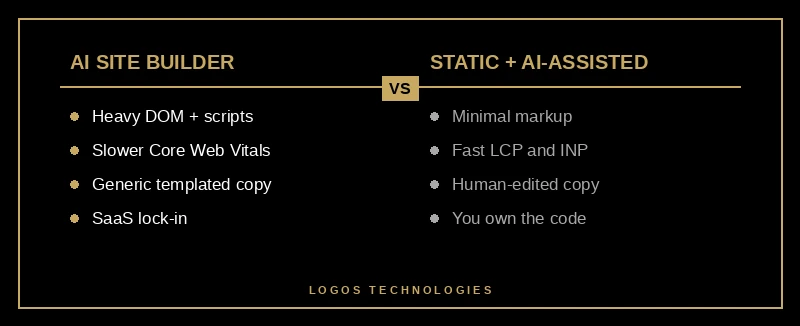
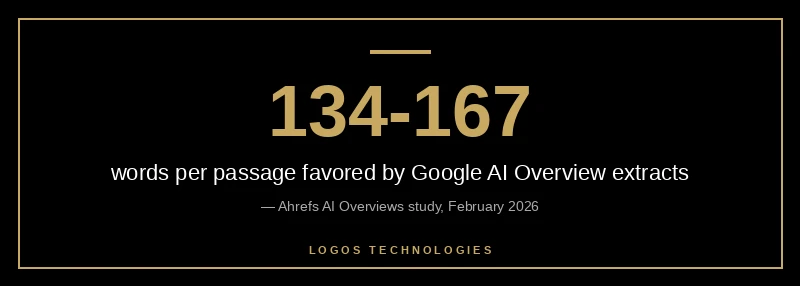
The second cost is content flatness. AI-drafted copy that ships without a human rewriting it reads like AI copy, and the AI layer on the search side is starting to detect that. Google's March 2026 core update reweighted what the industry has taken to calling "information gain" — how much a page adds that the existing top-ranking pages do not. A section that restates the consensus in slightly different words is no longer enough. AI Overviews favor 134–167 word passages that deliver a specific, attributable claim, and 88% of AI Overviews cite three or more sources — which means your content has to either be the source or go uncited.
The third cost is lock-in. AI site builders are software-as-a-service platforms. You are renting, not owning. If the vendor raises prices, changes the export format, pivots, or shuts down, the site you "built" in five minutes becomes a migration project measured in months. We cover this in detail in our breakdown of AI website builders versus hand-coded sites, which is the most-read cluster under this topic for a reason.
The fourth cost is the one nobody advertises: identical-looking sites. AI builders pull from the same training set of patterns, so sites generated by competing tools tend to look eerily similar. For a local business, looking like every other AI-built site in your market is a disadvantage the builder's marketing page will never mention.
AI-Built Sites vs Custom-Built Sites: What Changes for SEO in 2026?
The technical gap is narrower than it was, but the SEO gap is wider. Most AI website builders in 2026 are SEO-safe — they produce valid HTML, populate title tags, and do not block crawlers. Very few are SEO-strong. This is the single most consequential distinction in AI in web design 2026 and the one that separates sites that grow from sites that plateau.
Being SEO-strong in 2026 means clean semantic markup, fast load times, proper schema, strategic internal linking across a growing content library, and content genuinely written to match search intent. That list maps almost one-to-one to the ranking surfaces the AI layer on the search side uses to decide who gets cited. The 44.2% of LLM citations that come from the first 30% of a page are not going to hand-built sites because those sites are older — they go to hand-built sites because those sites have been architected to put the answer up top.
A static-site architecture — what we build at LOGOS Technologies, using Eleventy and a fast hand-coded frontend — also has a structural SEO advantage that AI builders struggle to match: there is no runtime, no database query, no hydration stall. The page the crawler sees is the page the user sees, and both are fast. AI tools inside that workflow are great. AI tools replacing that workflow are not.
The short version is that the question "AI or custom" is the wrong question. The right question is "static site with AI-assisted workflow" versus "AI builder-generated site." We unpack the full decision framework in our guide to how small businesses should actually rank on Google in 2026, and it applies directly here.
How to Use AI Without Wrecking Your Google Rankings
If you are running a small business and want to approach AI in web design 2026 intelligently, the pattern that is working looks like this. Google's own guidance on AI-generated content has been consistent since early 2023: what matters is whether the content is high quality, helpful, and original — not whether a human or a model produced the first draft.
Start with strategy. Write the positioning, the offer, and the three things your site must accomplish as a human. A prompt cannot tell you what makes your business different — you tell it. If you cannot articulate that clearly, AI will produce generic output, because that is what generic input earns.
Pick an architecture that will not fight you later. A static site built on a modern generator like Eleventy gives you near-free performance and deep SEO control, and it plays nicely with every AI tool in the pipeline. A bloated builder-generated site fights every tool.
Use AI for the research, the drafts, the alt text, the schema, the image compression, and the internal link suggestions — then have a human do the final pass. This is the pattern sayenkodesign, Coalition Technologies, and most serious 2026 agencies are converging on, and it is the pattern we use at LOGOS Technologies.
Measure the right things. Track AI Overview citations, not just organic rankings. Track Largest Contentful Paint and Interaction to Next Paint, not just "pagespeed score." Track qualified leads, not just traffic. We broke down the metrics that actually matter for small business sites in more depth — the short version is that the AI era rewards sites that optimize for the one percent of visits that convert, not the sixty percent that bounce.
Most importantly, do not outsource your brand voice to a model. The content flatness penalty is real in 2026, and the businesses whose writing sounds distinctly like them are the ones being cited by the AI layer, because those are the ones adding information the model has not already absorbed from ten thousand other sites.
Finally, plan to revisit this stack every quarter. The AI layer on the search side is shifting faster than any other part of SEO, the tools on the production side ship meaningful updates every few weeks, and the competitive pressure on small business search terms is rising. A website strategy that treats AI in web design 2026 as a one-time decision will age out by the end of the year. A strategy that treats it as a discipline — with recurring checks on Core Web Vitals, AI Overview citations, and content freshness — is the one that keeps compounding.
Frequently Asked Questions
Is AI replacing web designers in 2026?
AI is not replacing web designers in 2026, but it is replacing the parts of a web designer's job that were always repetitive — basic layout generation, rote copy drafts, alt text, meta descriptions, and asset production. A TechRadar survey reported that 75% of web designers now fear AI more than shrinking budgets, but the designers gaining market share are the ones using AI to ship faster and focusing their own hours on strategy, brand, and technical performance.
Are AI-built websites bad for SEO?
Not automatically, but most AI-built websites are SEO-safe rather than SEO-strong. They produce valid markup and basic meta tags, but they tend to miss on semantic HTML depth, Core Web Vitals tuning, clean internal linking, and the kind of differentiated content that earns AI Overview citations. A hand-coded static site combined with AI-assisted workflow consistently outranks an AI-generated site in competitive categories.
How does AI in search affect small business websites?
AI Overviews now appear on roughly 50–60% of U.S. Google searches and have reduced click-through rates on affected queries by around 58% for the top organic result. For small business sites, the practical impact is that ranking is no longer enough — you have to structure content to be extractable as an AI answer, with direct-answer sentences in the first 200 words, 134–167 word passages, and schema markup that tells the AI layer what the page is.
Should I use an AI website builder for my small business?
If your only goals are minimum cost and fastest possible launch for a single-page brochure site, an AI builder is a valid starting point. If the site is a strategic asset — a source of leads, bookings, sales, or credibility — an AI-built site will hit a ceiling that you will eventually pay to migrate off. A custom static site with AI-assisted workflow tends to cost less over a three-year horizon and ranks better from day one.
What AI tools should a small business actually use for its website?
Use AI for first-draft copy that a human will edit, for alt text and meta descriptions, for JSON-LD schema generation, for image compression and WebP conversion, for on-site chat and FAQ, and for competitive research. Avoid AI for your positioning, your hero section, your homepage strategy, or any final-draft content. The rule of thumb is that AI is excellent for bounded, verifiable tasks and poor for tasks that require taste or original insight.
Does Google penalize AI-generated content?
Google does not penalize AI-generated content specifically — it penalizes unoriginal, low-information-gain content, which AI-generated content often happens to be. The March 2026 core update reweighted information gain as a ranking signal. AI content that a human has edited, fact-checked, and added original perspective to performs well. AI content shipped raw performs badly. The distinction is craft, not detection.
Ready to Build a Website That Works With AI, Not Against It
AI in web design in 2026 is neither a threat nor a magic wand. It is a set of tools, and like any set of tools, it rewards people who know which one to use for which job. The small businesses winning in this environment are the ones treating AI as leverage on top of a fast, hand-coded static site — not as a replacement for the strategy, the brand, and the engineering that make a website actually perform.
LOGOS Technologies is based in Papillion, Nebraska, and builds fast static websites for small and mid-sized businesses across the country. We use AI heavily in our own workflow — for research, drafts, schema, and image work — and never for the parts of a site that decide whether a visitor converts. If you are weighing an AI builder against a custom site, or trying to figure out how to make the AI-era search layer actually cite your business, take a look at our web design services or contact us to talk through what would actually work for your business.