
AI Website Builder vs Hand-Coded: What Actually Matters for Your Business

Table of Contents
The AI website builder market hit $2.87 billion in 2025 and is projected to reach $3.41 billion this year. Platforms like Wix ADI, Framer, and a wave of newer tools promise to build your entire website from a text prompt. Type a description of your business, hit enter, and watch a full site materialize in under a minute.
It sounds like the end of traditional web development. But after working with businesses that have tried the AI-first approach — and then come looking for something better — the picture is more complicated than the marketing suggests.
The real question isn't whether an AI website builder can produce a website. It obviously can. The question is whether what it produces will actually perform for your business over the next two to three years.
What AI Website Builders Get Right
Credit where it's due: AI web design tools have gotten dramatically better. The best platforms in 2026 can generate responsive layouts, populate content that at least reads like it belongs on a business website, and handle basic SEO metadata automatically. According to The Business Research Company, the AI-powered design tools market is growing at a 22% compound annual rate, and that growth isn't accidental — these tools solve real problems.
For a solo freelancer who needs a portfolio page up by Friday, or a brand-new business that needs something online while they figure out their real strategy, an AI website builder can work as a starting point. Speed to launch is a legitimate advantage. Some platforms cut development timelines by 60% compared to traditional workflows.
But "speed to launch" and "built to perform" are two very different things.
Where the Code Falls Apart
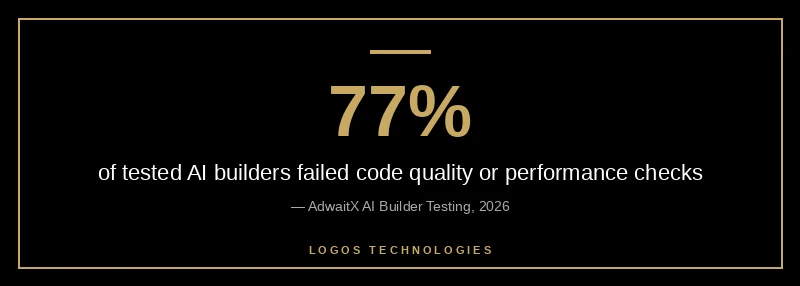
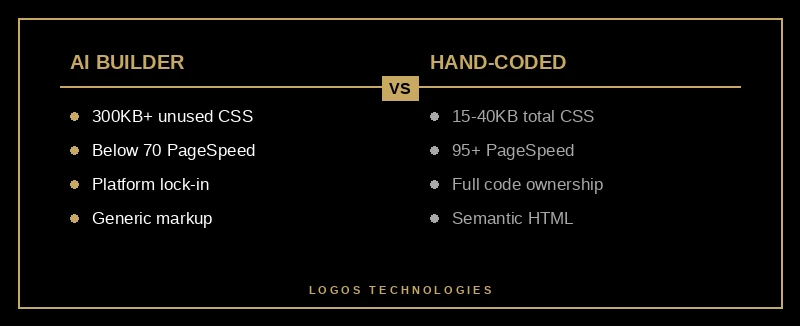
Here's where the AI-versus-hand-coded conversation gets interesting. Independent testing of over 30 AI website builders found that 23 of them failed basic quality checks — specifically, they shipped with over 300KB of unused CSS, lacked export options (locking you into the platform), or scored below 70 on Google PageSpeed Insights.
That 300KB of unused CSS isn't just an abstract concern. Every kilobyte of unnecessary code your site downloads is time your visitor spends waiting. Google's own research has shown for years that each additional second of load time increases bounce rates. When we build a site with clean, hand-written HTML and CSS, the total stylesheet for a typical small business site runs between 15KB and 40KB. That's not a minor difference — it's an order of magnitude.
The issue goes beyond file size. AI-generated markup tends to nest divs inside divs inside divs, creating a DOM structure that makes browsers work harder to render. Third-party JavaScript from tracking pixels and embedded widget scripts adds to the initial payload. The result is a site that looks finished but runs like it's carrying a backpack full of rocks.
We've written extensively about why speed needs to be built into a site from the start, not bolted on after the fact. AI builders do the opposite — they generate everything at once and then leave you to figure out what's slowing things down.
Does an AI Website Builder Actually Help You Rank on Google?
This is the question that matters most to small businesses, and the honest answer is: most AI website builders are SEO-safe but very few are SEO-strong. That distinction matters more in 2026 than it ever did.
Being SEO-safe means the platform generates valid HTML, includes a title tag and meta description, and doesn't actively block search engines from crawling your content. Being SEO-strong means your site has clean semantic markup, fast load times, proper schema structured data, optimized images, strategic internal linking, and content that's written to match real search intent — not just fill a page.
According to SE Ranking's 2025 analysis, roughly 94% of all web pages receive zero organic traffic from Google. The sites that break into that top 6% don't get there by accident. They get there through clean code, strong technical SEO foundations, and content that answers real questions better than the competition.
Most AI builders will generate a title tag for you. Very few will build proper schema markup into your pages. Even fewer will create the kind of strategic internal linking structure that helps Google understand how your pages relate to each other — something we covered in our guide to how to rank on Google in 2026.
And here's a subtler problem: AI-generated content often reads generic. Google's helpful content system is specifically designed to identify and demote content that exists primarily to rank rather than to inform. If your AI builder generated the same "Welcome to [Business Name], we offer quality [Service]" copy that ten thousand other sites are running, that's not a ranking signal — that's noise.
The Lock-In Problem Nobody Talks About
Platform lock-in is arguably the biggest risk of AI website builders, and it's the one that gets the least attention. When you build on a platform like Wix or Squarespace — AI-enhanced or not — your site lives on their servers, runs on their infrastructure, and depends on their continued existence and pricing decisions.
If you decide to move, you can usually export your content as text. What you can't export is the design system, the URL structure (without careful redirect planning), the SEO equity your pages have accumulated, or any custom functionality the platform handled for you. Migrations are expensive, time-consuming, and almost always involve a temporary rankings drop.
A hand-coded static site, by contrast, is a collection of HTML files. You can host it literally anywhere — Netlify, Vercel, Cloudflare, a $5 VPS, your own server. Moving takes minutes, not months. Your code is yours. Your design is yours. Your URLs stay exactly where they are.
We explored this ownership question in depth when comparing custom website design versus templates. The same logic applies here, amplified. At least with a traditional template, you can usually see and edit the underlying code. With an AI builder, you often can't — the code it generates is abstracted behind a visual editor, and what's underneath may not be something you'd want to maintain even if you could access it.
When an AI Builder Might Actually Make Sense
Not every business needs a hand-coded, performance-optimized site from day one. Here are the scenarios where an AI website builder is a reasonable choice:
You need a landing page live in 48 hours for a specific campaign, and it's going to be retired in a month. You're testing a business idea and need to validate demand before investing in a real web presence. You have zero budget — genuinely zero, not "I'd rather not spend money" — and need something online immediately.
In those cases, an AI builder is a tool, and using it is fine. The trouble comes when businesses treat a quick AI-generated site as a permanent solution and then wonder why they aren't showing up on Google six months later.
What a Hand-Coded Website Actually Gives You
When a developer builds your site by hand — writing the HTML, CSS, and JavaScript specifically for your business — every line of code exists for a reason. There's no unused CSS bloating your load times. There's no generic JavaScript library loading widgets you'll never use. The Core Web Vitals scores aren't something you have to fix after launch — they're baked into the architecture from the first commit.
Beyond performance, hand-coded sites give you complete control over your SEO for small business strategy. You choose exactly which schema types to implement. You structure your internal links deliberately, creating topical clusters that help Google understand your expertise. You write content for real people searching real questions, not to fill a template.
The result is a site that loads in under one second, scores 95+ on PageSpeed Insights, and is built to compound in value as your content library grows. That's not a theoretical benefit — it's what we deliver at LOGOS Technologies for every client.

The Bottom Line
AI website builders are tools — useful, improving, and genuinely helpful in the right context. But the gap between "a website exists" and "a website that ranks, converts, and grows your business" is still enormous. That gap is where code quality, technical SEO, performance optimization, and strategic content come together, and it's where the AI-generated approach consistently falls short.
If your website is the foundation of how customers find your business, it deserves more than auto-generated code and generic copy. It deserves architecture that's built to perform.
At LOGOS Technologies, we build fast, hand-coded static websites designed to rank. If you're ready to invest in a site that actually works for your business — or if you've outgrown your AI-built site and need something better — check out our web design services or get in touch with us directly. We're based in Papillion, Nebraska, and we work with businesses nationwide.