

Can AI-Generated Websites Rank on Google? What the 2026 Data Actually Shows

Table of Contents
TL;DR — Quick Hits
- Google does not penalize AI-generated websites for being AI-generated — it penalizes low-quality, scaled content regardless of origin.
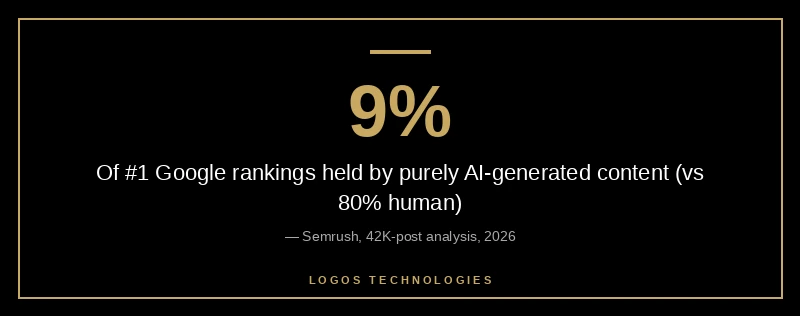
- A Semrush analysis of 42,000 blog posts found human content holds the #1 Google position 80% of the time; purely AI-generated content holds it just 9% of the time.
- About 13% of top-ranking Google content is now AI-generated, up from roughly 2% before GPT-2.
- The biggest ranking blocker for AI-built sites is not the content — it's the bloated front-end code, client-side rendering, and weak Core Web Vitals.
- The hybrid approach — AI for drafting, humans for editing, custom code for the front end — is what actually ranks in 2026.
The question is no longer whether AI-generated websites can rank on Google. They can. The question is why so many of them don't, and what separates the AI-built sites that pull traffic from the ones that quietly index and then fade.
There is now real data to answer that. Google's own guidance on AI-generated content has been public since 2023 and has not meaningfully changed: rewarding high-quality content, however it is produced, is consistent with what Google has done for many years. What has changed is the volume — AI-written pages now appear in roughly 13% of top search results, up from about 2% before GPT-2, according to a Semrush analysis of more than 20,000 blog URLs. The signal is clear: Google is not blocking AI content, but it is also not lifting it. What lifts a page in 2026 is the same thing that has always lifted a page — useful content delivered through a fast, technically clean website.
What does Google's actual AI content policy say?
Google's policy is that AI is not a ranking factor in either direction. The policy targets "scaled content abuse" — large volumes of low-value pages produced primarily to manipulate rankings — not AI as a tool. A site that uses AI to draft outlines, generate first drafts, or produce variant copy is not breaking any guideline. A site that publishes 500 thin AI-generated pages a week to chase keywords is.
The practical test is the same one Google has applied for a decade: would a real human reader find this page genuinely useful? AI-assisted content that meets that bar ranks. AI content that doesn't, doesn't. What the Search Engine Land study of 1,300 keywords found is that even when AI content technically ranks, human-edited content ranks higher — by a factor of about eight to one at position one.
How do AI-generated websites actually perform in search?
The 16-month experiment is the one to read. Researchers tracked 2,000 AI-generated articles across new domains and found that 71% were indexed within 36 days, and roughly 80% of the test sites began ranking for at least 100 queries fairly quickly. That sounds promising — until you look at month 12. Long-term visibility on those same sites stayed flat or declined. Impressions and clicks never climbed past minimal. Most of the ranking gains were front-loaded against thin competition, then erased as Google's quality signals caught up.
This matches what we see across the AI website builder market. A site generated end-to-end by an AI builder can absolutely get indexed and pick up a few long-tail rankings inside a month. What it usually cannot do is hold a competitive head-term against a hand-built site with real expertise behind it — because the moment the SERP gets crowded, the gap between "indexed" and "ranked" becomes a quality gap, and quality is exactly what scaled AI output struggles with.
A separate Semrush analysis of 42,000 blog posts found that human-written content held the #1 Google position about 80% of the time, while purely AI-generated content held #1 just 9% of the time. Notably, both human and AI content reached the top 10 at similar rates (around 57–58%), so the floor is fine. It's the ceiling — page one, top three, the positions that actually drive traffic — where the gap shows up.
Why do AI website builders struggle to rank even when the content is fine?
This is the part most articles miss. When people ask whether AI-generated websites rank, they usually mean the content. But the website itself — the HTML, the JavaScript bundle, the rendering model — is a separate ranking surface. And this is where AI website builders consistently lose points that have nothing to do with what's written on the page.
A few patterns we see across Wix ADI, Squarespace AI, Framer, and the newer agentic builders:
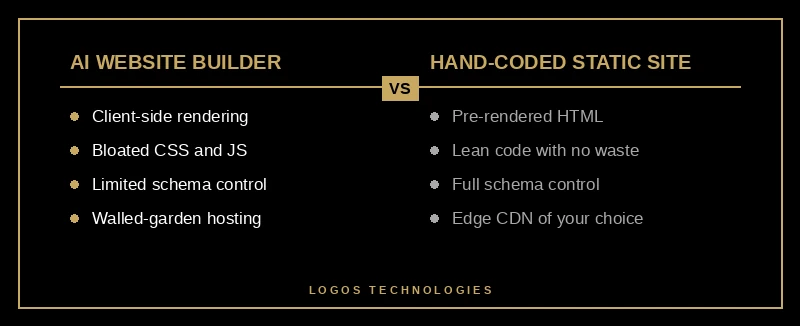
- Heavy client-side rendering. Many AI builders ship single-page-app architectures where the visible content is painted by JavaScript after the bundle loads. Googlebot can render JavaScript, but it does so on a delay and with a smaller crawl budget. The cleaner option is server-rendered or pre-rendered HTML, which is exactly what static site generators produce.
- Bloated CSS and unused JS. Drag-and-drop builders carry the weight of every feature you might use — animation libraries, form widgets, analytics shims — even when the page uses none of them. That weight shows up directly in Core Web Vitals, particularly LCP and INP.
- Limited schema and head-tag control. Most AI builders restrict access to canonical tags, structured data, and per-page meta. You can usually edit a title and description; you generally cannot inject arbitrary JSON-LD or fine-tune Open Graph at scale.
- Walled-garden hosting. When the platform owns the rendering layer, the platform decides your edge caching strategy, your headers, your CDN. That's fine for a brochure site. For a site that needs to compete on speed, it's a ceiling.
This is why the more useful framing is not "AI vs. human content" but "AI-assisted content + clean front end." We covered the broader strategic picture in our pillar guide on AI in web design 2026, and the specific tradeoffs of builders versus hand-built sites in AI website builder vs hand-coded. The takeaway is the same in both: you can use AI to write faster and still ship a site that ranks — as long as the site itself is built to rank.
What about AI Overviews — does it matter if my content shows up there?
It matters more than ranking #1 used to. As of Q1 2026, roughly 25% of Google searches now trigger an AI Overview, and the cited pages inside those overviews see CTR drops of around 34% compared to traditional position-one results — even when they're cited. The AI Overview is becoming the answer; the cited links are becoming footnotes.
The implication for AI-generated websites is double-edged. AI content can be cited in AI Overviews — Google's systems are pulling from a different signal stack there, weighted toward extractability and source authority. But AI content from a brand-new, weakly-linked domain rarely makes the cut. The sites being cited tend to be established sources with topical depth, clear formatting, and structured data. We dug into that in our guide to generative engine optimization for AI Overviews.
If you're building an AI-assisted site and the goal is to be cited in AI search, the lever is not "more AI content." It's stronger structure: schema markup, clear question-and-answer formatting, an FAQ section on every relevant page, and outbound links to high-authority sources that establish your topical neighborhood. That's the same playbook that wins traditional SEO — it just pays double in 2026.
What's the right way to use AI on a website that needs to rank?
The hybrid approach is what the data keeps pointing to: AI for the parts of writing that are mechanical, humans for the parts that are not, and custom code for the front end. Concretely:
- Use AI to research, outline, and draft. This is where the time savings are real and the quality risk is lowest.
- Have a human with actual subject expertise edit, fact-check, and rewrite anything generic. AI is structurally bad at the specific — your local market, your client mix, your edge cases. That's where the originality lives.
- Ship the site on infrastructure that Google rewards. For most small businesses, that means a static or pre-rendered site with sub-second load times, clean HTML, and full control over schema and head tags. We build LOGOS client sites this way for the same reason: it's the only way to get AI-assisted content to actually pull its weight in search.
The mistake we see most often is using AI to scale content output on a website that was never going to rank in the first place. The fix is rarely "less AI." It's usually "different website." If you want the broader playbook, our pillar guide on AI in web design for 2026 maps out where AI helps small business sites and where it quietly costs you rankings.
Frequently Asked Questions
Does Google penalize AI-generated content?
No. Google's stated policy is that AI is not a ranking factor on its own. What Google penalizes is scaled content abuse — high-volume, low-value content produced to manipulate rankings — regardless of whether a human or an AI wrote it. AI-assisted content that meets Google's quality and helpfulness standards can rank.
Can a website built entirely by an AI website builder rank on Google?
It can be indexed and rank for low-competition long-tail queries, often within a month. The harder problem is ranking competitive head terms over time. Most AI website builders carry technical SEO disadvantages — heavy client-side rendering, bloated CSS, limited schema control, weak Core Web Vitals — that quietly cap how high the site can go.
How much AI content can I have on my site without hurting SEO?
There is no percentage limit. Google has confirmed it does not measure AI-versus-human ratios. The practical limit is quality: any AI output that ships without human editing, fact-checking, or original insight tends to underperform regardless of how much or how little there is. A 10-page site of strong AI-assisted content can outrank a 200-page site of unedited AI sludge.
Will AI-generated content get cited in Google AI Overviews?
It can be, but it usually isn't from new or weakly-linked domains. AI Overviews favor sources with topical authority, structured content, schema markup, and clear question-and-answer formatting. AI-assisted content on a site that already has authority can be cited; pure AI content on a brand-new domain rarely is.
Is it cheaper to use an AI website builder than hire a custom web designer?
Up front, yes. Long term, the cost calculus is different. AI builder sites that don't rank generate no organic leads, which is usually the point of having a website in the first place. The cost of a custom-built site that ranks is recovered in the leads it brings in. The cost of a cheap AI-built site that doesn't rank compounds — every month you pay for hosting and get nothing in return.

If you're rethinking how to build or rebuild a site that has to actually rank in 2026, this is exactly the kind of problem we solve at LOGOS Technologies. We build hand-coded, static, blazing-fast websites for small businesses across Papillion, Nebraska and the rest of the country — the kind of front end that gives AI-assisted content room to breathe in search. Take a look at our web design services, or contact us and we'll walk through what your site would need to compete on AI-era Google.