

Are Page Builders Bad for SEO? What 917,000 Elementor Sites Actually Show

Table of Contents
TL;DR — Quick Hits
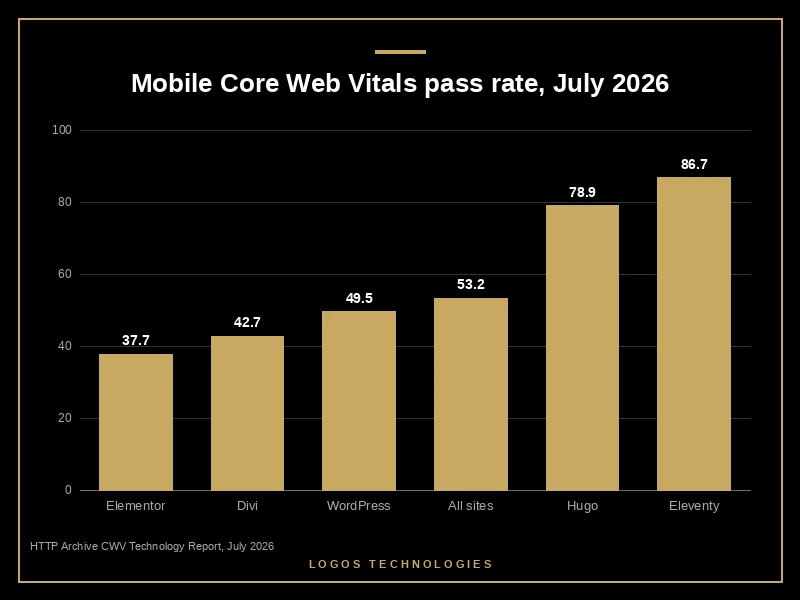
- Elementor sites pass all three Core Web Vitals on 37.7% of mobile origins. The web-wide average is 53.2%.
- Adding a page builder to WordPress costs roughly 12 percentage points of pass rate — WordPress overall sits at 49.5%.
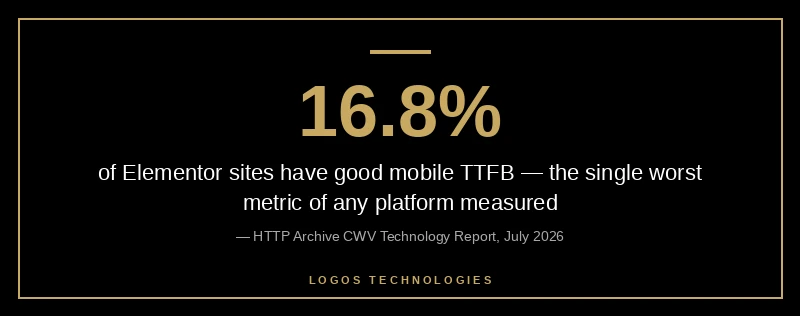
- The failure is not JavaScript. Elementor's INP passes at 89.4%; its LCP passes at 42.4% and TTFB at just 16.8%.
- Static site generators pass at 78.9% (Hugo) to 86.7% (Eleventy) on the same metric, same month.
- Page builders are not all equal: Bricks (55.3%) and Beaver Builder (54.8%) beat Elementor by about 17 points.
Most articles about page builder SEO argue from opinion — usually the opinion of whoever sells the builder. This one argues from the Chrome User Experience Report, which measures real Chrome users on real connections and publishes the results by technology every month. Pull the July 2026 numbers out of the HTTP Archive Core Web Vitals Technology Report and the picture is not ambiguous: of the 917,206 mobile origins running Elementor, 37.7% pass all three Core Web Vitals. Across all 8.7 million origins CrUX tracks, the figure is 53.2%.
That gap matters because page experience is a real, documented input to Google's ranking systems, not folklore. Google's own page experience guidance says the signals are used to help rank pages, and Semrush's audit of 50,000 domains found that 96% of sites had at least one page failing a Core Web Vitals assessment. Passing is a competitive advantage precisely because most sites do not.
Are page builders bad for SEO?
Page builders are not bad for SEO in the sense of blocking indexing or breaking crawlability — modern builders emit clean, crawlable HTML. They are bad for SEO in the narrower and more expensive sense that they consistently underperform on Core Web Vitals, and Core Web Vitals is the one ranking input the builder controls on your behalf. The July 2026 field data puts Elementor 15.5 points below the web average and 11.8 points below plain WordPress. That single number is the whole page builder SEO argument, and it is why so many owners eventually go looking for a WordPress alternative rather than another optimization plugin.
The counterintuitive part is which metric fails. Everyone assumes builders wreck interactivity because they ship so much JavaScript. They do not. Elementor's INP — Google's responsiveness metric, which replaced FID in March 2024 — passes on 89.4% of mobile origins, better than the 80.4% web-wide average. CLS passes at 88.5%, also above average.
The real problem is TTFB, not JavaScript
Elementor's weakest metric by a wide margin is Time to First Byte: 16.8% of its mobile origins are rated good. That is the lowest figure of any major platform in the July 2026 dataset — worse than WordPress overall (24.4%), far worse than Shopify (82.6%) or Squarespace (81.5%), and roughly a quarter of Eleventy's 65.2%.
TTFB measures how long the server takes to send the first byte of the document. It is not a rendering problem; it is an architecture problem. A page builder stores your layout as serialized data in the WordPress database, then reassembles it into HTML on every single request: query the database, hydrate the builder's element tree, run the shortcode and widget layer, resolve the global styles, emit the markup. None of that happens on a static site, because the HTML was already built at deploy time and is sitting on a CDN edge node.
Slow TTFB then poisons LCP, because Largest Contentful Paint cannot start until the document arrives. That is why Elementor's LCP pass rate is 42.4%. Ahrefs reached the same structural conclusion in their Core Web Vitals study of 5.2 million pages: LCP has the most contributing components and is the hardest of the three to fix. We walk through the mechanics of that chain in our guide to reducing Time to First Byte.
Not every page builder performs the same
Treating "page builder" as one category is the most common mistake in this debate. In the same July 2026 CrUX snapshot, Bricks passes at 55.3% and Beaver Builder at 54.8% — both above the web-wide average and roughly 17 points ahead of Elementor. Divi lands at 42.7%, between the two extremes.
The spread tracks how much each builder assumes about your page. Builders that generate a large default CSS and JavaScript payload for every page, regardless of what that page contains, carry that weight into every request. Builders with a smaller footprint start from a better baseline. This is the same render-blocking problem we cover in eliminating render-blocking resources — the builder just makes it structural instead of incidental.
It is also worth being fair about direction of travel. Elementor's mobile pass rate rose from 33.2% in July 2025 to 37.7% in July 2026. That is genuine improvement. But the web-wide average rose from 50.0% to 53.2% over the same year, so the gap only narrowed from 16.8 points to 15.5 points. At that rate it closes sometime in the late 2030s.

What static sites do differently
Static sites win on Core Web Vitals by removing the work rather than optimizing it. On the July 2026 data, Hugo passes at 78.9% across 5,974 mobile origins, Jekyll at 79.1%, and Astro at 69.8% across 38,870. Eleventy — the generator this site is built with — sits at 86.7%, though on a much smaller sample of 196 origins, so treat that one as directional rather than definitive. The pattern across all four is the same and the sample sizes for Hugo and Astro are large enough to trust.
The mechanism is unglamorous. There is no database query, no template hydration, no plugin chain — the HTML for every page is generated once at build time and served from a CDN. TTFB becomes a network problem instead of a compute problem, and every downstream metric inherits the head start. That is the core of the case for choosing a WordPress alternative built on static architecture, and it is why static sites beat WordPress on speed without anyone running a single optimization plugin.
The honest trade-off: you give up drag-and-drop editing. For a marketing site that changes a few times a month, that is a good trade. For a site whose content changes hourly and is edited by five non-technical people, it may not be — and a well-configured lightweight builder on good hosting is a defensible choice. What is not defensible is assuming the builder is free. It costs about 15 points of Core Web Vitals pass rate, and that is a page builder SEO cost you pay on every page, forever.
Frequently Asked Questions
Does Google penalize sites built with page builders?
No. Google has no penalty for any builder, and it does not detect or care which one you use. What it measures is the outcome — the page experience signals described in Google's own documentation. A page builder site that passes Core Web Vitals is treated exactly like a hand-coded site that passes. The problem is that most of them do not.
Is Elementor bad for SEO?
Elementor's on-page SEO features — title tags, meta descriptions, schema controls — are fine. Its performance profile is where page builder SEO breaks down: 37.7% of Elementor mobile origins pass Core Web Vitals against a 53.2% web-wide average in July 2026. If you already run Elementor, the highest-leverage fix is TTFB, which means better hosting and full-page caching, not another optimization plugin.
Can you fix page builder performance without rebuilding the site?
Partially. Object caching, a full-page cache, a CDN in front of the origin, and disabling unused builder widgets will move TTFB and LCP meaningfully. What caching cannot fix is the CSS and JavaScript the builder ships on every page. That is why the ceiling for a tuned builder site is roughly the web average, while a static build starts well above it.
Which page builder is best for Core Web Vitals?
On July 2026 CrUX field data, Bricks (55.3%) and Beaver Builder (54.8%) lead the major builders, followed by Divi (42.7%) and Elementor (37.7%). If you are committed to WordPress and a visual editor, those first two are the defensible choices. If ranking speed is the priority, no builder currently matches a static site generator.
How much does page speed actually affect rankings?
Page experience is a genuine ranking input but not a dominant one — relevance and content quality outrank it. Where speed reliably wins is on ties and on conversion, where the effect is direct rather than mediated by Google. We broke the revenue side of that down in what the page speed data actually shows.
Where this leaves you
If your site runs a page builder and your rankings have plateaued, pull your own numbers before you change anything: run your domain through the CrUX data and look specifically at TTFB and LCP. If TTFB is red, no amount of image compression or lazy loading will save you — the problem is upstream of rendering, and it is architectural.
At LOGOS Technologies we build hand-coded static sites from Papillion, Nebraska, for businesses that would rather start above the average than optimize their way toward it. If you want a straight answer about whether your current build is costing you rankings, take a look at our web design services or just contact us and we will pull the field data for your domain and tell you what it says — including if the answer is that your builder is fine.