

How to Measure Website ROI: The Numbers That Actually Matter for Small Businesses

Most small business owners I talk to know they need a website. What they struggle with is answering a deceptively simple question: is my website actually making me money?
It's a fair question. You paid for design, hosting, maybe some SEO work. Months go by. Traffic trickles in. But connecting that traffic to actual revenue? That's where things get murky for a lot of business owners. The good news is that measuring website ROI isn't as complicated as it looks once you know which numbers to watch and which ones to ignore.
What Website ROI Actually Means (and Why Most People Calculate It Wrong)
Website ROI is the return on investment you get from your website relative to what you spent building and maintaining it. The basic formula is straightforward: (Revenue Generated - Website Cost) / Website Cost × 100.
The problem is that most business owners only count direct e-commerce sales. If someone doesn't click "Buy Now" on the site, they assume the website didn't contribute. That's a massive blind spot.
According to HubSpot's 2026 marketing statistics, websites and blogs remain the number one ROI-generating channel for businesses — and small businesses are 23% more likely than average to see positive returns from their blog content specifically. A well-executed SEO strategy alone can yield a median ROI of roughly 748%, meaning about $7.48 back for every $1 spent.

But here's the catch: those returns don't show up on day one. The data consistently shows that months one through six often produce break-even or even negative ROI, while months seven through twelve is where returns climb to 150–200%. If you're judging your website's performance after 90 days, you're reading the scoreboard at halftime.
The Five Metrics That Actually Predict Website ROI
Forget vanity metrics like total pageviews or social media followers. These five numbers tell you whether your website is generating real business value.
1. Conversion Rate
This is the percentage of visitors who take a desired action — filling out a contact form, calling your business, requesting a quote, or making a purchase. The average B2B website converts at about 1.8%, and e-commerce sites hover just under 2%. If you're below those benchmarks, your site is leaking money regardless of how much traffic it gets.
We broke down the mechanics of this in our guide to website conversion optimization, but the short version is: conversion rate is the single most important metric for website ROI because it directly connects traffic to revenue.
2. Cost Per Acquisition (CPA)
How much does it cost you to acquire one customer through your website? Divide your total website and marketing spend by the number of new customers your site generated. If your CPA is lower than your average customer lifetime value, your website is profitable. If it's higher, something needs to change — usually the site itself, not just your ad spend.
3. Organic Traffic Growth
Paid traffic stops the moment you stop paying for it. Organic traffic compounds over time. Track your month-over-month organic search traffic. A site that's growing organically at 10–15% per month is building an asset that will pay dividends for years. This is exactly why SEO for small business matters so much — it's the compounding interest of digital marketing.
4. Page Speed and Core Web Vitals
This one surprises people, but page speed has a direct, measurable impact on revenue. Research from Google shows that as page load time increases from one second to three seconds, bounce probability increases by 32%. From one to five seconds? That jumps to 90%. Every second your site takes to load is money walking out the door. We covered the revenue data in detail in what the page speed numbers actually show.

5. Lead Source Attribution
If you're a service business, you need to know which leads came from your website versus other channels. Use UTM parameters, call tracking numbers, and form submissions with source fields. Without this, you're guessing at your website ROI instead of measuring it.
How Much Should a Small Business Website Cost (and Return)?
This is the question everyone wants answered, so let's put some real numbers on it.
A professionally designed small business website typically costs between $3,000 and $15,000 upfront, with $50–$200 per month in hosting and maintenance. Many business owners see that price tag and hesitate. But consider what the data says about the alternative.
According to recent small business research, businesses with professional websites earn roughly 50% more revenue than those without one. And 88% of online shoppers say they won't return to a website after a bad experience — which means a cheap, slow, poorly designed site might actually be worse than no site at all.
The math gets even more compelling when you factor in what a lead generation website that actually converts can do for a service business. If your average job is worth $2,000 and your site brings in just two additional leads per month that close at a 25% rate, that's $1,000 per month in new revenue — or $12,000 per year from a site that cost you $5,000 to build.
That's a 140% first-year return, and it only improves in year two when there's no upfront cost to recoup.
Why Most Small Business Websites Underperform on ROI
If the potential returns are so strong, why do so many small business websites fail to deliver? After building sites for businesses across dozens of industries, I've seen the same patterns over and over.
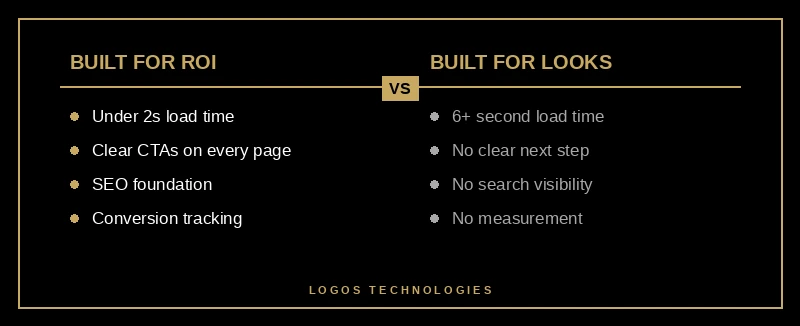
The site was built for looks, not performance. A beautiful website that takes six seconds to load and has no clear call to action will underperform a plain site that loads in under two seconds and tells visitors exactly what to do next. Design matters, but speed needs to be built in from the start — not bolted on after the fact.
No SEO foundation. A website without technical SEO is a billboard in the desert. Nobody sees it. Google's March 2026 core update continued to reward sites with strong E-E-A-T signals and quality content. If your site isn't built with search engines in mind, you're invisible to 90% of potential customers who start their search on Google.
No conversion path. Traffic without a conversion path is just a number on a dashboard. Every page on your site should guide visitors toward a specific action, whether that's a contact form, phone call, or quote request. Your landing pages need to be designed for conversion, not just information delivery.
No measurement. You can't improve what you don't measure. At minimum, every small business website needs Google Analytics 4 configured with conversion events, Google Search Console connected for search performance data, and some form of call tracking if phone calls are a primary lead source.
A Simple Framework for Tracking Your Website ROI Starting Today
You don't need expensive analytics platforms to start measuring website ROI. Here's a practical framework any small business owner can implement this week.
First, calculate your total website investment. Add up your design/development costs, hosting, any plugins or tools, content creation costs, and SEO or marketing spend. Divide the one-time costs across 12 months to get a monthly figure, then add your recurring costs. That's your monthly website investment.
Second, set up conversion tracking. In Google Analytics 4, create events for every action that represents a potential customer: form submissions, phone number clicks, email link clicks, and chat initiations. Assign a monetary value to each based on your close rate and average deal size.
Third, review monthly. Pull your conversion data, multiply by your assigned values, and compare against your monthly investment. That ratio is your website ROI.
Fourth, optimize what's underperforming. If traffic is high but conversions are low, the problem is your site's design or user experience. If conversions are fine but traffic is low, the problem is SEO and content. If both are low, you probably need a professional website redesign built around performance and conversion from the ground up.
Your Website Should Be Your Best Salesperson
A well-built website works 24 hours a day, seven days a week. It doesn't call in sick. It doesn't need benefits. And when it's built correctly — fast, optimized for search, designed to convert — it delivers an ROI that most other marketing channels can't match.
If you're not sure whether your current website is pulling its weight, or if you're ready to invest in a site that's engineered to generate measurable returns, LOGOS Technologies can help. We build fast, static websites specifically designed to rank on Google and convert visitors into customers.
See how our web design services work or get in touch to talk about what a performance-built website could do for your business. We're based in Papillion, Nebraska and work with businesses nationwide.